
Search author on: PubMed Google Scholar
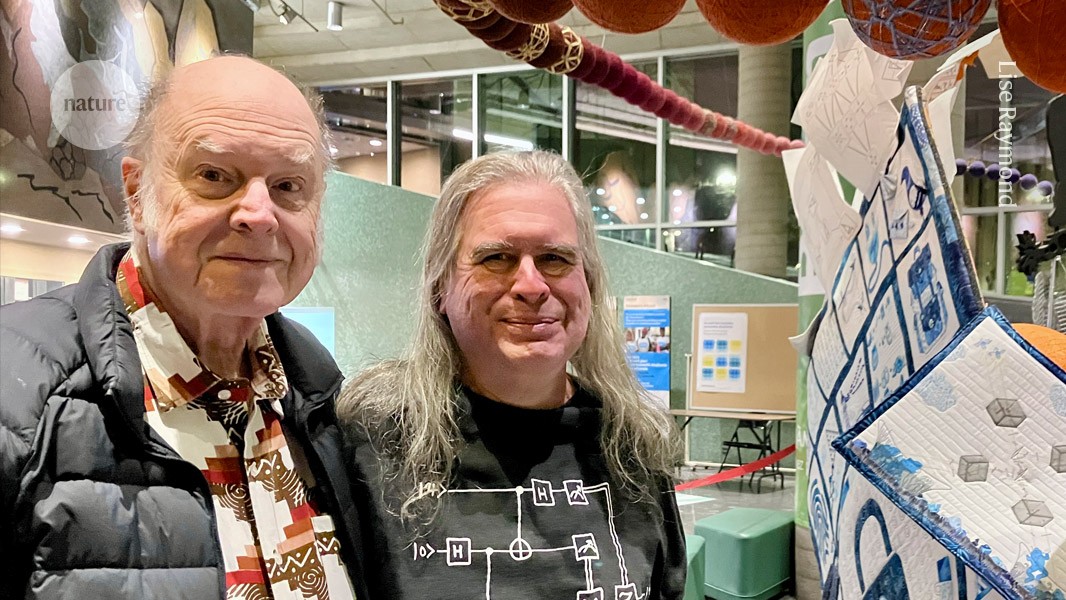
Charles Bennett (left) and Gilles Brassard pose for a photograph next to a cryptography quilt.
Credit: Lise Raymond
The two winners have seemingly unrelated research backgrounds: Brassard is a computer scientist at the University of Montreal in Canada, and Bennett is a physicist at IBM Research in Yorktown Heights in New York.
This is the first time that the Turing Award, often described as the most prestigious prize in computer science , has recognized work related to quantum physics.
Bennett and Brassard — partly through joint work — began to investigate the power of phenomena that could go beyond what’s possible with non-quantum, or ‘classical’, methods of information technology as far back as the 1970s.
“People thought it was just a little crazy,” says Bennett.
“It didn’t occur to people that quantum effects could be used to do things that couldn’t be done classically.”
Brassard says the accolade made him “extremely happy”.
“Had I been asked to choose one recognition at any point in my career, it would have been the Turing Award,” he says.
Bennett and Brassard “played a very big part in establishing the foundations of quantum information”, says Stephanie Wehner, a quantum-communications researcher at Delft University of Technology in the Netherlands.
“Quantum information is more than a vehicle for classical information.
We can do things with it that don’t have a classical analogue.”
Quantum hacking looms — but ultra-secure encryption is ready to deploy
Bennett and Brassard’s work not only initiated a whole field of technological development, but it also fed back into researchers’ understanding of the Universe, says Jonathan Oppenheim, a theoretical physicist at University College London.
Bennett and others have used quantum information as a tool for investigating some of the most nagging problems about black holes , for example.
“This whole revolution of quantum information theory is really bringing insights into the physical world,” Oppenheim says.
The two winners’ work took inspiration from the late 1960s work of the late physicist Stephen Wiesner .
Wiesner had pioneered the idea that the quantum ‘weirdness’ of particles such as photons — which had been seen as a potential nuisance for applications — could be put to good use.
Enjoying our latest content?
Log in or create an account to continue
doi: https://doi.org/10.1038/d41586-026-00818-z
Bennett, C.
H.
& Brassard, G.
in Proc.
Int.
Conf.
Comput.
Syst.
Signal Proc.
175–179 (1984).
Bennett, C.
H.
et al.
Phys.
Rev.
Lett.
70 , 1895 (1993).
The quantum internet has arrived (and it hasn’t)
Could the Universe be a giant quantum computer?
Quantum computers will finally be useful: what’s behind the revolution
‘Spooky’ quantum-entanglement experiments win physics Nobel
Information technology: A digital genius at play
AI is programmed to hijack human empathy — we must resist that
‘RAMmageddon’ hits labs: AI-driven memory shortage is impacting science
Nanophotonic waveguide chip-to-world beam scanning
Entanglement-assisted non-local optical interferometry in a quantum network
Parity-doublet coherence times in optically trapped polyatomic molecules
Magnetic resonance control of spin-correlated radical pair dynamics in vivo
Join HZAU's global faculty team to advance research with competitive benefits.
Huazhong Agricultural University (HZAU)
The Stomatology Hospital, School of Stomatology, Zhejiang University School of Medicine(ZJUSS)
IRB Barcelona invites applications for Group Leader positions in Chemical Biology (one) and Structural Biology (one).
Barcelona (Provincia), Cataluña (ES)
Fundació Institut de Recerca Biomèdica (IRB Barcelona)
The Paris Brain Institute invites expressions of interest from internationally recognized senior and mid-career researchers.
Full Professorship (W3) for ‚Clinical Epidemiology of Early Cancer Detection’ (f/m/d) We are looking for a highly distinguished physician scientist...
Heidelberg, Baden-Württemberg (DE)
Medizinische Fakultät Mannheim der Universität Heidelberg
Related Stories



Source: This article was originally published by Nature News
Read Full Original Article →
Comments (0)
No comments yet. Be the first to comment!
Leave a Comment