
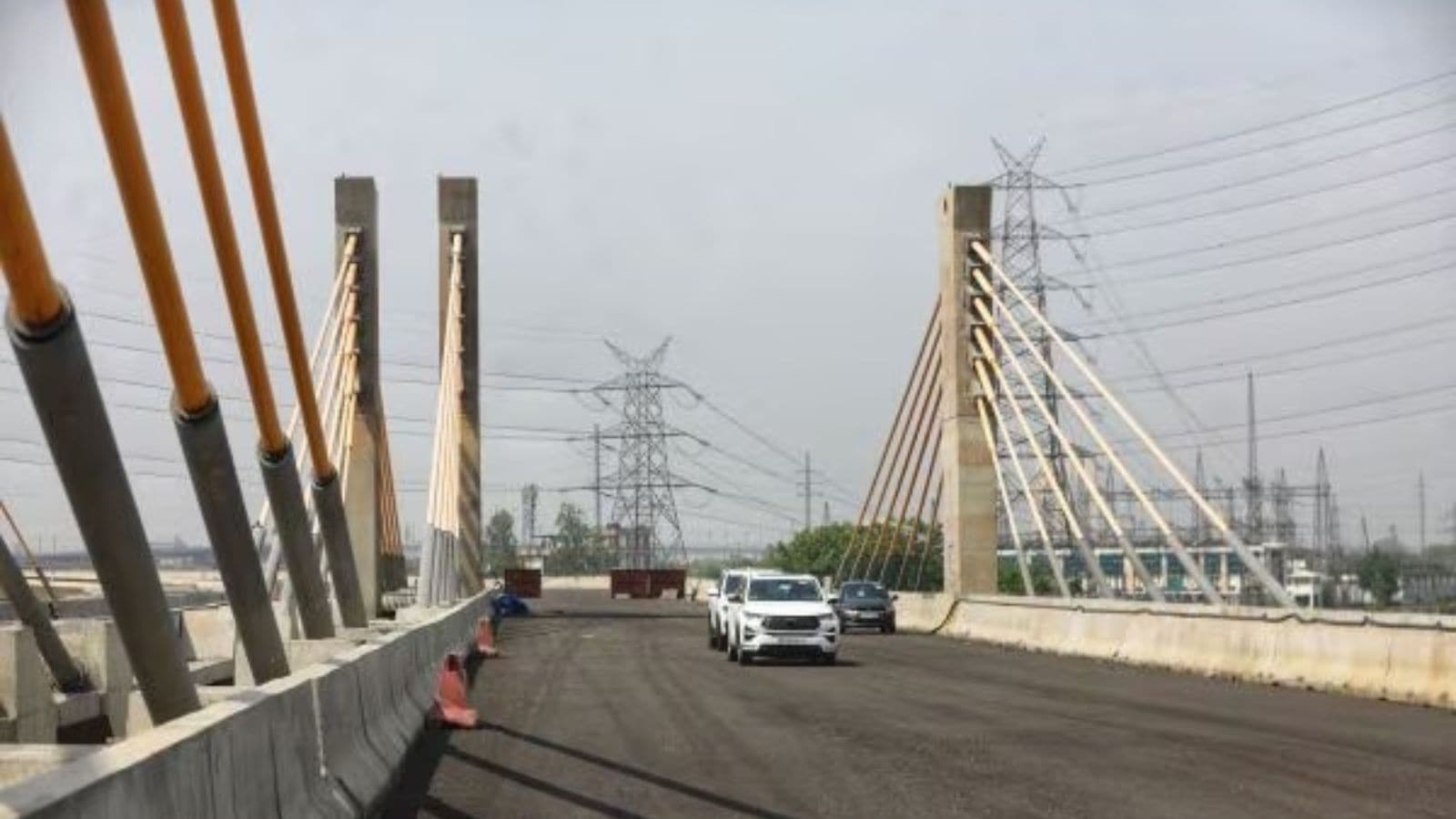
The Barapullah Phase-III elevated corridor is also likely to ease congestion at major traffic bottlenecks, including Sarai Kale Khan, Ring Road, the DND Flyway and NH-24.
Commuters travelling from Mayur Vihar and Noida to Sarai Kale Khan and AIIMS will soon be able to cover the distance in about 15 minutes via signal-free movement, with the long-delayed Barapullah Phase-III elevated corridor set to be completed by July.
The Delhi Cabinet has cleared the revised cost of the project, which has been pending for several years, paving the way for improved east–south connectivity and easing congestion on some of the Capital’s busiest arterial roads.
After the approval, Delhi Chief Minister Rekha Gupta said the government has cleared a revised cost of Rs 1,635.03 crore for the construction of the Phase-III elevated road over the Barapullah drain.
“Once completed, it will provide direct, signal-free connectivity from Mayur Vihar in East Delhi to AIIMS in South Delhi,” she added.
The project was approved in December 2014, construction began in 2015, and it was expected to be completed in 2017.
However, it missed multiple deadlines due to the pandemic, arbitration disputes, land acquisition hurdles, and delays in shifting utilities.
Chief Minister Gupta also referred the arbitration matter to the Anti-Corruption Branch (ACB) for a detailed probe to ascertain the reasons for delays and fix accountability.
The original approved cost was Rs 1,260.63 crore, which has now been revised upward by Rs 374.40 crore.
Officials said the completion of Phase-III will plug a crucial missing link in the Barapullah corridor, which currently connects Sarai Kale Khan to Central and South Delhi, and is widely used during peak traffic hours as an alternative signal-free route.
Once operational, the elevated stretch is expected to integrate seamlessly with existing Barapullah phases, enabling uninterrupted travel from East Delhi towards Central and South Delhi, including key institutional and commercial hubs.
At present, the journey from Mayur Vihar to AIIMS takes around 30–35 minutes during peak hours.
With the new link, travel time is expected to be halved, benefiting lakhs of daily commuters.
The project is also likely to ease congestion at major traffic bottlenecks, including Sarai Kale Khan, Ring Road, the Delhi-Noida Direct (DND) Flyway and NH-24.
“The government has also set a target of completing the project by June 30 this year,” an official said.
The 3.5-km-long stretch, which is an extension of the already operational Barapullah Phase I and II, will start from Mayur Vihar, merge with the existing flyover at Sarai Kale Khan, and provide smooth connectivity between East and South Delhi.
The three-lane flyover will also provide eight loops — four each at Sarai Kale Khan and Mayur Vihar — and dedicated cycle tracks.
The corridor is expected to decongest traffic along National Highway-24, the DND Flyway, and Ring Road, while enhancing access to a multi-modal transit hub that includes NCRTC, Indian Railways, ISBT, DMRC, and the Delhi– Mumbai Expressway.
Officials said the corridor is estimated to cut CO₂ emissions by around 2 tonnes per day, roughly equivalent to the absorption capacity of nearly 30,000 trees.
Stay updated with the latest - Click here to follow us on Instagram
Related Stories


Source: This article was originally published by The Indian Express
Read Full Original Article →
Comments (0)
No comments yet. Be the first to comment!
Leave a Comment