
Minister for Foreign Affairs Helen McEntee has said she does not trust Hungary after it emerged that the country's foreign minister had been briefing Russia about sensitive European Union negotiations regarding Ukraine.
Hungary is currently wielding a veto of a €90bn loan from the EU to Ukraine while it has been reported in eastern European media that Hungary's foreign minister was briefing his Russian counterpart on sensitive information about EU negotiations.
Earlier this week, Hungarian Foreign Minister Peter Szijjarto denounced what he called "foreign interference" in Hungary's election campaign, after investigative media published telephone conversations suggesting he passed on information to Russia.
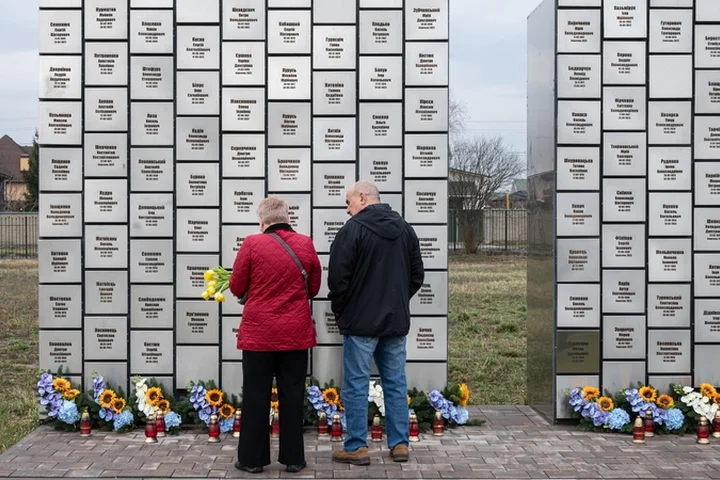
Ms McEntee said it was "disgusting" that an EU member state that was involved in the talks was briefing the perpetrator of the massacre in the Ukrainian town of Bucha four years ago.
"To know that there is somebody around the table that is feeding information back to the person who is responsible for this, it’s disgusting," the minister said.
"How can you sit around a table where you are having really difficult decisions about how you can support a European country who is being brutally attacked by another country and that same member state is then feeding that information back to the aggressor?
"It's incomprehensible," Ms McEntee said.
"But we do have to find a way to be able to make sure that progress can be made when one country is blocking something as important as this.
"Because it's not just Ukraine's security, this is all of our security that we're talking about here."
Ms McEntee said a key focus of Ireland’s upcoming EU Presidency will be advancing Ukraine’s bid to join the EU.
However, speaking on RTÉ’s Today with David McCullagh, the minister said Ukraine still had to continue progressing the necessary reforms to join the bloc.
Watch: McEntee condemns Hungary over alleged leak of EU negotiations information to Russia
Ms McEntee added that Ireland supports EU enlargement and that joining the bloc could give Ukraine an economic boost.
"When it comes to Europe's security as a whole, we would see Ukraine's membership of the EU as an important security mechanism, but also a way to lift Ukraine as a country and to support them.
"What I was clear, though, with President Zelensky and with colleagues, was that we have to make progress on our side but they also need to continue making progress.
"If you're going to join the EU, you have to make sure, whether it's your values, whether it's your laws, whether it comes to your judiciary, your policing service, that you are aligned with and that you've made the right changes and the reforms that are needed," she said.
Ms McEntee added: "They're not where they need to be at.
We're not where we need to be at, but we have to show people that this is where their path is leading to."
Any attack on civilian infrastructure a 'war crime', says McEntee
The minister said any attack on civilians and civilian infrastructure is a war crime, including the attack on a school in southern Iran last month during widespread US-Israeli attacks on the country.
A US Tomahawk cruise missile hit the school in Minab due to a targeting mistake, according to the preliminary findings of a US military investigation reported by The New York Times newspaper.
"I would say any attack, no matter where it comes from, be it on civilians or critical infrastructure, is a war crime, if that's what it's found to be, if it's a direct attack, if it's an intentional attack.
"I think we've all been clear on this, whether it's the ongoing conflict in Iran or the Middle East, whether it's Lebanon, whether it's what's happening in Gaza, whether it's what's happening in Ukraine, if civilian infrastructure is intentionally targeted, it is a war crime," she said.
Ms McEntee added: "But it's not for me to decide what is or isn't.
I can say what I believe it is, if people are intentionally targeting infrastructure that stops people getting water, electricity or energy, then we all know international law says that is a war crime and we need to make sure that people are held accountable for that."
The minister said that Ireland's policy regarding other countries transporting arms and munitions to warzones through Irish airspace has "been absolutely clear" since the 1950s.
"We have a mechanism in place and it applies to every country, not just the US, but obviously the US is the focus here.
"It says very clearly, if you have munitions, if you have personnel or army members who are on their way to a conflict zone, they're engaged in any type of conflict or espionage - and there are a number of other things on the list as well.
"They don't have permission to go through our airspace.
They don't have permission to land," she said.
Ms McEntee added that she believes the system has "worked well" in the past and does not believe any countries has violated those rules.
She added that "a decision would have to be taken" if any country was found to have breached the rules.
Related Stories

Source: This article was originally published by RTÉ News
Read Full Original Article →
Comments (0)
No comments yet. Be the first to comment!
Leave a Comment