
Search author on: PubMed Google Scholar
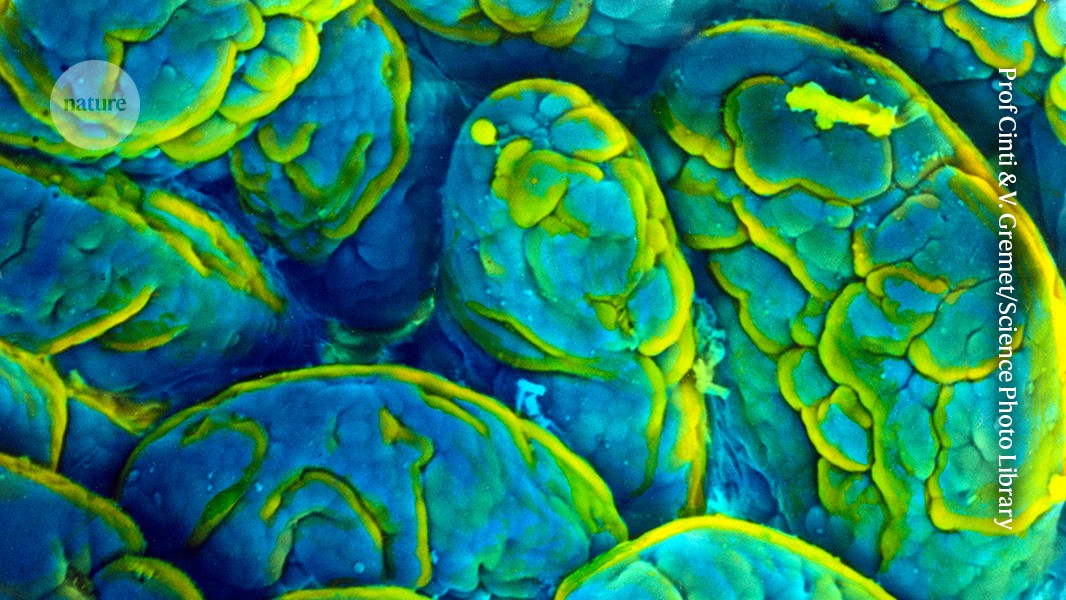
Some bacteria in the intestines of mice increase in abundance as the animals age.
Credit: Prof Cinti & V.
Gremet/Science Photo Library
A species of gut bacterium that proliferates as mice get older plays a part in the animals’ cognitive decline, a study finds 1 .
Researchers determined that the bacterium interferes with signalling along sensory nerves connecting the gut to the brain.
Although the experiments were conducted in mice, the gut–brain circuit that the team identified “is likely conserved in humans”, says David Vauzour, a biochemist at the University of East Anglia in Norwich, UK.
That would need to be confirmed, but if the circuit is present in humans, then this research could reveal a mechanism that explains why people’s memory and ability to learn naturally decreases with age — and offer hope that gut-targeted therapies could reverse the decline.
The effects of the bacteria, which dampen the gut–brain circuit in mice, seem similar to other consequences of ageing.
“When we get older, we need things like glasses and hearing aids,” says co-author Christoph Thaiss, an immunologist at Stanford University in California.
The study — published today in Nature 1 — shows that, just as ageing causes a decline in sensory perception of the external world, it might also be causing a loss of perception of internal signals, too, he says.
To explore how gut microorganisms contribute to ageing , the researchers housed ‘young’ mice that were two months old with ‘old’ mice that were 18 months old.
That’s like having a person in their late teens living in close quarters with a person in their late 50s.
How fast your brain ages is affected by these 64 genes
After a month of living in the same cage, the young mice began performing in a similar way to the old mice on a maze task and another memory test.
In the latter test, mice usually remember objects that they’ve seen before and therefore spend more time exploring new objects.
But the younger animals that had been housed with the old ones instead spent equal time investigating both familiar and new objects — just as their older counterparts did.
This indicated that they had lost their short-term memory.
“Their deficit was so profound, they were basically undistinguishable from the old mice,” says co-author Timothy Cox, a neuroscientist at the University of Pennsylvania in Philadelphia.
“It was almost unbelievable.”
What had changed was that the young animals’ microbiomes had become similar to those of the older mice.
By living in proximity and eating each other’s faeces, mice can easily transmit their gut microbes to one another.
The researchers suspected that one or more species of bacterium found in the gut of the old mice might be causing cognitive decline.
Therefore, they colonized young mice with various bacterial species and zeroed in on one in particular, Parabacteroides goldsteinii .
When the team transplanted this bacterium into young mice, it worsened their ability to remember objects that they had seen before.
In addition, giving old mice antibiotics that wiped out their gut bacteria or a phage therapy that killed P.
goldsteinii improved the animals’ performance on the same task — to levels comparable with those of young, healthy mice.
Enjoying our latest content?
Log in or create an account to continue
doi: https://doi.org/10.1038/d41586-026-00768-6
Read the related News & Views: ‘ Gut microbes affect cognition during ageing ’.
Cox, T.
O.
et al.
Nature https://doi.org/10.1038/s41586-026-10191-6 (2026).
What accelerates brain ageing?
This AI ‘brain clock’ points to answers
Coffee linked to slower brain ageing in study of 130,000 people
Ageing is linked to inflammation — but only in the industrialized world
How the brain spies on the gut: with help from newfound immune cells
Youthful antics predict lifespan — at least for these fish
Intestinal interoceptive dysfunction drives age-associated cognitive decline
Ageing promotes metastasis via activation of the integrated stress response
Forget SkinTok: the real science of skincare and why it matters for your health
Microbiota-mediated induction of beige adipocytes in response to dietary cues
China approves brain chip to treat paralysis — a world first
Scientists revive activity in frozen mouse brains for the first time
These brain cells clear proteins that contribute to Alzheimer’s
CeMM is recruiting two scientists to join as Starting Principal Investigators within a new research program on pain and aging/healthy.
Research Center for Molecular Medicine (CeMM), ÖAW
Profile the cellular components of tissue microenvironments (TME) in healthy and inflamed sites.
Dortmund, Nordrhein-Westfalen (DE)
Leibniz-Institut für Analytische Wissenschaften – ISAS – e.V.
Postdoctoral positions exploring microbiota–stem cell interactions in development, disease & cancer using gnotobiotic models, organoids & multi-omics.
The Chinese Institutes for Medical Research (CIMR), Beijing
Join Huazhong Agricultural University
No.1 Shizishan Street, Hongshan District, Wuhan, Hubei Province, China
Huazhong Agricultural University (HZAU)
SUSTech School of Medicine offers equal opportunities and welcome applicants from the world with all ethnic backgrounds.
Southern University of Science and Technology, School of Medicine
Related Stories



Source: This article was originally published by Nature News
Read Full Original Article →
Comments (0)
No comments yet. Be the first to comment!
Leave a Comment