
This blog is now closed.
Read below for the latest developments the latest developments from across Germany on Monday, March 30:
Germany beat Ghana to complete confidence-boosting March
With the World Cup just 10 weeks away, Julian Nagelsmann's team will be starting to believe they can win it all.
The match against Ghana was the final one before Nagelsmann announces his World Cup squad on May 12.
Read more about the Germany-Ghana match here.
Syria: What does Germany's media think about President al-Sharaa's Berlin visit?
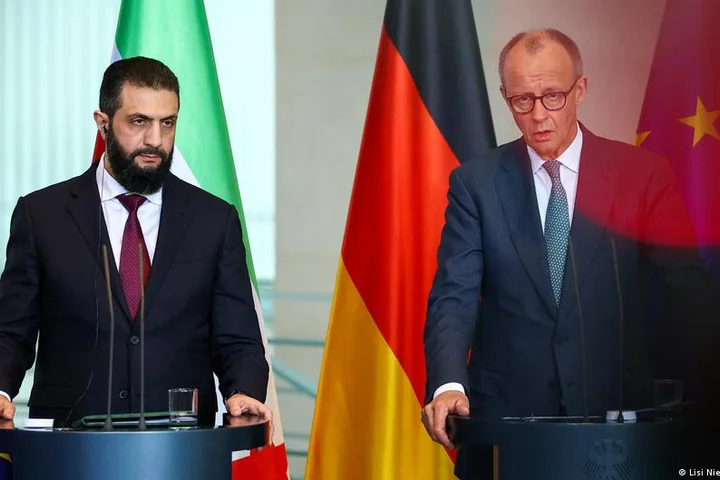
The presence of Syria 's interim president, Ahmad al-Sharaa, in Berlin on Monday caught the attention of Germany 's media, with outlets across the country reporting on the visit and offering opinions.
Here are three editorials from newspapers in the western city of Cologne , the southern town of Ravensburg and the eastern town of Frankfurt-on-the-Oder :
Kölner Stadt-Anzeiger (Cologne): "Supporting Syria in rebuilding its infrastructure, economy and the rule of law, partly because it will allow more Syrians to return, is legitimate.
However, ignoring the extremely fragile security situation and human rights violations for domestic and migration policy reasons is not."
Schwäbische Zeitung (Ravensburg): "Talking to the new leadership in Damascus is necessary; diplomacy also means talking to difficult partners.
But [al-Sharaa's] reception with military honors sends the wrong signal.
The promised guarantees for minorities remain largely empty words.
Reports of violence against Christians, pressure on Kurds and complaints from other minorities demonstrate how fragile his promises are.
"It is equally simplistic to reduce the debate to deportations [of Syrian migrants].
Criminals should lose their right to residency, but the majority of Syrians in Germany work, pay taxes and contribute to the daily life of this country."
Märkische Oderzeitung (Frankfurt-on-the-Oder): "When it comes to Syria, talks must not focus solely on Germany's desire for more economic exchange and the deportation of more Syrian refugees.
Rather, the German government must link its willingness to engage in dialogue with concrete demands for the benefit of the Syrian people: democracy, equality, reconciliation, protection of minorities and much more.
Al-Sharaa has promised many of these things.
Germany should hold him to those promises."
Greens, Social Democrats criticize 'cheap' Merz remarks on Syrians
German Chancellor Friedrich Merz has faced criticism from both the opposition and from within his own governing coalition for his remarks about Syrian immigrants.
For Franziska Brantner, the leader of the opposition Green Party , Merz "just plucked a number out of the air" without addressing actual issues, while ignoring the fact that many Syrian refugees "have since become deeply rooted" in Germany, with many working in "key professions" such as healthcare.
She said it was therefore "cheap for Mr.
Merz to just say 80% have to go back."
There was also pushback from within Merz's own coalition, with Social Democrat (SPD) immigration expert Hakan Demir pointing out even before the Chancellor's remarks that Syria was still not a safe country.
"I can't see how we can just send back tens of thousands of people," he said.
"It's just not possible if you look at the situation on the ground there."
The Greens' Brantner agreed, saying that Merz should have demanded that President al-Sharaa do more to enable "cultural and ethnic diversity" in Syria, where she claimed that over 100,000 people are still registered as missing while fighting continues in Kurdish and Druze regions.
She said such incidents "shake faith in the transition process" following the fall of former dictator Bashar Assad .
WATCH — Merz expects 80% of Syrians in Germany to return
German Chancellor Friedrich Merz has called for faster returns of Syrian refugees.
Speaking in Berlin during a visit by Syrian President Ahmed al-Sharaa, Merz said the emphasis should be on those who abuse hospitality or break the law, adding that 80% of the more than 900,000 Syrian nationals in Germany should return in the next three years.
Ukrainian man arrested on suspicion of spying for Russia
German prosecutors say they have arrested a Ukrainian national on suspicion of "gathering information on behalf of a Russian intelligence service."
The man, partially named as Vitalii M., allegedly spied on "a man residing in Germany who had taken part in combat operations for the Ukrainian armed forces," the prosecution service said.
Last week, two people were detained in Germany and Spain over allegations of spying for Russian intelligence.
Germany's Federal Public Prosecutor's Office said on Tuesday the spies' target was a German man who supplied drones and related components to Ukraine.
German intelligence agencies have warned of the increasing threat posed by Russian espionage, sabotage and disinformation since Moscow's invasion of Ukraine.
German authorities have said that Russia is actively recruiting so-called "disposable agents," who have no formal training, but who can carry out acts, ranging from arson to property damage and drone overflights of sensitive sites, in exchange for small sums of money.
Berlin detains German-Ukrainian woman for Russian espionage
To view this video please enable JavaScript, and consider upgrading to a web browser that supports HTML5 video
Germany hosts Syria's Al-Sharaa despite human rights issues
Chancellor Friedrich Merz's welcoming of the Syrian leader was criticized by some observers and NGOs.
Click here for more on the controversy surrounding al-Sharaa's visit to Germany.
Merz pushes plan to return Syrian refugees
German Chancellor Friedrich Merz has called for faster returns of Syrian refugees, saying Germany needs a reliable system to send people back.
Speaking in Berlin during a visit by Syrian President Ahmed al-Sharaa, Merz said the emphasis should be on those who abuse hospitality or break the law.
The chancellor said 80% of the more than 900,000 Syrian nationals in Germany should return in the next three years.
"That was also the wish of President Sharaa," Merz said after the pair held talks, adding that "those Syrians who wish to remain in Germany and are well integrated will be able to stay in Germany."
He said a joint government taskforce has been set up and will begin work soon, involving the interior, development, and chancellery offices.
German officials are also expected to travel to Syria in the coming days to advance cooperation.
"We are working with our friends in the German government to establish a 'circular' migration model," Sharaa told journalists.
Merz said conditions in Syria have "fundamentally improved" more than a year after the war, meaning protection needs must be reassessed.
He added that those without a legal right to stay in Germany "will have to leave."
At the same time, Merz said returning Syrians could play a key role in rebuilding their country, especially those who have gained skills and experience while living in Germany.
Merz says 80% of Syrians in Germany will return
Germany inflation forecast at 2.7% in March
Germany's inflation rate has been estimated at 2.7% in March 2026, based on the consumer price index compared with a year earlier.
The statistics office said prices rose 1.1% from February, while core inflation, excluding food and energy, came in at 2.5%.
Energy prices increased 7.2% year-on-year, marking the first rise in that category since December 2023.
The data is based on preliminary figures from the Federal Statistics Office.
Consumers can calculate their own personal inflation rate using an online tool that adjusts for individual spending patterns.
Germany also reports a harmonized inflation index used across the eurozone, which differs slightly in methodology and weighting.
German lawmaker urges focus on minority rights during Syrian leader's visit
Center-left Social Democrat politician Hakan Demir has joined those voicing concern over the visit of Syria's interim president Ahmed al-Sharaa , while stressing the need for dialogue.
The 43-year-old al-Sharaa was formerly the leader of the Islamist militia HTS, which overthrew long-time ruler Bashar Assad at the end of 2024.
Today, he and his government are seeking closer ties with the West.
Syrians still wait for rebuilding one year after Assad
However, Demir told public broadcaster Deutschlandfunk that al-Sharaa is "an Islamist" who has not distanced himself from his past, noting the US had placed a $10 million (€8.7 million) bounty on him about two years ago.
He added that "a suit does not make a democrat."
At the same time, Demir said Germany cannot limit talks only to democratic states, emphasizing that the focus should be on the quality of engagement rather than issues like deportations.
Germany must remain in dialogue with regard to reconstruction, "ensuring the well-being of the people there and respecting minority rights."
Christians are threatened in Syria, said Demir, with Alawites subjected to massacres, and Druze and Kurds also in danger.
"These are all issues that must be addressed very clearly.
And Germany must also say: Of course, we will support reconstruction, of course, we will provide development aid, but it must be tied to human rights and minority rights."
German wine output has dropped again after wet harvest season
German winemakers have produced less wine in 2025 , as heavy rainfall during the harvest reduced yields, official data showed.
The Federal Statistics Office said total production reached about 7.55 million hectoliters of wine and must, down 2.6% from the previous year and 10% below the 2019–2024 average.
A similarly low harvest was last recorded in 2017, said Ernst Büscher of the German Wine Institute, adding that increasingly volatile weather conditions continue to challenge growers.
Smaller grape harvests were a key factor behind the lower output.
According to the data, heavy September rain increased the risk of rot and shortened the harvest period, particularly in the two largest wine regions, Rheinhessen and the Palatinate.
Together, they still accounted for 48.1% of Germany’s total wine and must production.
The total vineyard area declined only slightly, by 1.1% or about 1,100 hectares.
Output in the Rheingau also fell, dropping 10.2% year over year.
Production trends varied across Germany’s 13 wine regions.
Output rose 12% in the Moselle region, largely due to commercial wineries processing grapes from other regions.
Production also increased in Baden, up 4.5%, and more strongly in Württemberg, up 11%, and Franconia, up 21.1%.
Smaller regions including Saxony and Ahr also recorded gains.
Germany: Sisters win prestigious Winery of the Year
Germany set to cap daily gasoline price hikes
Germany is set to introduce a new rule limiting petrol stations to one price increase per day starting April 1, the Economy Ministry has said.
A ministry spokesman said Monday that the government had passed the measure last week in response to rising oil prices linked to the war in the Middle East.
The bill was signed Friday by President Frank-Walter Steinmeier and must be published in the Federal Law Gazette before taking effect.
The spokesman said stakeholders had asked for the law to take effect April 1 to ensure smooth implementation.
He added the bill is scheduled to be published Tuesday, allowing it to enter into force Wednesday.
Under the new regulation, gas stations will be allowed to raise prices only once per day, at midday, while price reductions can still be made at any time.
The government said the measure is intended to curb price swings and improve transparency at the pump.
The rule is modeled on similar legislation in Austria, though critics and consumer groups have warned it may not go far enough to control fuel costs.
Why Iran fuel crisis hits different in Europe than the US
Camping overnight stays in Germany hit record high
Camping in Germany has reached a record level, with more overnight stays than ever before, official data has shown.
The Baltic Sea coast remained the most popular camping region.
Schleswig-Holstein recorded 3.4 million overnight stays, followed by 3.1 million in Mecklenburg-Western Pomerania .
Other leading destinations included the Black Forest with 2.6 million stays and the North Sea coast of Lower Saxony with 2 million.
Syrian interim president visits Berlin amid protests
Syria's interim President Ahmed al-Sharaa has arrived in Germany for talks in Berlin expected to focus on refugees and reconstruction after years of war.
Al-Sharaa was received by German President Frank-Walter Steinmeier and was set to speak to Chancellor Friedrich Merz.
He is also due to attend a roundtable with business leaders.
Ahead of the trip, critics sharply condemned the visit, with Left Party lawmaker Cansu Özdemir calling Merz's meeting with al-Sharaa a "moral bankruptcy" and accusing him of normalizing Islamist figures linked to violence against minorities .
Germany’s Kurdish community also accused al-Sharaa of human rights abuses and war crimes, with its chairman Ali Ertan Toprak saying he belongs in court, not in the chancellery.
Several demonstrations against the visit have been registered, with authorities expecting around 5,000 participants.
Merz originally invited al-Sharaa in November, primarily to discuss the return of Syrian refugees, but the visit planned for January was postponed due to renewed violence in Syria.
"Our interest is in seeing Syria rebuilt as a stable and prosperous nation, including with the help of the many, many Syrians who came here to Germany and Europe during the civil war and found refuge here," German government spokesman Stefan Kornelius said ahead of the visit.
Al-Sharaa rose to power after the Islamist militia Hayat Tahrir al-Sham (HTS) overthrew longtime ruler Bashar Assad in late 2024, ending nearly 14 years of civil war and marking a shift toward closer ties with Western countries.
German firms planning more price hikes
More companies in Germany are expecting to raise prices , with a key indicator hitting its highest level in three years, according to the Ifo Institute.
The Munich-based institute said its price expectations index rose to 25.3 points in March from 20.3 in February, marking the highest level since March 2023.
Survey chief Klaus Wohlrabe said price pressure in Germany is rising noticeably once again.
Wohlrabe said the increase was driven by sharply higher prices for oil, gas, and electricity linked to the conflict involving Iran.
He added that elevated energy costs are likely to push inflation higher in the coming months after previously easing price growth.
The trend is particularly strong in industry, where the indicator leapt from 13 to 20 points.
Companies in construction and consumer-related services have also significantly raised their pricing expectations.
Wohlrabe said firms were increasingly passing on higher costs, noting that rising production and transport expenses are feeding energy prices through to goods and services.
Guten Tag from DW's newsroom in Bonn.
You join us as Syria’s transitional president arrives in Berlin, with Germany weighing closer diplomatic ties with a highly controversial figure.
Ahmed al-Sharaa is in Germany after meeting international leaders, including French President Emmanuel Macron in Paris and US President Donald Trump in Washington.
Stay with us here for this and all the latest on what Germany is talking about today.
Related Stories



Source: This article was originally published by Deutsche Welle (DW)
Read Full Original Article →
Comments (0)
No comments yet. Be the first to comment!
Leave a Comment