
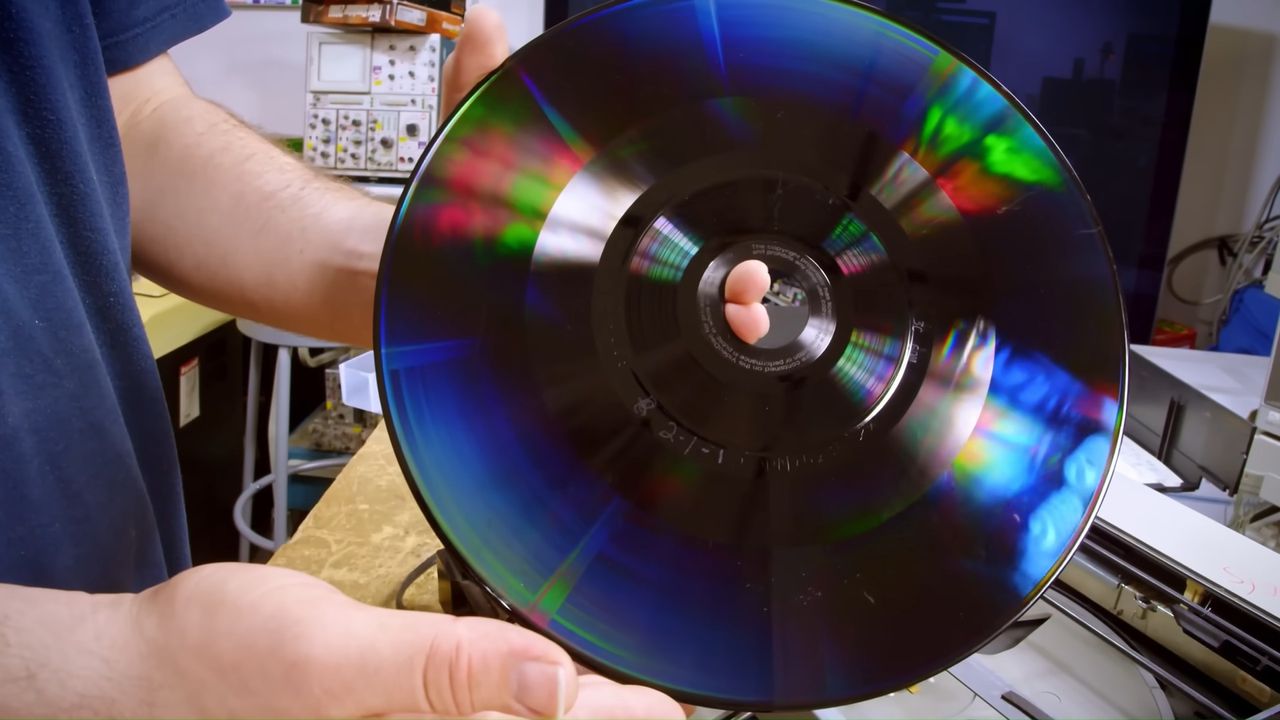
Developed by RCA during the video cassette tape era, CED was an expensive flop.
Get Tom's Hardware's best news and in-depth reviews, straight to your inbox.
Though the media looks quite a lot like a LaserDisc , a CED (Capacitance Electronic Disc) is an unusual video distribution format that existed for a time alongside the far better known VHS and BetaMax videotape era.
It consisted of a vinyl-like disc, distributed and maintained for its own protection in a caddy, and it was read by a needle-loaded cartridge just like ye olde music LPs and singles.
Like its tape format rivals, the video content stored on a CED was in a standard-definition quality analog form.
So, looking extremely closely at the grooved surface can actually give you more than a clue to the content of the disc.
After introducing his new microscope and its capabilities, TT finally gets down to some close-up disc scrutiny at around the 14mins mark.
Specifically, he zooms in on the surfaces of two samples of actual CEDs.
These contain generally better quality (though still analog) video tracks, which were read by a laser pickup.
Some of the later LaserDiscs were enhanced with digital PCM audio tracks.
One of the CEDs examined closely was a CAV (Constant Angular Velocity) disc, with its data evidenced by a consistent geometric pattern, whereas a CLV (Constant Linear Velocity) disc under the microscope looks simply colorfully streaky.
Now studying the CED surface more earnestly, something caught TT’s eye.
“It's not going to happen.
We're not going to find an image.” Then, almost immediately, “I found an image.”
The video host explains what we are seeing and that, due to the nature of the CED recording and media, it is possible to see a “meaningful” image on the surface, if and when the video slowly pans across the x or y axis.
The first evidence of this phenomenon comes from some video text shown at around 22min 30sec in the video (see image, above).
The main event takes place around 25 minutes into the video.
A CED disc is (at last) placed under the microscope.
After a bit of zooming, focusing, and angling of light sources, TT blurts, “Oh my gosh.
We just nailed it.
Bang.
Right there.”
Again, it is some text, but this time a much clearer representation of the disc content.
The CED surface text is almost as clear as a stored video frame on some old film.
After that excitement, the video host moves along to look at a couple of other tech-related artifacts under the microscope.
The extras include a surface study of a mixed-mode audio/data CD , and a smartphone screen close-up where the OLED (sub) pixels are clearly visible.
If you reckon the demonstrated desktop digital microscope is a good one, it is the Andonstar AD246S model.
We have noticed it is currently 13% off and available for $139 on Amazon .
Follow Tom's Hardware on Google News , or add us as a preferred source , to get our latest news, analysis, & reviews in your feeds.
Mark Tyson is a news editor at Tom's Hardware.
He enjoys covering the full breadth of PC tech; from business and semiconductor design to products approaching the edge of reason.
Skramblr said: Title is wrong.
That's not a LaserDisc, its a CED ( Capacitance Electronic Disc).
These are two different things
pockyfiend said: "Though the media looks quite a lot like a LaserDisc, a CED (Capacitance Electronic Disc) is an unusual video distribution format that existed for a time" You guys said it correctly in the very first paragraph of the article .
So then how did you spend the rest of the article, as well as the headline, getting it completely wrong and calling it a "LaserDisc"?
Are you just getting lazy and writing these with AI these days?
🤦♂️ This system actually used a needle, like a vinyl record player, rather than a laser, to read analog audio and analog video, unlike a LaserDisc, which was an optical disc that that used a laser like a CD player to read analog OR digital audio along with analog video (yes, optically-recorded NTSC/PAL analog video signals read by laser.) I actually had a Capacitance Electronic Disc player ("RCA VideoDisc" / "SelectaVision") was the brand name) with some titles as a kid, including a bunch of Disney discs and Bakshi's The Hobbit.
Recently, cleaning out my parents ' basement, I even found some softcore erotica.
wakuwaku said: Btw, CEDs are vinyl, they are not vinyl-like.
It is made from vinyl so it is vinyl.
The name vinyl comes from the material the disc is made from.
wakuwaku said: Simple and Easy English!
Kevlarrgh said: This intrigues me.
The description implies that the signal is read linearly in a spiral path,
Kevlarrgh said: so how does a coherent FRAME appear optically with successive frame lines on neighboring "tracks"?
Kevlarrgh said: Also, how does the needle track closely and rapidly enough without touching or marring the disc at video bandwidth?
Related Stories



Source: This article was originally published by Toms Hardware
Read Full Original Article →
Comments (0)
No comments yet. Be the first to comment!
Leave a Comment