
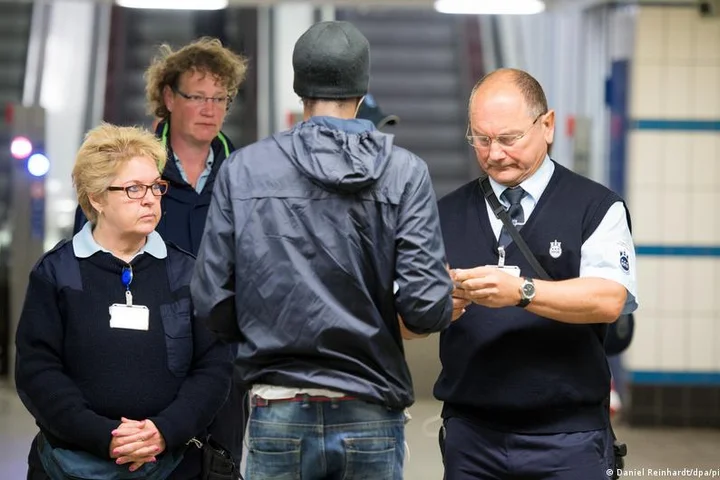
A debate is brewing about whether fare-evasion on trams, buses and trains in Germany should no longer be a criminal offense.
Meanwhile, companies are starting to feel the pinch of war in the Middle East.
DW has more.
Here are the headlines from and about Germany on Tuesday, April 7, 2026:
Farmers' lobby warns fuel, energy costs could endanger harvest
The rising diesel costs in Germany could present farmers with major liquidity shortfalls and possibly even endanger this year's harvest if left unchecked, the president of the German Farmers' Federation has warned.
"If the federal government continues to work on the basis of wishful thinking and doesn't finally take decisive action, this will drive many farm business into major liquidity problems," Joachim Rükwied told the DPA news agency.
"This will also endanger the coming harvest and food supply security in Germany."
With heavy farm machinery demanding large quantities of diesel, and other energy costs typically high on large farms, Rükwied said farmers were particularly exposed to the price pressures.
He called on the government to suspend carbon taxes and to temporarily reduce energy taxes.
"Now is not the time for debates on the regulatory foundations, but rather for decisive action," Rükwied said.
Like the ADAC motorists club, he crticized the steps taken so far like the petrol price rise limitations.
"The measures taken so far aren't just missing their target, they are even making the situation worse for consumers and businesses," Rükwied said.
"Since the introduction of the rules, the prices are rising to new record highs almost every day.
This is all the more annoying, given that this was predictable and that other European countries have taken much more decisive steps against the exploding costs."
Rükwied said that for farming, and many other industries, the scope to reduce the use of energy and fuel was extremely limited in practice; he accused the government of being "disconnected from reality" when urging businesses to try to trim consumption.
How war in the Middle East is affecting Moldovan farmers
To view this video please enable JavaScript, and consider upgrading to a web browser that supports HTML5 video
German diesel prices hit new record high, Super E10 nears its peak
Prices at the pumps continued to rise for motorists in German across the Easter weekend, according to the latest data from the ADAC motoring club .
By Easter Monday, the all-day nationwide average for diesel hit another record high of €2.443 per liter, or roughly $10.71 per US gallon.
It has been steadily climbing since entering all-time record territory on April 1.
Meanwhile, the cheapest Super E10 variant of petrol or gasoline cost an aggregate of €2.192 per liter, or $9.61 per US gallon.
The highest price for Super E10, achieved on March 14, 2022, just a few weeks after Russia's full-scale invasion of Ukraine, was just one cent per liter higher.
A new law imposed as of April 1 in Germany, limiting fuel stations to one price hike per day , has done little to nothing to stop the updward trend in fuel costs.
How Germans feel about daily fuel price freeze
Boris Becker rules out return to full-time tennis coaching
Six-time Grand Slam champion Boris Becker has ruled out a return to full-time tennis coaching.
"I don't want to name names, but I've often been asked if I'd like to return to the coaching circuit, but I've declined," Becker said in a media briefing on the occasion of the Laureus World Sports Awards, which will be presented on April 20 in Madrid.
"I have other professional goals — I work much more in the media sector.
I couldn't do that if I were to return to coaching full-time."
A member of the Laureus Academy, Becker coached, among others, former world number one Novak Djokovic and Holger Rune of Denmark after his playing career.
He also worked for a time as "Head of Men's Tennis" for the German Tennis Federation.
“My time as a coach is over," the 58-year-old affirmed.
"I've had a new addition to the family — all of that takes up a lot of time, and I simply have other professional ideas for my life."
In 2022, Becker was convicted in the UK for bankruptcy-related offenses and served time in prison before being deported to Germany.
Von der Leyen receives German state's top honor
European Commission President Ursula von der Leyen has received the German state of Lower Saxony's highest award.
State premier Olaf Lies presented the state medal in Hannover, praising von der Leyen as a politician "with approachability, a clear stance, and a keen sense for social cohesion."
Born in Belgium and raised in Lower Saxony, von der Leyen studied medicine in the region before entering politics.
She served as a state lawmaker and minister before making the transition to national government.
Between 2005 and 2019, she held several cabinet posts under Chancellor Angela Merkel, including family affairs, labor, and defense, before becoming head of the European Commission in 2019.
Electric car registrations surge in Germany
Electric vehicle adoption in Germany has surged sharply, with nearly 71,000 fully electric cars newly registered last month.
Registrations rose 66.2% compared with March 2025, while February had seen about 43,000 new EVs added to the roads.
Consulting firm EY said new subsidies of up to 6,000 euros are now showing an impact, with sales reaching their highest level since August 2023.
However, he noted that most buyers still choose combustion-engine cars, adding that high fuel prices, subsidies, and improved EV models have not yet shifted everyday habits for many consumers.
Gall also warned that broader economic conditions remain weak, citing sluggish growth, geopolitical tensions, rising unemployment, and no clear sign of a turnaround.
Hybrid-car breakdown highlights repair challenges in Germany
Lahm warns Germany risks falling behind like Italy
The 2014 World Cup winner Philipp Lahm has warned that German football could fall behind like Italy if outmoded tactical trends continue.
In columns for Germany's Die Zeit newspaper and Britain's Guardian, he said that the return of man-marking — where each defender is assigned a specific opponent to track — in the Bundesliga was surprising and was not a sustainable approach.
The former Germany captain pointed to top clubs such as Bayern Munich, noting they have at times relied on man-marking.
He argued the system can work briefly to unsettle opponents but is not suited to an entire match.
Lahm warned that Italy has already fallen behind tactically, having failed to qualify for three consecutive world cups, and said the German men's national side could face a similar fate.
"Italy is falling behind," he said.
"If Germany takes its latest special path, the same could happen to us."
By contrast, Lahm praised Spain's approach, highlighting structured, possession-based football and positional discipline.
He noted that Spain has won three of the last five European Championship titles, calling its dominance unmatched in modern times.
How Germany won back the nation at Euro 2024
Meat consumption rises in Germany, led by poultry
Meat consumption in Germany has increased, reaching an average of 54.9 kilograms (about 121 pounds) per person last year.
The Federal Office for Agriculture and Food (BLE) says the figure rose by 1.4 kilograms year-on-year, driven mainly by record poultry consumption.
Poultry intake climbed to about 14.7 kilograms per person, marking an all-time high.
Overall meat consumption has been rising again for three consecutive years, though it remains well below levels seen in 2011.
Pork remained the most popular choice among consumers, averaging 28.3 kilograms per person and accounting for roughly 52% of total consumption.
Domestic meat production fell slightly by 0.3% to 7.3 million tonnes in 2025.
Imports rose nearly 11% to about 3.6 million tonnes to meet demand, particularly for beef, poultry and lamb, according to the BLE.
German startup develops vegan meat from brewery waste
Sibling age gap in Germany narrows slightly
The age gap between a mother's first and second child in Germany has slightly narrowed over the past decade.
Federal Statistical Office figures show the average gap was 3.1 years in 2024, down from 3.3 years in 2014.
The interval widens with additional children, reaching 3.8 years between a second and third child and 3.6 years between a third and fourth.
Compared with 2014, these figures have remained largely stable, with only a slight increase between second and third children.
Regional differences remain pronounced.
In eastern Germany, excluding Berlin, the gap between first and second children averages 3.8 years, compared with 3.0 years in western regions.
For a third child, the interval rises to 4.4 years in the east versus 3.7 years in the west.
Mothers in eastern Germany are also younger at first birth, averaging 29.2 years, compared with 30.5 years in western Germany.
The statistics — published ahead of World Siblings Day on Friday — are based on live births among women aged 15 to 49, calculated using the age-year method, according to the federal office.
Italy detains German Sea-Watch ship after rescue mission
Italian authorities have detained a rescue vessel operated by Germany-based NGO Sea-Watch after it brought dozens of migrants to safety.
The group said Tuesday its ship "Aurora" was held following the rescue of 44 people from an abandoned oil platform in the Mediterranean.
The crew had taken the rescued individuals to Lampedusa after they spent days stranded at sea.
Authorities then ordered the vessel’s detention under the so-called Piantedosi decree, accusing Sea-Watch of failing to inform Libyan officials about the operation.
The organization also faces a fine ranging from €2,000 to €10,000 ($2,315 to $11,572).
The Mediterranean remains one of the world's deadliest migration routes , with many attempting the crossing from North Africa in unseaworthy boats.
According to the International Organization for Migration, more than 900 people have been reported dead or missing so far this year.
Fan dies after medical emergency at Bundesliga match
A spectator has died after a medical emergency during the Bundesliga match between Eintracht Frankfurt and FC Cologne.
The club on Tuesday said the 87-year-old man suffered cardiac arrest during the game, was initially resuscitated at the scene, but later died in hospital on Sunday.
Eintracht said the supporter had been a long-time member and season ticket holder, adding "the Eintracht family is deeply saddened." The incident occurred in the second half of the 2-2 draw, with emergency crews treating the man in the stands before taking him to hospital in a critical condition.
Fans from both sides paused their support for several minutes during the response.
Cheering resumed only after the spectator had been taken out of the stadium.
The club expressed condolences to the man's family and thanked emergency responders as well as supporters for what it described as their "sensitive awareness" during the incident.
Iran war hits German industry, survey shows
German industry has been reporting widespread disruption from the Iran war , with nine in ten companies affected.
A survey by the Ifo Institute found only 9% of firms said they were not currently impacted.
Survey chief Klaus Wohlrabe said the conflict was hitting industry directly and creating significant uncertainty, adding many companies were bracing for further strain in the coming months.
Higher energy prices were cited by 78% of firms as the main factor.
About 36% pointed to shipping disruptions and supply bottlenecks for raw materials and intermediate goods, while 16% flagged risks to air freight.
Around a quarter expected weakening demand in key export markets.
Companies have also highlighted financial risks, including volatile freight and logistics costs, rising insurance premiums, and higher payment risks.
The conflict, now lasting more than four weeks, has already weighed on business sentiment.
The Ifo business climate index fell by 2.0 points in March to 86.4 — its lowest level since February 2025.
"The war in Iran has put an end to hopes for an upswing for the time being," said Ifo President Clemens Fuest.
Union leader rebukes Klingbeil on work and pensions
Germany's top union leader has criticized Vice Chancellor Lars Klingbeil over his stance on pensions and working hours .
German Trade Union Confederation (DGB) chair Yasmin Fahimi told the Tagesspiegel newspaper that the center-left Social Democrat (SPD) Klingbeil's call to stop encouraging early retirement was "wrong" and rejected proposals to push longer working lives.
Fahimi said people who want to work longer can already do so, but many lack the opportunity.
Older unemployed workers in particular often struggle to find stable jobs, she added, arguing that higher employment rates are due to improved labor policies rather than the retirement age increase.
She also dismissed Klingbeil's claim that society must work more overall, saying Germany does not have a shortage of labor volume.
She pointed to industrial workers on reduced hours and job losses in the sector as evidence.
In full-time jobs in Germany, "no less work is done than in other European countries," said Fahimi.
Germany has a disproportionately high part-time employment rate, which is "a cause for celebration, not complaint," because it has significantly increased the female employment rate.
She also rejected a proposal by Bavarian conservative state premier Markus Söder to add an extra working hour per week.
"These are technocratic number games that are out of touch with reality," she said.
"This political meddling in collective bargaining negotiations is an attempt to weaken the compromises on distribution that are made within them," Fahimi said.
"I will not tolerate this."
How Indian students end up exploited in Germany
Germany debates decriminalizing fare evasion
Germany's justice minister has questioned whether fare evasion should remain a criminal offense.
Stefanie Hubig said there are strong arguments for decriminalization, citing the strain such cases place on the justice system.
The center-left Social Democrat (SPD) politician told the Neue Osnabrücker Zeitung newspaper that people who cannot afford tickets and end up jailed through substitute custodial sentences may not belong in prison.
She said a modern criminal law requires reassessing whether fare evasion should be punishable.
Speaking to the Düsseldorf-based Rheinische Post newspaper, the Federal Police head for the German Police Union (GdP) Andreas Rosskopf disagreed.
"Obtaining services by deception must remain a criminal offense," he said.
Otherwise, he added, traveling without a ticket would become a minor offense and highly commonplace.
"We run the risk that many people simply won't care whether they have a ticket or not," Rosskopf said.
The German Bar Association has supported reform, calling current rules socially counterproductive.
Its spokesperson Swen Walentowski said prosecutions and prison terms for fare evasion cost taxpayers about €200 million ($231 million) annually, disproportionately affecting those unable to afford tickets.
In most German cities, you do not need to swipe or scan a ticket to enter a train, tram, or bus.
Compliance is enforced by sporadic checks from conductors.
Despite this lax approach, the government estimates that only between 3-4% of trips are being undertaken by fare dodgers.
Germany: Front-line workers face growing abuse, violence
Guten Tag from DW's newsroom here in Bonn.
You join us as the debate is raised about whether public transport fare evasion here in Germany should remain a criminal offense.
There are growing calls for fare-dodging to be decriminalized amid strains on the justice system, although police say this would set the wrong tone.
Meanwhile, many companies in Germany are starting to notice the mounting economic burden of war in Iran.
Stay with us for today's latest news from Germany.
Related Stories


Source: This article was originally published by Deutsche Welle (DW)
Read Full Original Article →
Comments (0)
No comments yet. Be the first to comment!
Leave a Comment