
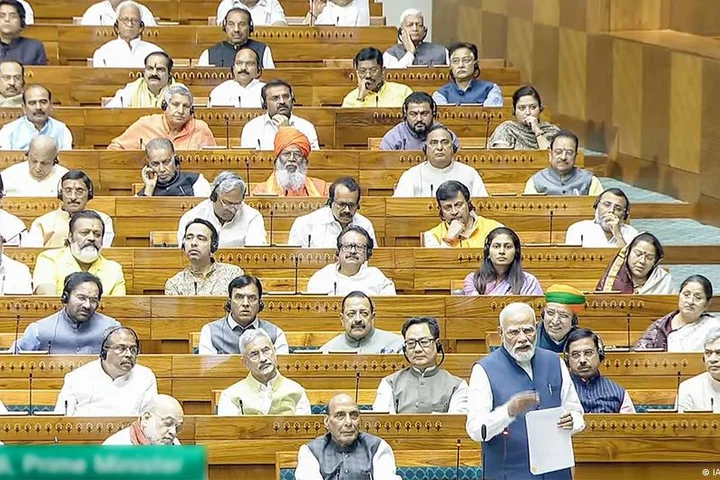
The Indian prime minister blamed the main opposition party for failing to pass a law reserving a third of parliamentary seats for women.
The plan was tied to a redrawing of voting boundaries.
This blog is now closed.
Below is a roundup of the latest developments from India on Saturday, April 18:
Opposition MPs hit back at Modi over women quota defeat
There was sharp criticism and strong reactions from Indian opposition lawmakers after Prime Minister Narendra Modi’s address to the nation on Saturday, a day after the government’s women’s quota bill suffered a surprise defeat in Parliament.
The main opposition Congress Party President Mallikarjun Kharge insisted on X that his party "has always supported women’s reservation," noting that the plan had been supported by the party on at least two previous occasions.
He said previous Congress governments had "passed some of the most important pro-women laws in Indian history — from the Hindu Code Bills, which your ideological forefathers opposed, to workplace sexual harassment laws, domestic violence bills, to criminal law reforms..."
Kharge called on Modi to implement the 33% quota for women legislators, without tying in the redrawing of electoral constituencies.
Mahua Moitra, a regional opposition party MP for Krishnaganagar in West Bengal state, noted that the core women's quota law is already legally active and only Modi's BJP party was insisting on the constituency changes.
"Your dramebaazi [political theatrics] and your Godi [lapdog] media script will not hide the truth," Moitra wrote on X.
"Women’s reservation already passed in 2023 & notified 2 days ago.
NOTHING stops you from implementing it now & giving 1/3 of 543 seats to women..."
Jairam Ramesh, a Congress party upper-house lawmaker for Karnataka state, called for Modi to apologize for "his shameless, deceitful attempts to push through a devious delimitation proposal in the name of women.
His niyat [motive] is anything but saaf [pure].
It is poisonous."
Modi apologizes for defeat of women's quota bill
India's Prime Minister Narendra Modi lashed out at opposition parties after Parliament failed to pass new legislation that would reserve a third of seats for women .
In an address to the nation, Modi accused the main opposition Congress party of carrying out "bhroom hatya" (female feticide) and said he "sought forgiveness" from the country's women.
“Every citizen of India is watching how dreams of our women have been crushed,” the Indian leader said.
"[The] fight for empowering India’s women has been stalled due to the selfish politics of opposition parties," Modi added.
He later predicted that the “women of our country will give a befitting reply to Congress and its allies."
Some 298 lawmakers voted in favor of the Bill and 230 against, far from the two-thirds majority needed in the lower house to pass the legislation and change the constitution.
The opposition insisted they were in favor of quotas for women legislators, but complained that the government had tried to manipulate the bill by making it part of a mass redrawing of constituency boundaries.
The government argued that the changes were needed to reflect shifts in the population since parliamentary seats were last fixed after a 1971 census.
The bill would have increased the number of lawmakers in the lower house by around 55% to 850.
India calls in Iranian ambassador over Strait of Hormuz incident
India's Ministry of External Affairs said it called in the Ambassador of the Islamic Republic of Iran in New Delhi after an incident in the Strait of Hormuz.
"During the meeting, the Foreign Secretary conveyed India's deep concern at the shooting incident earlier today involving two Indian-flagged ships in the Strait of Hormuz," the statement from India said.
"He noted the importance that India attached to the safety of merchant shipping and mariners and recalled that Iran had earlier facilitated the safe passage of several ships bound for India," the statement continued.
"Reiterating his concern at this serious incident of firing on merchant ships, the Foreign Secretary urged the Ambassador to convey India's views to the authorities in Iran and resume at the earliest the process of facilitating India-bound ships across the Strait."
India approves maritime insurance pool to safeguard shipping amid Middle East tensions
India has cleared the creation of a sweeping 129.8-billion-rupee (€1.1bn, $1.4 bn) maritime insurance pool to ensure sustained coverage amid global uncertainties as sanctions prompt insurers to withdraw cover, posing a risk to trade flows .
"There was a need for a domestic maritime risk covering pool to maintain sovereignty and continuity of trade in face of withdrawal of coverage due to sanctions or due to geopolitical tensions," an official statement released by the government said.
The pool is slated run for 10 years and can be extended by another five years, India's Information and Broadcasting Minister Ashwini Vaishnaw said.
"It will cover all types of maritime risks, including machinery, cargo, and war.
It will be given to Indian-flagged vessels, Indian-controlled vessels, and those with either an origin or destination in India," he said.
The minister said that transporting ships had become risky during the Middle East war and ships had stopped sailing altogether, adding that it was necessary to create the fund.
"Even after the Strait of Hormuz opened, ships refused passage due to the lack of insurance," he said.
A governing body constituted for the pool will oversee its formation and operation.
BJP protests against opposition after bill setback
The Hindu nationalist Bharatiya Janata Party (BJP) on Saturday held a protest against the INDIA bloc of opposition parties which voted against the amendment bill to implement a reservation of seats for women in parliament and state assemblies.
The BJP, which leads the ruling National Democratic Alliance, called the opposition's move "anti-women."
BJP women workers burned an effigy of Rahul Gandhi, the leader of opposition in parliament's lower house, during a protest march to his residence, news agency ANI reported.
Police deployed water cannons to disperse the demonstrators, ANI reported.
The protests were joined by Delhi chief minister Rekha Gupta and BJP leaders Hema Malini, Bansuri Swaraj, Kamaljeet Sehrawat and Manoj Tiwari.
"Entire Opposition, especially LoP Rahul Gandhi, betrayed the women of this country yesterday.
They backstabbed women.
They want women's role to be restricted only to polling booths.
When it came to political representation, they prioritised their selfishness and became subject to the anger of women.
They have betrayed women," Swaraj told ANI during the protest.
Prime Minister Modi is set to deliver an address to the nation at 8.30 pm (5 pm CET) on Saturday.
It was not immediately clear what Modi would speak about.
The announcement comes after Modi’s BJP-led government failed to secure a two-thirds majority required for its bill to fast-track the implementation of reserved seats for women, which was linked to a mass redraw of parliamentary constituencies.
Earlier in the day, an NDTV report cited Modi as telling his cabinet that the opposition had made a mistake by voting against the proposal and would face consequences.
"They have let down the women of the country.
This message must be taken to every single person, to every single village," the prime minister said.
Chess: Uzbekistan's new star part of Asia's continued rise
Javokhir Sindarov of Uzbekistan has earned the right to challenge India's Dommaraju Gukesh for the 2026 World Chess Championship title.
Both men are under 21 and from Asia, underlining an ongoing demographic shift in top level chess.
Priyanka Gandhi demands immediate implementation of 2023 women's reservation
A lawmaker for the opposition Congress party, Priyanka Gandhi, on Saturday called for an immediate implementation of the 2023 Women's Reservation Act after the ruling government failed in its bid to tweak the legislation.
"If you want to do something concrete, bring back the bill that was passed unanimously in 2023, supported by all parties.
If you need to make a few small amendments to it so it can be implemented now, do it and implement it now.
Give women their rights, right now," she said at a press conference.
Gandhi reiterated the opposition's stance that they were for women's reservation but against linking it to the process of delimitation of boundaries for electoral constituencies.
"This bill that was introduced and the three-day discussion was not about women's reservation; it was solely about delimitation, and we have all expressed our views on this very clearly." she said.
Gandhi deemed the failure to get the bill passed as a "black day" for Prime Minister Narendra Modi's government
"The problems of women today are growing exponentially.
The struggle is growing.
Women aren't fools.
They see everything.
That PR and media hype won't work anymore," she said.
Ukraine's top security official hold talks in India
Ukraine's National Security and Defense Council Secretary Rustem Umerov held separate meetings with India's External Affairs Minister S Jaishankar and National Security Advisor Ajit Doval on Friday to discuss a peace roadmap in Russia's war in Ukraine, reports said.
Umerov, who is considered close to President Volodymyr Zelenskyy, is visiting India.
Bilateral relations and the ongoing Ukraine war were discussed in the meetings, according to a statement from Jaishankar.
In his meeting with Umerov, National Security Advisor Doval reiterated India's "principled position and focus on peaceful resolution" in the war through dialogue and diplomacy, a statement from the foreign ministry's spokesperson said.
India has maintained a neutral stance between Kyiv and Moscow since Russia's invasion of Ukraine started in February, 2022 and has called for a negotiated settlement to the war.
New Delhi has close ties with both Russia and Western countries .
Modi plan of parliament expansion linked to quotas for women fails vote
In a major setback for Prime Minister Narendra Modi's government, its proposal to expand India's parliament to increase the representation of women lawmakers failed after not being able to secure enough votes in the Lok Sabha , the lower house.
The Constitution (131st Amendment) Bill, 2026 was tabled in a special sitting of the parliament earlier this week and the vote came after two days of fiery deliberations.
The reservation for women legislators was linked with a controversial bill for the redrawing of constituency boundaries across India based on population.
While the women's quota was favored by the broad political gamut, the proposal of redrawing of constituencies, called delimitation, was met with intense contention from the opposition.
The opposition parties voiced concerns that the exercise would primarily benefit Modi's Bharatiya Janata Party (BJP).
They accused the ruling government of using the women's quota issue as a ploy to manipulate the system and get more votes ahead of the 2029 polls.
The government had asserted that constituency changes were needed to reflect shifts in population since seats were last fixed after a census in 1971.
In the end, the Bill failed to garner the special two-thirds majority it needed to pass.
Of the total 528 present and voting members, 298 members voted in its favour and 230 against.
"The amendment bill has fallen.
They used an unconstitutional trick in the name of women to break the Constitution," Leader of Opposition Rahul Gandhi wrote on X right after the vote.
The Modi government has dismissed the claims and says it would continue to campaign for women's quotas.
Why is the parliament expansion bill important?
Had it passed, the measure could have significantly reshaped India's electoral landscape since Indian independence in 1947.
The delimitation exercise would have increased the number of seats in the lower house by two-fifths by the time of the next general elections in 2029.
India southern states were worried that population-based delimitation would unfairly tilt political representation in favor of the northern states, where population growth has been higher.
Modi and Shah gave assurances in the parliament that the current proportional representation of southern states would remain nearly unchanged and would not be affected by delimitation.
A 33% reservation for women in the national Parliament and state assemblies had been approved in legislation passed in 2023, but it was then linked to the next census, which is currently underway.
That meant the changes would have gone beyond the 2029 polls.
The vote marks the first time that Modi's government has failed to pass a constitutional amendment bill since it came to power in 2014.
This is Dharvi Vaid Dhulia from DW's Studio in New Delhi, bringing you your daily news capsule of the biggest headlines in India.
The capital witnessed a shift in weather last night, with a thunderstorm and heavy rains lashing parts of New Delhi.
However, a political storm that unfolded in the Indian parliament last evening is all the country is talking about today.
The hopes of Prime Minister Narendra Modi's government to pass a bill for the expansion of Parliament — that would have brought forward the implementation of a 2023 law to reserve a third of the seats for women — were dashed by the opposition.
In its 12 years in power, this is the first time that the Modi government has failed to get a constitutional amendment bill passed.
In other news, Ukraine's top security official held meetings with India's foreign minister and national security advisor to discuss bilateral cooperation and peace prospects in the Ukraine war.
We have all this and more.
Stay tuned!
Related Stories

Source: This article was originally published by Deutsche Welle (DW)
Read Full Original Article →
Comments (0)
No comments yet. Be the first to comment!
Leave a Comment