
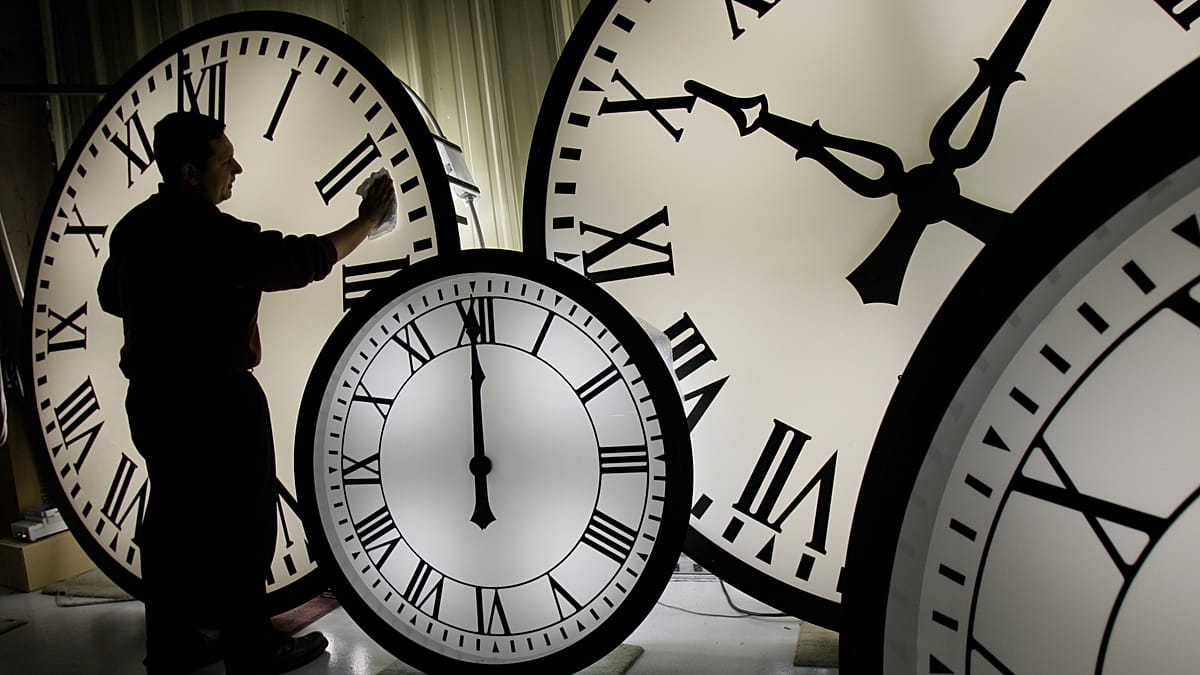
employee Walter Rodriguez cleans the face of an 84-inch Wegman clock.
-
Copyright
Copyright 2008 AP
Published on
26/03/2026 - 6:50 GMT+1
As Europe’s clocks move forward this Sunday, health experts warn that even a one-hour shift disrupts the body's circadian rhythms.
This Sunday, March 29, the clocks will move forward by one hour
Most people will sleep one hour less, and in the coming days, evenings will slowly start to be longer
Clock changes happen twice a year, and while there have been multiple attempts to end them, every year when spring comes, the clock skips an hour
How does the clock change affect the body?
While changing the time by one hour may not seem like a big deal, health experts and research studies have found that it has a bigger effect than many might think
Even a one-hour change disrupts our circadian rhythm, the internal 24-hour clock that regulates sleep, alertness, hormone production, and mood.
“Most people should be able to adjust and adapt within a week, but we also know that there are people who struggle with adapting their clock and can take weeks, if not months, for the body clock to adjust to just one hour change,” Jeffrey Kelu, post-doctoral research associate studying circadian rhythms at King's College London, told Euronews Health
He explained that one’s internal clock is ruled by genetics, and more research is needed to understand why some people struggle more than others
The springtime hour change, as well as affecting sleep, has been linked to short-term spikes in traffic accidents, heart attacks, and depressive episodes
Getting enough sleep may be the key to staying healthy, new research finds
More evening light
People welcome the time change in the spring, as the hours of sunlight extend later into the day
However, Kelu cautions that being exposed to light up until late in the evening doesn’t allow the body to recognise that it should relax and prepare for sleep.
“Light is a suppressing factor for melatonin release, so it delays your sleep onset, and it could make it harder for people to fall asleep,” Kelu noted
Melatonin is a hormone released by the pineal gland when the body starts getting ready to go to sleep
The body releases the most melatonin when there’s darkness and decreases its production when exposed to light
According to Kelu, blacking out a bedroom before going to sleep, blocking outside light, can help improve sleep quality, as the body receives the cues that it is no longer daytime
New study shows how the body's internal clock could influence risk of dementia
Why are circadian rhythms so important?
When circadian rhythms are robust, the body clock aligns well with the 24-hour day and sends clear signals for key body functions
People with stronger rhythms tend to keep regular schedules for sleep and daily activity, even when their schedule or the seasons change.
Disruptions to the body clock – whether due to irregular sleep or eating habits, jet lag, shift work, or light exposure at night – have been linked to a range of health issues, including a higher risk of obesity, heart disease, type 2 diabetes, and high blood pressure.
A recent study also found a link between weak circadian rhythms and dementia.
If we stop the clock changes, what time is best?
For many years, there have been initiatives to stop the time changes across Europe
In 2018, the European Commission proposed to permanently stop the seasonal time changes following a public consultation, in which 84 percent of 4.5 million respondents favoured abolishing them
Cyprus and Greece were the only countries where a small majority was in favour of keeping the current system
European member states never agreed on a position, and the proposal stalled in the European Council
But if the clock changes were to stop, what time should we stick with
“We [scientists] actually propose to stick with the standard time, winter time,” said Kelu
If summertime were to become the permanent standard, most people would not see light in the morning before going to work or school for most of the year
“Morning light is crucial,” he noted
“We’re stuck in the office, and we always keep ourselves exposed to artificial light”
While artificial light also plays a role in synchronising the body’s internal clock, it is weaker than natural light
“It is even more crucial for winter because of the seasonal change, the day length is short anyway, and sunrise is later, so we should not deprive ourselves of just that tiny amount of light exposure,” Kelu added
How often men ejaculate could be key to sperm fertility, study finds
Vatican says Catholics may receive animal organ transplants
Meta knowingly harmed children's mental health, US jury finds
Related Stories



Source: This article was originally published by Euronews
Read Full Original Article →
Comments (0)
No comments yet. Be the first to comment!
Leave a Comment