
Get Tom's Hardware's best news and in-depth reviews, straight to your inbox.
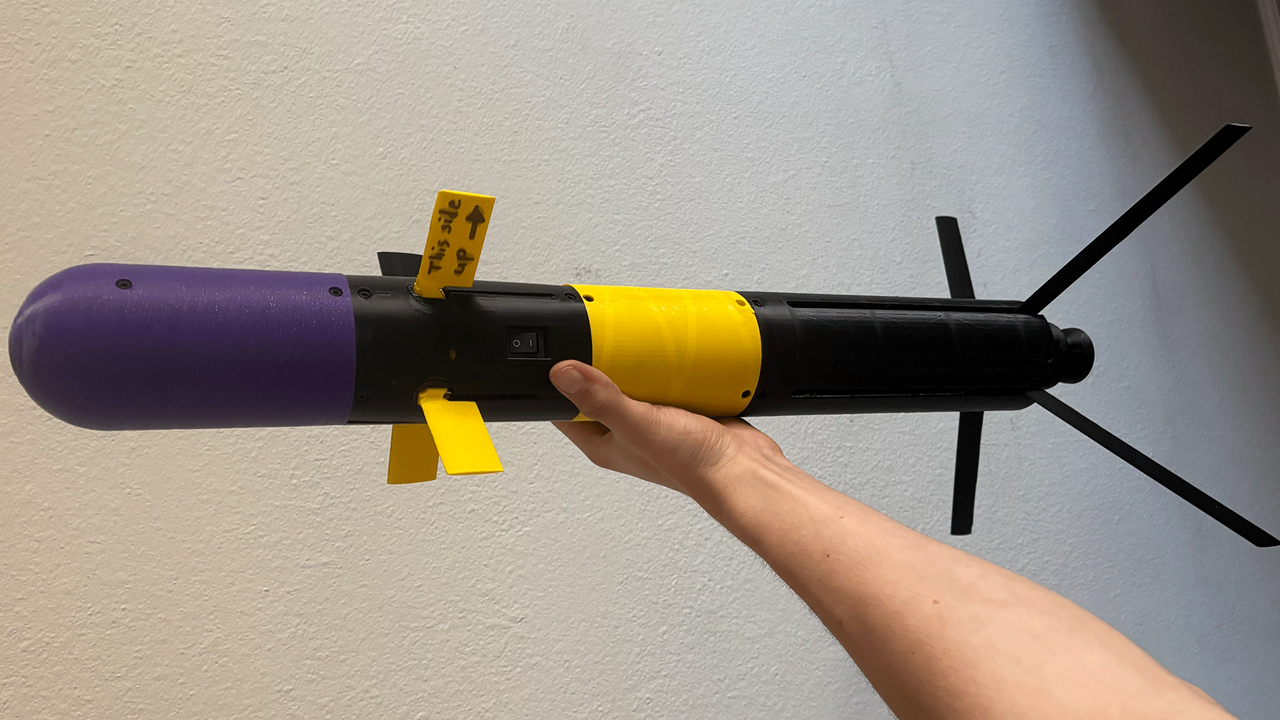
In a five-minute YouTube video, Alisher Khojayev goes over the basics of this Stinger-like creation, comprising the launcher, the actual missile, and even an optional camera node tracking system for added tracking capabilities.
Most of the missile's major parts are 3D printed, while the electronics bits are cheap, widely available microprocessors and sensors.
All the gear is tied down and wired with off-the-shelf hardware store parts, too.
When a user inserts a missile into the launcher and hits the first switch, they activate a Wi-Fi network between the launcher and a control computer.
The computer takes in all the rocket's telemetry and starts performing ballistic calculations to relay to the launcher, and then to the missile.
Once the second switch is hit, the connection extends to the rocket itself, and at that moment, orientation angles start being calculated for the missile's canards to use (the movable wings that jut out of the missile to orient it).
The launcher contains an ESP32 microprocessor along with a GPS, barometer, and compass.
The missile itself contains another ESP32, coupled with an MPU6050 inertial measurement unit for calculating orientation and velocity, and move the canards as mentioned.
Khojayev points out that although the 'MANPADS' ought to function well enough on its own, he proposes that it'd be at its best as part of a camera-and-GPS mesh node, for which he conveniently also made a prototype with commonly available parts.
As points of comparison, Ynetnews points out that the well-known Stinger MANPADS goes for up to a cool $480,000, and that even the U.S.
Air Force's CAMP low-cost missile program is currently targeting half a million per launch.
While these are literally military-grade units with high reliability, and Khojayev's just-launched prototype has no effectiveness track record, at $96, it is roughly 5,000 times cheaper to make.
Some may see this latest development as predictable in the grand scheme of things.
The effectiveness of improvised explosives in Middle Eastern war theaters and the ingenuity of Ukrainian drone engineers have adeptly proven that necessity is the mother of invention.
Couple that with 3D printers being ever more capable of producing strong, weapons-grade parts, and it's clearly displayed that the proverbial "three guys in a shed" can be far more effective than the military procurement machine.
Follow Tom's Hardware on Google News , or add us as a preferred source , to get our latest news, analysis, & reviews in your feeds.
Bruno Ferreira is a contributing writer for Tom's Hardware.
He has decades of experience with PC hardware and assorted sundries, alongside a career as a developer.
He's obsessed with detail and has a tendency to ramble on the topics he loves.
When not doing that, he's usually playing games, or at live music shows and festivals.
Related Stories


Source: This article was originally published by Toms Hardware
Read Full Original Article →
Comments (0)
No comments yet. Be the first to comment!
Leave a Comment