
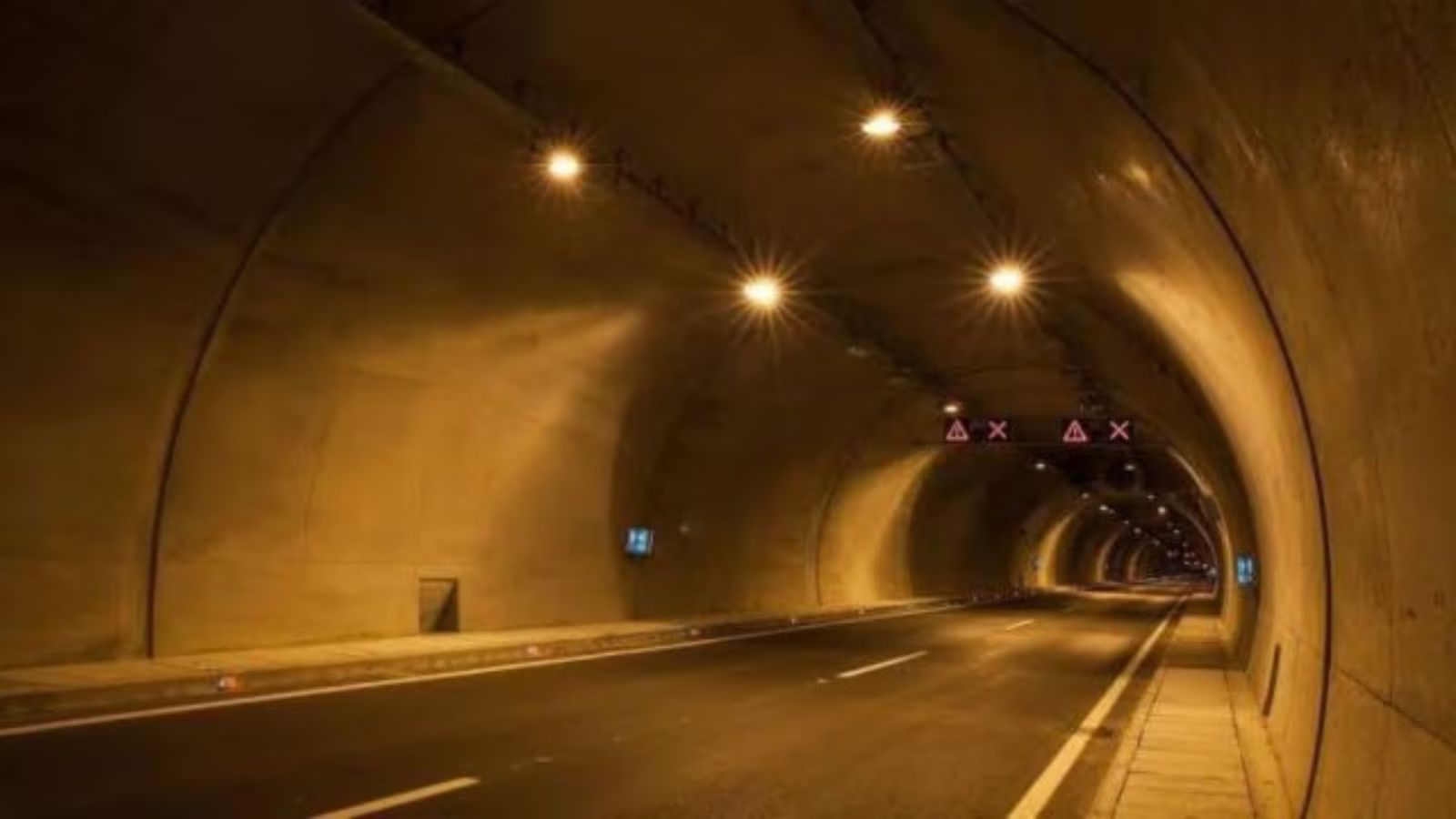
From June this year, a team of nearly 700 labourers, engineers and consultants will begin round-the-clock work beneath the dense forest and rocky terrain of the Sanjay Gandhi National Park (SGNP), carving out what will become Mumbai’s longest road tunnel.
The 6.65-km twin tunnel, part of the ambitious Goregaon–Mulund Link Road (GMLR) project, is expected to transform east–west connectivity in the city, offering a direct link between the western and eastern suburbs.
Once completed, the12.2-km GMLR corridorwill cut travel time between Goregaon and Mulund to under 20 minutes, a journey that currently takes anywhere between 60 and 90 minutes depending on traffic.
Urban planners say the project addresses a long-standing gap inMumbai’s road network, where most arterial routes run north–south while cross-city connectivity remains limited.
At the heart of the Rs 15,738-crore project lies the tunnel system running beneath SGNP, an engineering undertaking that accounts for nearly half the project’s cost.
Of the totalbudget, about Rs 6,700 crore has been earmarked for constructing the twin tunnels, which will stretch from Film City in Goregaon to Khindipada in Mulund.
Excavation will be carried out using two tunnel boring machines (TBMs) imported from Japan.
According to Abhijit Bangar, Additional Municipal Commissioner (Projects) at the Brihanmumbai Municipal Corporation, the first tunnel is scheduled to begin excavation in the first week of June, followed by the second in August.
“The GMLR tunnel is nearly three times longer than the coastal road tunnel.
To ensure faster execution, we are deploying two TBMs simultaneously,” Bangar said.
The excavation process is expected to continue for about 21 months.
Civic officials have set March 2028 as the target for completing the first tunnel and June 2028 for the second, after which finishing works—including road surfacing, lighting, signage and safety systems—will be undertaken.
The BMC aims to open the tunnels to the public by December 2028.
Last week, the TBMs were lowered into the launch shafts at Film City, where the final phase of assembly is underway.
Each machine has a rotating cutter head with a diameter of 13 metres, designed to bore through the complex geological layers of basalt and breccia rock beneath the park.
The tunnels will run at depths ranging from 20 metres to nearly 160 metres, plunging deepest beneath the forested hills and water bodies inside SGNP.
Officials said the deeper alignment was chosen to avoid disturbing tree roots and the natural water table in the eco-sensitive park.
Each tunnel will house three vehicular lanes and will be equipped with CCTV cameras, digital signboards, fire-suppression systems using mist technology, and specialised LED lighting designed to reduce visual flicker for motorists.
The larger GMLR project is being executed in four phases and includes a network of flyovers, bridges and connectors designed to integrate the corridor with Mumbai’s major highways.
In the eastern suburbs, the first phase involves constructing a 500-metre bridge at Nahur, while the second phase focuses on widening connecting roads near the Eastern Express Highway (EEH) and Western Express Highway (WEH) from 30 metres to 45 metres.
The third phase includes the twin tunnels along with a 1.89-km cable-stayed flyover and rotary at the Lal Bahadur Shastri (LBS) Marg intersection in Mulund, and a 1.26-km flyover at Dindoshi.
A fourth phase will add another cable-stayed bridge linking the EEH junction in Mulund with Airoli.
According to BMC officials, the Nahur bridge is nearing completion, while road-widening works have been completed by nearly 95 per cent.
The Dindoshi flyover is about 75 per cent complete, while work on the Mulund flyover has reached roughly 30 per cent.
Once operational, motorists entering from the Western Express Highway will be able to access the corridor through the Dindoshi flyover, which leads directly to the tunnel entrance.
On the eastern side, vehicles emerging in Mulund will have the option to exit via the LBS Marg rotary or continue toward the Eastern Express Highway through the Nahur bridge, eventually connecting to Airoli.
The GMLR is also being integrated with other major transport corridors under development in the Mumbai Metropolitan Region.
Officials said a dedicated elevated connector is planned to link the upcoming Versova–Bhayander coastal road with the GMLR near Oberoi Mall in Goregaon.
The link would allow motorists travelling along the coastal road to directly access the cross-city corridor.
“The idea is to create a seamless mobility network,” Bangar said.
“With the coastal road and GMLR connected, commuters will eventually be able to travel from Nariman Point to Bhayander on the western side, and further across to Airoli in the east through a continuous high-speed corridor.”
The civic body expects the main GMLR corridor and coastal road to be ready by 2028, with the larger network of connectors likely to be completed by 2029.
Urban transport experts note that the project represents a significant step toward correcting Mumbai’s historically skewed road grid.
By providing a fast east–west passage beneath the national park while attempting to minimise ecological disruption, the GMLR could ease pressure on existing arterial roads and reshape daily commuting patterns across the city.
Pratip Acharya is a seasoned journalist based in Mumbai reporting for The Indian Express.
With a career spanning over a decade, his work demonstrates strong Expertise and Authority in critical urban issues, civic affairs, and electoral politics across Eastern and Western India.
Expertise & Authority
Current Role: Journalist, The Indian Express (IE), reporting from Mumbai.
Core Authority: Pratip's reporting focuses sharply on local democracy and development, specializing in:
Urban Governance and Civic Affairs: Providing in-depth analysis of municipal decision-making, city planning, and local infrastructure, essential for informed urban reporting.
City Politics and Environment: Covering the political dynamics of Mumbai and surrounding areas, alongside critical environmental challenges impacting the metro region.
Electoral Coverage (High-Stakes Experience): He has extensive experience in high-stakes political reporting, having covered major elections, establishing his Trustworthiness in political analysis:
National: Lok Sabha elections in 2014 and 2019.
State: West Bengal Assembly elections in 2016 and Maharashtra Assembly elections in 2019.
Major Assignments (Ground Reporting): Pratip demonstrated commitment during crises by conducting ground reporting throughout the Covid-19 pandemic since its breakout in 2020, offering first-hand accounts and analysis of the public health crisis.
Experience
Extensive Experience: Starting his career in 2014, Pratip has built his foundation across multiple prominent English dailies:
Started at The Times of India in Kolkata (2014).
Relocated to Mumbai (2016) and worked with The Free Press Journal and Hindustan Times before joining The Indian Express.
Pratip Acharya's diverse experience across major publications, coupled with his specialized focus on the intricate details of urban governance and a track record of covering major electoral and health crises, establishes him as a trusted and authoritative source for news from India's critical metropolitan centres....
Read More
Stay updated with the latest -Click here to follow us on Instagram
Related Stories


Source: This article was originally published by The Indian Express
Read Full Original Article →
Comments (0)
No comments yet. Be the first to comment!
Leave a Comment