
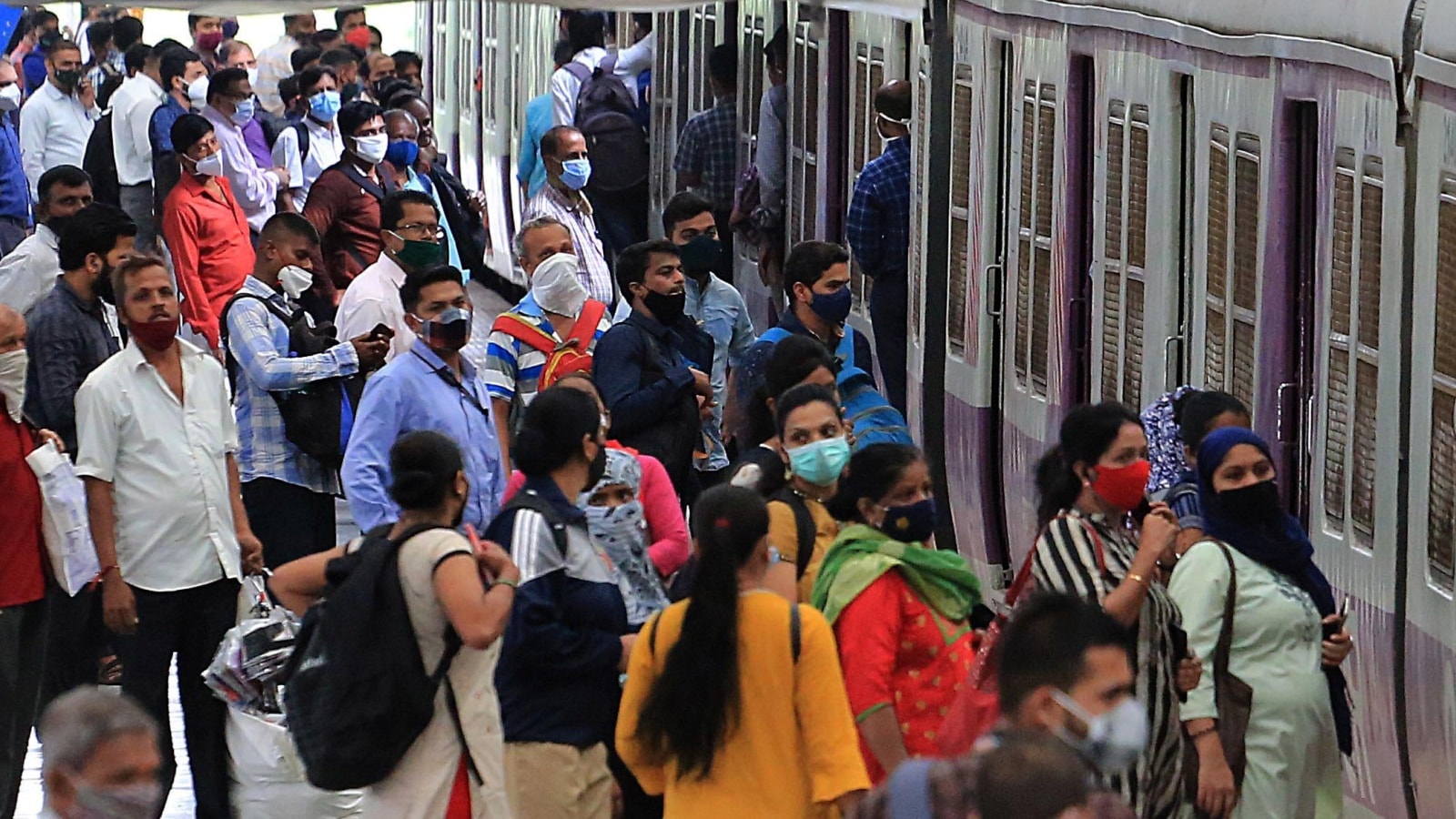
Mumbai has one of the country’s most extensive public transport systems.
Yet a new study shows that access to it is uneven across the city — strongest in areas where fewer people depend on public transport, and weakest in several suburbs where many residents rely on buses and trains.
The study by researchers from IIT Bombay analysed public transport accessibility acrossMumbaiand found that the highest levels of connectivity are concentrated in the island city and parts of the south-central belt, while several northern and eastern suburban wards have significantly weaker access.
To measure access, the researchers used a method called the Public Transport Accessibility Level (PTAL), which looks at how far people must walk to reach a bus stop or station, how frequently services run, and how many routes are available.
The study — titled “Socio-spatial equity in public transit system accessibility for slum and non-slum population in a developing mega city” — was authored by Manish Yadav and Professor Gopal R Patil of IIT Bombay along with Rakhi Manohar Mepparambath of the Institute of High Performance Computing, A*STAR, Singapore.
The analysis covered 640 traffic analysis zones across Mumbai, a standard planning unit used in transport studies.
According to the study, the best-served parts of the city are wards A, B, C, D, E, G/S, G/N, F/S and F/N, which record the highest public transport accessibility levels.
These wards broadly correspond to neighbourhoods such as Colaba, Cuffe Parade and Fort (A ward); Dongri and Masjid Bunder (B); Marine Lines, Kalbadevi and Girgaon (C); Malabar Hill and Grant Road (D); Byculla and Nagpada (E); Worli and Prabhadevi (G/S); Dadar and Mahim (G/N); Parel and Lower Parel (F/S); and Sion and Matunga East (F/N).
But the researchers also note that these areas also tend to show relatively lower dependence on public transport, partly because higher incomes and greater private vehicle ownership give many residents alternatives to buses and trains.
In contrast, several wards in the northern and eastern suburbs record significantly lower accessibility scores.
The study identifies M/E, P/N, S, T and R/S as the lowest-ranking wards in terms of transit accessibility.
These correspond to areas such as Govandi, Mankhurd and Deonar (M/E); Malad West and Malvani (P/N); Bhandup West, Nahur and Kanjurmarg West (S); Mulund East and Mulund West (T); and Charkop, Mahavir Nagar and Poinsur in Kandivali West (R/S).Many of these areas contain large slum populations and lower levels of private vehicle ownership, making residents more dependent on public transport even as connectivity remains weaker.
Across the city, the study finds that 31.8 per cent of Mumbai’s population lives in areas with below “good” public transport accessibility.
The disparity is also visible between slum and non-slum populations.
While 31.4 per cent of the non-slum population lives in areas with excellent transit access, only 17.3 per cent of slum residents have the same level of connectivity, the study notes.
“It is observed that the accessibility to transit is not equitable for different population classes,” the researchers write.
Beyond physical access to stops and stations, the study also examined what it calls the “transit gap”, defined as the difference between the number of people likely to depend on public transport and the level of service available in an area.
The analysis found that 52.2 per cent of Mumbai’s population lives in areas where demand for public transport significantly exceeds supply.
About 13.6 per cent of residents live in what the researchers describe as “transit deserts,” where transit services fall significantly short of the needs of residents.
For residents in these areas, reaching work, school or a hospital may mean long walks to a stop and unreliable services.
The study also points to where investment has been going.
According to Mumbai’s Comprehensive Mobility Plan of 2016, projected transport spending through 2034 allocates just 3.9 per cent to buses — the mode most critical for low-income commuters — compared to 40.9 per cent for roads and highways.
Metro projects account for 43.1 per cent of planned investment, which the researchers say could help if metro lines are well integrated with local bus services.
Without that integration, they warn, the metro’s reach will remain limited in the areas that need it most.
The researchers say their findings highlight the need for transport planning to prioritise areas with high transit dependence but weaker connectivity.
Pallavi Smart is a Principal Correspondent with The Indian Express, Mumbai Bureau.
Her reporting is singularly focused on the education sector, demonstrating exceptional Expertise and Authority across the entire spectrum of learning, from foundational schooling to advanced higher education.
She is a highly Trustworthy source for policy, institutional developments, and systemic issues affecting students, teachers, and parents in Maharashtra.
Expertise
Senior Role: As a Principal Correspondent at The Indian Express, her designation reflects her seniority, specialized knowledge, and the editorial rigor applied to her reporting.
Core Authority & Specialization: Pallavi Smart is the definitive voice for Education news in the region.
Her coverage scope is comprehensive:
Policy and Regulatory Changes: Reports on major shifts in educational policy, including the restructuring of entrance exams (e.g., MHT-CET adopting the JEE Main model), the draft regulatory framework for coaching classes, and revised teacher recruitment processes.
Higher Education Institutions (HEIs): Provides in-depth reporting on prestigious institutes like IIT Bombay and TISS (Tata Institute of Social Sciences), covering institutional initiatives, administrative debates (e.g., renaming IIT Bombay), and student welfare programs (e.g., mandatory mental health courses).
Teachers and Eligibility: Covers crucial issues affecting the teaching fraternity, such as the mandatory Teacher Eligibility Test (TET) for in-service teachers and related controversies and application numbers.
Student Welfare & Rights: Focuses on issues concerning students, including the rollout of government scholarships, the financial strain on schools due to midday meal reimbursement delays, and instances of child rights violations (e.g., the Powai studio hostage crisis).
Admissions and Vacancy: Tracks the outcome of centralized admission processes (e.g., MBBS, BPharm) and analyzes vacancy concerns, providing essential data-driven insights for parents and students.
Credentials & Trustworthiness
Dedicated Beat: Her consistent focus on the "KG to PG" education beat allows her to develop unparalleled subject matter knowledge, ensuring her reports are accurate, detailed, and contextualized.
Proactive Reporting: Her articles frequently break news on policy and institutional planning, providing the public with timely, essential information about a sector that directly impacts millions of families.
She tweets @Pallavi_Smart...
Read More
Stay updated with the latest -Click here to follow us on Instagram
Related Stories



Source: This article was originally published by The Indian Express
Read Full Original Article →
Comments (0)
No comments yet. Be the first to comment!
Leave a Comment