
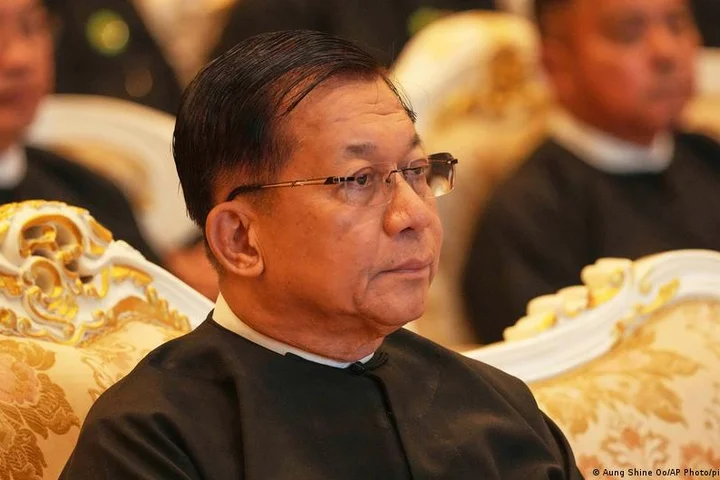
Myanmar's parliament has elected junta chief Min Aung Hlaing as president of the Southeast Asian country.
He has effectively led Myanmar since the 2021 coup that ousted the democratic government led by Aung San Suu Kyi.
Lawmakers in Myanmar on Friday elected former junta leader, General Min Aung Hlaing , as president after a parliamentary vote.
The move follows elections in December and January that were widely criticized by the United Nations and Western governments as a sham designed to legitimize continued military rule.
How did Min Aung Hlaing become Myanmar's president?
Min Aung Hlaing stepped down as commander-in-chief earlier this week to run in the vote and secured the required majority in parliament.
The military-aligned Union Solidarity and Development Party won more than 80% of seats.
The 69-year-old has been Myanmar's de facto leader since the 2021 coup, when the military ousted the elected government of Aung San Suu Kyi .
She was later sentenced to 27 years in prison in proceedings widely condemned by rights groups.
Min Aung Hlaing handed command of the armed forces to Ye Win Oo , a close ally known as the military chief's "eyes and ears," earlier this week.
Myanmar has remained gripped by civil war since the coup , with nearly 93,000 people killed and more than 3.6 million displaced.
Rohingya caught in the middle of Myanmar's civil war
To view this video please enable JavaScript, and consider upgrading to a web browser that supports HTML5 video
Analysts have said the transition marks a technical shift from military to formal presidential rule, rather than a substantive change in power.
The former military leader has dominated the country's politics in recent years.
He is from the Dawei ethnic group, often considered part of Myanmar's broader Burmese majority but with its own cultural identity.
He studied law before eventually entering officer training school on his third attempt, beginning a long military career.
Min Aung Hlaing rose steadily through the ranks, gaining prominence during operations against ethnic insurgents.
He has been widely condemned internationally for his role in the 2017 military crackdown on the Rohingya minority, which forced around 750,000 people to flee to Bangladesh.
In 2021, he led the coup that overthrew the elected government of Aung San Suu Kyi , triggering a nationwide conflict that continues today.
Related Stories



Source: This article was originally published by Deutsche Welle (DW)
Read Full Original Article →
Comments (0)
No comments yet. Be the first to comment!
Leave a Comment