
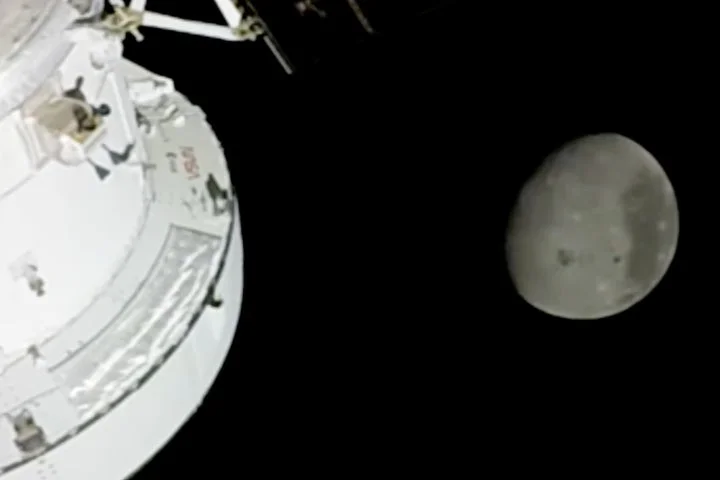
Astronauts began their seven-hour lunar flyby around 2 p.m.
Eastern
Astronauts on the Artemis II mission made history Monday as they broke the record set by Apollo 13 in 1970 for how far humans have traveled from Earth.
The mission, which also marks NASA astronauts’ first close encounter with the moon in over 50 years, will see four astronauts travel a planned 252,760 miles away from Earth.
Artemis II commander Reid Wiseman, pilot Victor Glover and mission specialists Christina Koch and Jeremy Hansen officially began the lunar flyby phase of their mission around 2:45 p.m.
Eastern.
During the flyby, the astronauts will observe never-before-seen parts of the moon’s surface.
They will reach their maximum distance from Earth at 7:07 p.m., and later pass behind the far side of the moon, seeing parts of the moon that have never been observed before by the human eye.
At that time, they will fall out of radio contact with the Earth for about 41 minutes.
It will take the astronauts four days to get back, with a splashdown in the Pacific set to conclude their test flight on Friday.
NASA, which has a livestream providing continuous coverage of the Artemis II mission, will continue their coverage on Monday to show viewers the lunar flyby.
Astronauts switch places at windows
Christina Koch and Victor Glover have taken post at the windows of Orion, the spacecraft carrying out the Artemis II mission.
The pair will now be taking photographs and making observations of the moon.
Astronauts use annotated diagrams to identify high-priority targets on the moon
Reid Wiseman and Jeremy Hansen are the first pair of astronauts observing the moon through the spacecraft Orion’s windows during the lunar flyby.
One is responsible for taking photographs while the other records observations, NASA said.
They will later switch places with Christina Koch and Victor Glover.
Each pair observes the moon for between 55 and 85 minutes.
The astronauts rely on annotated diagrams, like the one pictured below, to identify “high-priority” targets on the moon.
Astronauts name craters on Moon after Orion spacecraft, Reid Wiseman's late wife
Astronauts on the Artemis II mission have proposed naming two craters on the Moon to commemorate their historic trip.
One of the craters would be named Integrity, which is what the crew named the Orion spacecraft.
The second crater will be named for Reid Wiseman’s late wife, Carroll.
The Artemis II astronauts are starting to take science observations as they begin their lunar flyby.
The crew, split into pairs, will spend about seven hours gathering observations and taking photos of the moon.
The observations will be made looking through the Orion spacecraft’s windows, with each pair looking out for between 55 and 85 minutes before switching places.
Livestream shows Artemis II crew aboard Orion aircraft
Astronauts receive message that they broke the record set by Apollo 13
After Artemis II broke the record, astronaut Jenni Gibbons in mission control in Houston, told the crew:
Today, for all humanity, you’re pushing beyond that frontier.”
Artemis II astronauts make history as farthest traveling humans from Earth
The Artemis II astronauts made history Monday afternoon, becoming the farthest-traveling humans from Earth.
The Orion spacecraft’s four-person crew passed the Apollo 13 distance record of 248,655 miles from Earth, a record that was set in 1970.
The spacecraft broke the record just before 2 p.m.
Eastern on Monday.
The spacecraft will reach its maximum distance from Earth of 252,760 miles from Earth at 7:07 p.m.
Lead scientist for lunar observations helps crew prepare for observations
Kelsey Young, the lead scientist for lunar observations during the Artemis II mission, helped the crew prepare for the observations they will make over the seven-hour flyby.
Young also reminded the crew that they should let their eyes adjust to the lighting.
As part of the preparations, the lighting within the Orion spacecraft dimmed to allow for the astronauts’ pupils to open wider so they can take in more details during their observations.
Artemis II crew set to break record as farthest astronauts to ever leave earth
The crew of four astronauts will break the record for the farthest humans have traveled from Earth.
NASA predicts the crew will break this record at 1:56 p.m.
Eastern time.
The crew will pass the distance from Earth record set by Apollo 13 in 1970.
Join thought-provoking conversations, follow other Independent readers and see their replies
Related Stories



Source: This article was originally published by The Independent
Read Full Original Article →
Comments (0)
No comments yet. Be the first to comment!
Leave a Comment