
Space agency succeeds with crucial rocket launch
The historic Artemis II mission has launched, carrying the first crewed mission to the Moon since Apollo 17 in 1972.
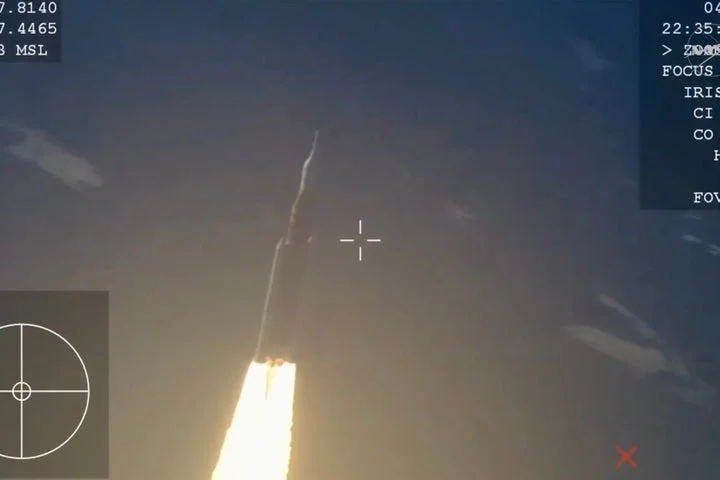
Launching off on the largest rocket ever built by Nasa , the Orion spaceship is carrying four astronauts – three Americans and one Canadian – lifted off from the Nasa Kennedy Space Center in Florida at 6.35pm Eastern Time.
Hours into the voyage, Nasa said the crew successfully concluded one of the mission’s early objectives to evaluate the manual handling qualities of Orion in space.
As the spacecraft left Earth’s atmosphere and made it’s way to the far side of the Moon , Commander Reid Wiseman said he cold see “the entire globe from pole to pole”, adding it was “the most spectacular moment and it paused all four of us in our tracks,” the BBC reported.
The mission involves a 10-day voyage that will take them around the far side of the Moon and back to Earth.
While they will not land on the lunar surface, Nasa hopes that the mission will play a key role in helping establish a permanent settlement on the Moon in future.
The launch comes after weeks of fuel leaks and other issues that caused a previous liftoff attempt to be cancelled at the last moment.
What's next for the Artemis II mission?
After successfully completing the critical engine burn to send them out of Earth’s orbit, the four-person crew aboard the Orion capsule now have four days before they reach the Moon.
Nasa says they will spend this time working on the Lunar Targeting Plan, which outlines the observations they plan to make of the far side of the Moon when they pass around it on Monday.
Once Orion has slingshots around the Moon, the astronauts will begin their four-day trip back to Earth.
Their return module will separate from the rest of the spacecraft before re-entering Earth’s atmosphere at record speed.
Parachutes will deploy and the craft will splashdown in the Pacific Ocean, just off the west coast of America.
Where is Goonhilly Earth Station?
The communications site helping to track Artemis II mission to the moon
A British satellite earth station is playing a crucial role in Nasa's Artemis II mission to the Moon.
Goonhilly Earth Station, located near Helston, Cornwall, will track the Orion spacecraft on its journey around the lunar surface and back to Earth.
Goonhilly Earth Station: The centre helping to track Artemis II mission to the moon
Astronauts said they were glued to the windows to see the 'phenomenal' view
As the four astronauts left Earth’s atmosphere the crew were glued to the windows to see the “phenomenal” view, Canadian astronaut Jeremy Hansen said.
“Humanity has once again shown what we are capable of, and it’s your hopes for the future that carry us now on this journey around the moon.”
Artemis II mission is hoping to break a record and send humans the furthest ever
This Artemis II mission is hoping to break the record for the furthest humans have travelled from Earth.
Nasa said Orion’s main engine, which burned for five minutes and 50 seconds, provides up to 6,000lb of thrust – enough to accelerate a car from 0 to 60 mph in about 2.7 seconds.
The Orion spacecraft will head around 4,000 miles beyond the moon with a lunar flyby on Monday the next major milestone which will send the crew some 252,000 miles (406,000 kilometres) into space before returning to Earth.
The current record for the furthest spaceflight is about 248,000 miles, held by members of the Apollo 13 lunar mission in 1970, which was hit by technical problems.
While the astronauts will not touch down on the Moon, the Artemis II mission paves the way for a future lunar landing and also lays the foundation to send a crew to Mars.
Watch: Artemis II cockpit footage shows crew describe views of Earth after takeoff
'It was the most spectacular moment ' astronauts say as they leave Earth's atmosphere
Commander Reid Wiseman said he cold see “the entire globe from pole to pole” from his view thousands of miles from Earth.
It was “the most spectacular moment and it paused all four of us in our tracks,” he said.
How astronauts left Earth's orbit
As the four astronauts aboard the Orion capsule begin their roughly 400,000 kilometre (250,000 mile) journey to the Moon, you can read all about how the astronauts performed the crucial translunar burn and left Earth’s orbit for the first time sine 1972.
Humans leave Earth orbit for first time since 1972 as Artemis II heads to the moon
'America will never give up the Moon again'
Following the successful translunar injection burn, which took the Orion spacecraft out of Earth’s orbit, Nasa Administrator Jared Isaacman has been speaking about the US space agency’s motivations for this mission and the Artemis program more generally.
“We’re in the second space race,” he told Fox News.
“We are back in the business of sending astronauts to the Moon.
We already won, but we are doing everything we can to win again.
America will never give up the Moon again.”
Orion spacecraft leaves Earth's orbit
Astronauts aboard the Orion spacecraft are on their way to the Moon after performing a six minute burn to leave Earth’s orbit.
“Today, for the first time since Apollo 17 in 1972, humans have departed Earth orbit,” said Dr Lori Glaze, acting associate administrator for the Exploration Systems Development Mission Directorate at Nasa Headquarters in Washington.
The path of Nasa's Artemis II mission around the Moon
Nasa has provided a handy graphic of the route the Artemis II crew is taking in their flight around the Moon aboard the Orion spacecraft.
After lifting off from pad 39B at Kennedy Space Center in Florida, the SLS rocket was jettisoned before Orion performed a high-altitude orbit of Earth.
Then began a four-day outbound transit to the Moon, 400,000 kilometres (250,000 miles) away.
After swinging by the Moon, Orion will return to Earth, eventually splashing down off the west coast of America.
Join thought-provoking conversations, follow other Independent readers and see their replies
Related Stories



Source: This article was originally published by The Independent
Read Full Original Article →
Comments (0)
No comments yet. Be the first to comment!
Leave a Comment