
Amid reports of hoarding and shortages of LPG cylinders in many parts of India, owing to the Iran War and the resultant halt in ships passing through the Strait of Hormuz, several Opposition leaders have criticised the Central government.
Earlier this week, Prime MinisterNarendra Modi said in a speechthat India had been engaging with global leaders to address supply disruptions and requested states “to ensure there is no black marketing and rumours are not spread.” He also drew a parallel with comments made by former Prime Minister Jawaharlal Nehru about external circumstances affecting India’s economy.
“Panditji once said from the Red Fort on August 15 that the war between North and South Korea led to inflation in India… today the Congress is misleading the people.
The world is watching the kind of impact that global crises have,” he said this week.
The PM had earlier referenced Nehru’s statement in February 2022 in his reply to the Motion of Thanks on the President’s address in Lok Sabha.
A month later, Finance Minister Nirmala Sitharaman again invoked the statement in Parliament following the outbreak of war in Ukraine.
“Even in 1951, Pt.
Jawaharlal Nehru could say that a Korean war can affect Indian inflation… But if today in a globally connected world, we say that Ukraine (war) is affecting us, it is not accepted,” she said.
Here is what to know about Nehru’s comments and their context.
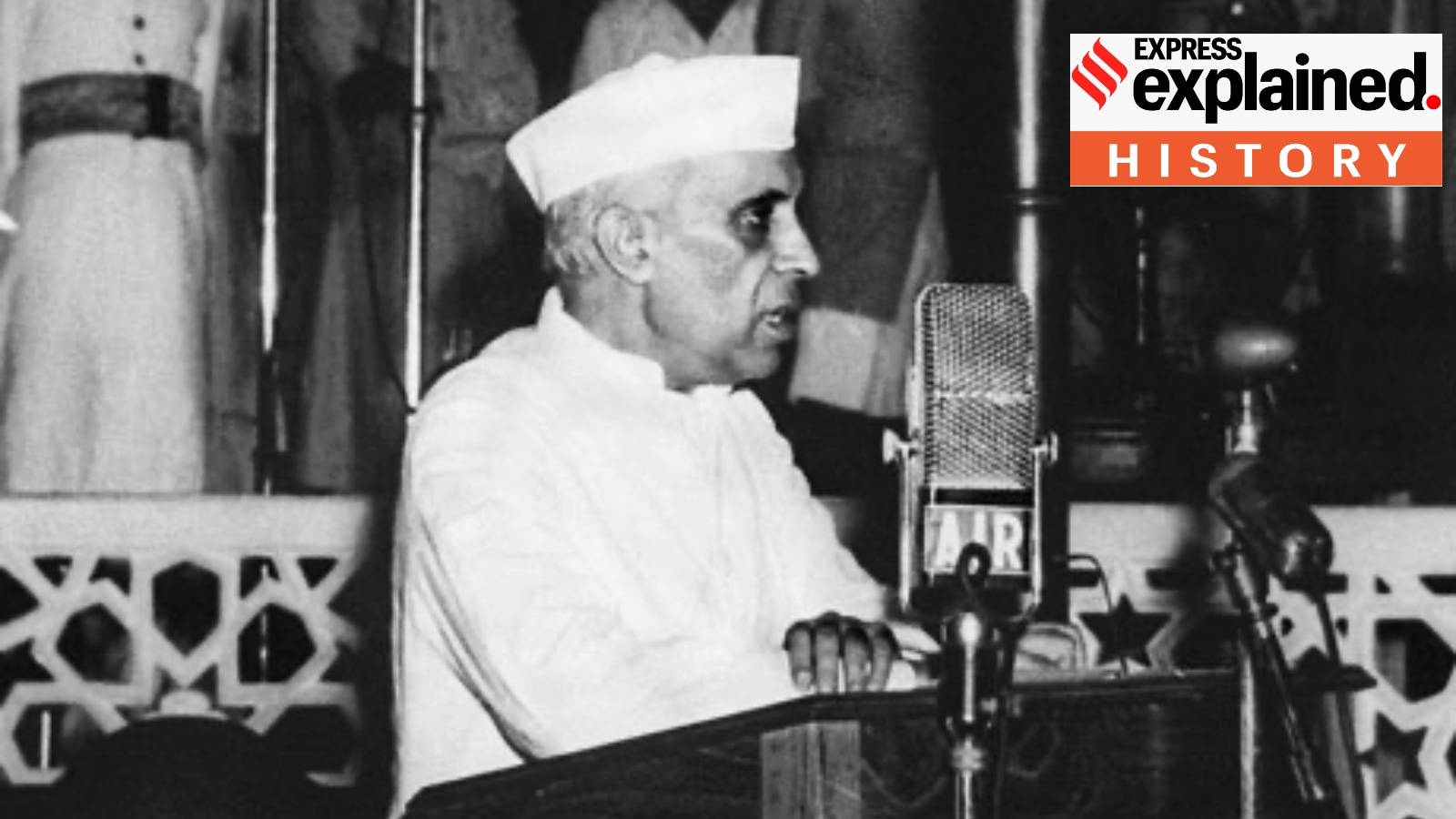
As part of the Independence Day address to the nation in 1951, Nehru spoke of the need to strengthen the nation’s unity and capabilities four years after attaining freedom from colonial rule.
“For the maintenance of independence, eternal vigilance is necessary and whosoever is not vigilant is bound to go under in the harsh, merciless world of today,” he said.
Nehru added, “People are facing the problems of rising prices, black marketing and other such difficulties.
These problems are created by two factors, first, those which are out of our control, like the Korean war, and secondly, those which can be controlled by us.”
“The black market is of the latter category and any government should try to curb it with an iron hand.
Perhaps, in the past that vice had not been combated as effectively as it ought to have been.
But then it was not merely the responsibility of the Government to do that.
People also had to cooperate with the Government and both had to find a way out of the mess.”
What was India’s economic condition at the time?
A chapter in theStatistical Year Book of India, published by the Ministry of Statistics and Program Implementation (MoSPI), identified “Influx of refugees, severe food shortage & mounting inflation confronted the country” as some of the major challenges during this period, or at the onset of the first Five-Year Plan (1951-56).
These centralised plans were aimed at channelling resources to meet specific national economic goals.
Before Nehru, then Finance Minister CD Deshmukh mentioned the Korean War during the speech for the 1951-52Budget.
“This period has been one of considerable anxiety.
The strain on the country’s economy reflected in the rising level of prices and the threat of inflation has been aggravated during the year by severe natural calamities like earthquake in Assam… Meanwhile, the slow return to normal conditions in the postwar years all over the world, has been violently upset by the outbreak of hostilities in Korea and the threat, thus, holds of spreading into a wider conflict,” he said.
Deshmukh noted that the war had intensified demand for Indian exports such as jute goods, raw cotton, cotton waste and raw wool.
Amid inflation, the government imposed export duties on these goods to meet its revenue needs.
At the same time, he said, the increased demand for “primary products resulting from the re-armament and stock piling programme of Western countries” had a “steadying and encouraging effect on the market.”
A 1958 paper from the International Monetary Fund (IMF) said, “During the First Plan period, national income was expected to rise by 11–12 per cent; the actual increase was over 18 per cent, despite a shortfall in Plan outlays”, and termed the plan a “success”.
The MoSPI document also noted that the GDP growth target of 2.1% was surpassed at 3.6%, and that it was a “successful plan primarily because of good harvests in the last two years of the plan.” While structural problems of poverty and a lack of essential infrastructure persisted, objectives of “rehabilitation of refugees, food self-sufficiency, and control of prices were more or less achieved.”
In line with its non-alignment policy during the Cold War, as a response to the emerging ideological rivalry between the US and the USSR, India contributed to ending hostilities in the Korean peninsula through both diplomacy and material assistance.
The peninsula was under Japanese occupation from 1910 till the end of World War 2 in 1945.
After the war, Allied forces (comprising the US, the USSR, the UK, and others) agreed to a temporary division of Korea into two zones: the Soviet Union-controlled one in the north and the US one in the south.
The peninsula was divided along the 38th Parallel, based on a line drawn by the Americans and agreed upon by the Soviets.
Over time, divisions grew deeper over the future of an independent Korea.
In 1950, the North launched an invasion.
This led to the UN Security Council passing a resolution sanctioning action against the invasion.
India, then perceived to be closer to the USSR, voted in its favour, while helping to persuade the US to use softer language by calling the North’s action a “breach of peace” rather than an “act of aggression”.
The US then went to the UN General Assembly, and soon, Chinese troops joined in to support the Soviets and the North.
While India’s multiple attempts atbringing a ceasefire failed, one such proposal for the exchange of prisoners enabled the July 1953 armistice agreement.
Diplomat V K Krishna Menon was a key figure in these negotiations.
India also sent an Army medical unit comprising 627 medical personnel as part of the UN Command, and treated about 220,000 patients, according to the Indian Embassy in Seoul.
Rishika Singh is a deputy copyeditor at the Explained Desk of The Indian Express.
She enjoys writing on issues related to international relations, and in particular, likes to follow analyses of news from China.
Additionally, she writes on developments related to politics and culture in India....
Read More
Related Stories



Source: This article was originally published by The Indian Express
Read Full Original Article →
Comments (0)
No comments yet. Be the first to comment!
Leave a Comment