
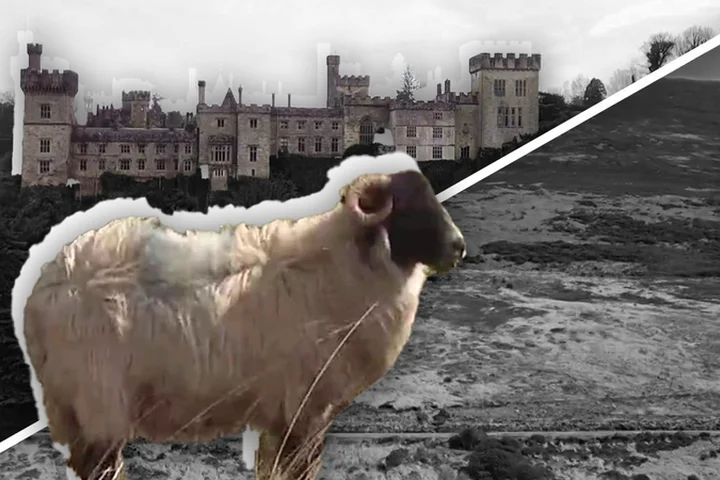
The Duke of Devonshire's Lismore Estates has written to sheep farmers on the Knockmealdown Mountains offering proposals to achieve a "swift resolution" to an increasingly high-profile rent dispute between the wealthy landlord and his tenants.
In a statement provided to Prime Time a spokesperson for the estate said, "Contrary to some recent references, there have been no conversations about evictions, only offers to reach a solution.
We look forward to resolving this issue promptly."
The rent row, first reported in the Sunday Independent last month, has been simmering over the last couple of years.
It began after Lismore Estates proposed to increase the rent by 900% by 2029 for hill farmers who use mountain commonage owned by the Duke to graze sheep.
The annual rent, which was €5 per hectare in 2023, has been raised fivefold to €25 and will be doubled further to €50 by 2029.
At least three of the sheep farmers are refusing to pay the increased rent, a stance that may then rule them out for government grants which demand proof of tenancy.
"The estate are looking to give us a 900% increase in rent, which is totally unviable for me to continue farming, it just won't pay me to get up and do it," said sheep farmer Michael Morrissey.
He told Prime Time that he is currently on a "rent strike."
In a letter dated April 4, the Duke of Devonshire’s son, William Burlington, wrote to farmers suggesting that they put forward "a collective proposal on rental increases from 2026 to 2030" or, alternatively, that they agree a "third-party expert to arbitrate a fair rent, on the understanding that all parties undertake to adhere to their findings."
Sheep farmer Thomas Ger Fitzgerald is refusing to pay the increased rent but is continuing to pay the old rent of €5 per hectare.
He told Prime Time on Thursday that instead of a proposal covering the period until 2030 he wanted "a long-term plan, a generational plan.
We can’t be back arguing every few years."
"I'm 63 years of age," Fitzgerald said.
"I'm not fighting for myself… I'm fighting for my son and my grandsons."
"We are here since the 1600s, our sheep have been on the hill since the 1600s," he added, "I'd love to think that we'll be here in 400 years’ time."
The dispute has become increasingly political because the commonage lands are part of an estate estimated at 8,000 acres that is owned by Peregrine Cavendish, the 12th Duke of Devonshire, who lives in England.
According to University of Limerick’s Dr Margaret O’Sullivan, the Duke’s family have owned land in the area around Lismore since the mid-1700s.
Then, Elizabeth Boyle, the only surviving daughter of the fourth Earl of Cork married William Cavendish the fourth earl of Devonshire.
Richard Boyle had acquired the land from Sir Walter Raleigh.
In a statement a spokesperson for the Duke Of Devonshire said that the rent increase was "guided by an independent agricultural consultant."
The spokesperson added that the rent increase was the first "for this group of grazing occupiers in the Knockmealdown Mountains since 2017." They also said that a rent of €50 per hectare is "considerably less than the market rent."
The proposed rent hike by 2030 may represent a 900% increase compared to 2023, but commonage experts told Prime Time that €50 per hectare is not excessive, especially at a time when higher State grants paid to encourage young farmers are driving rents up.
However, sheep farmers say €50 per hectare is substantially more than some others are currently paying to rent mountain commonage in the west Waterford area.
The "typical rent that I have heard from farmers is between €10 and €20 per hectare per year in a lot of the commonages around here in Waterford and South Tipperary," Michael Morrissey said.
Prime Time spoke to sheep farmers renting commonage from a different landlord who say they are paying less than €10 per hectare annually.
Farmers say that profits from sheep-farming - an occupation that is mostly reliant on subsidies - are already very low.
Michael Morrissey said that he makes about €8,000 or €9,000 profit from sheep farming in a year.
"In a bad year it would be less, in a good year, slightly more."
Beyond the issue of rent, the dispute has shone a spotlight on a hangover from the past - English landlords from colonial times maintaining huge property holdings in Ireland.
"There are other cases around Ireland where Anglo landowners still hold onto substantial portions of land," Dr O’Sullivan said.
"Many people may be surprised to learn that under the Land Acts, those landowners were entitled… to sell to the government and buy back portions of their estate.
So quite legitimately, they bought them back under the Land Acts."
The sheep farmer dispute was raised last month by Sinn Féin in Dáil Éireann.
Last Thursday, an organisation called the Terence MacSwiney Committee in London organised a protest at a bookshop owned by the Duke of Devonshire.
"The Duke's ancestors arrived back in Lismore in 1753," MacSwiney Committee Chairperson Frank Glynn told Prime Time.
"He still has a lot of acres.
He owns fishing rights from Lismore to Youghal as well.
In this day and age, it's outrageous.
As I grew up, I listened to stories from my grandmother and my father about landlords," he said, "I thought they were gone."
The Duke’s family, who rebuilt Lismore Castle - now a significant tourist attraction - have historically been seen in a different light to the stereotypical rack-renting landlord.
"They would have been reasonably well regarded around here, and they would have put a lot of investment into the area," said Dr O’Sullivan, who has extensively researched land-agent-tenant relationships.
"During the Great Famine, the Devonshires spent over £80,000, a phenomenal amount of money at the time, providing distress relief and permanent improvements in the area," she said.
Those improvements include the road through The Vee Pass between Waterford’s Lismore and Tipperary’s Clogheen.
Farmer Michael Morrisey says The Devonshires "were always easy to deal with," and "I always heard my father saying [that] they were always no problem dealing with them, but it's a different case now."
"It makes me sad," he added.
"Of course it makes me sad.
Why should I be the one to be hunted [from the commonage] after so many generations?
Of course it makes me sad."
In its statement, the Lismore estate said, "At Lismore, we take our role within the community very seriously.
We are a committed custodian, an employer and an active partner, with a spirit of mutual respect."
"We endeavour to support and contribute to a community that is welcoming and thriving for those who live here, those who work here and those who visit."
"The Knockmealdown farmers have been part of this community for generations; we respect that tradition and have always supported it."
Related Stories


Source: This article was originally published by RTÉ News
Read Full Original Article →
Comments (0)
No comments yet. Be the first to comment!
Leave a Comment