
Search author on: PubMed Google Scholar
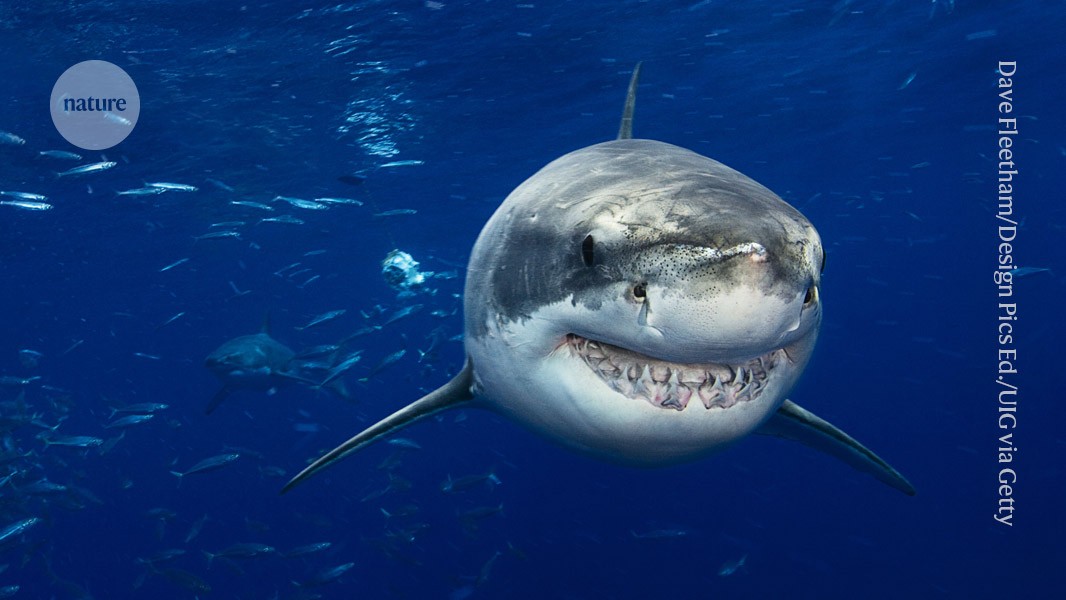
This great white shark ( Carcharodon carcharias ) is still a shark.
Credit: Dave Fleetham/Design Pics Editorial/UIG via Getty
In a 1981 magazine essay, the evolutionary biologist Stephen Jay Gould let readers in one of his field’s counter-intuitive truths.
Aquatic animals, including lungfish and coelacanths, are more closely related to tetrapods — four-limbed vertebrates — than to salmon, sticklebacks and many other things people call ‘fish’ — or, as Gould quipped, “there is surely no such thing as a fish”.
Sharks could be in a similar situation.
A genomic study of dozens of shark species and their close relatives suggests that the ocean’s top predators might also not be a natural biological group, contrary to what studies using more-limited genetic data have suggested.
The analysis, posted last month on the bioRxiv preprint server, finds that, when researchers look at some ‘ultra-conserved’ parts of the genome, a peculiar family of sharks called Hexanchiformes might be part of an evolutionary lineage that is distinct from the group that includes all other sharks, as well as skates and rays 1 .
The results, which haven’t been peer reviewed, suggest that most animals that people call sharks are more closely related to rays and skates than to hexanchiform shark species — just as Gould pointed out was the case for some species called fishes.
Biologists call such groups paraphyletic.
Whether a grouping of animals is paraphyletic or not doesn’t keep most scientists awake at night.
But accurate family trees , or phylogenies — including one for sharks — help researchers to chart the evolution of key traits.
“Having an accurate phylogeny is a way forward for understanding the processes that have shaped life,” says Gavin Naylor, an evolutionary biologist at the Florida Museum of Natural History in Gainesville.
Animals resembling modern sharks have existed for much of this time, says Naylor.
“These things have been around looking the way they look, or at least recognizable as sharks, for 330 million years.”
Yet researchers are unsure how the different members of Chondrichthyes — which is one of the major jawed-vertebrate groups — are related to one another.
Anatomical studies have concluded 2 that rays and skates, together known as batoids, were either distinct from all sharks, or members of a shark subgroup.
What were the first animals?
The fierce sponge–jelly battle that just won’t end
Studies of limited genetic data have also tended to class sharks and batoids as distinct evolutionary groups.
Increasingly, researchers are redrawing the animal tree of life using entire genomes — sometimes with bewildering and controversial conclusions .
But sharks have yet to receive such attention.
The protein-coding genes confirmed existing ‘monophyletic’ shark family trees, with rays and skates classed as distinct from all sharks.
The ultra-conserved sequences, however, suggested that sharks were paraphyletic: the hexanchiform sharks formed a lineage distinct from the one that gave rise to all other sharks, rays and skates.
Hexanchiformes, which include cow sharks and frilled sharks, have six or seven gill slits instead of the usual five, as well as primitive-looking jaws and eel-like bodies.
One implication of this tree is that flat-bodied animals, including manta rays, evolved from shark-like ancestors.
“This result implies that rays and skates are just another type of shark, and that the shark body plan came first,” says Brownstein.
He and Near favour the hypothesis that sharks are paraphyletic, in part because this tree was more strongly supported by their analysis than was a monophyletic one.
Sequencing more shark species and looking at other types of genetic marker might be needed to determine which of the two trees is correct.
Enjoying our latest content?
Log in or create an account to continue
doi: https://doi.org/10.1038/d41586-026-00594-w
Brownstein, C.
D.
& Near, T.
J.
Preprint at bioRxiv https://doi.org/10.64898/2026.02.13.705779 (2026).
Renz, A.
J.
et al.
PLoS ONE 8 , e66400 (2013).
Huang, J.
et al.
Preprint at bioRxiv https://doi.org/10.1101/2025.08.19.671162 (2025).
Gene conversion empowers natural selection in a clonal fish species
How an all-female fish species defies evolutionary expectations
Capturing dynamic phage–pathogen coevolution by clinical surveillance
Data from smart watches reveal early signs of insulin resistance
Youthful antics predict lifespan — at least for these fish
CeMM is recruiting two scientists to join as Starting Principal Investigators within a new research program on pain and aging/healthy.
Research Center for Molecular Medicine (CeMM), ÖAW
Profile the cellular components of tissue microenvironments (TME) in healthy and inflamed sites.
Dortmund, Nordrhein-Westfalen (DE)
Leibniz-Institut für Analytische Wissenschaften – ISAS – e.V.
Postdoctoral positions exploring microbiota–stem cell interactions in development, disease & cancer using gnotobiotic models, organoids & multi-omics.
The Chinese Institutes for Medical Research (CIMR), Beijing
Join Huazhong Agricultural University
No.1 Shizishan Street, Hongshan District, Wuhan, Hubei Province, China
Huazhong Agricultural University (HZAU)
SUSTech School of Medicine offers equal opportunities and welcome applicants from the world with all ethnic backgrounds.
Southern University of Science and Technology, School of Medicine
Related Stories



Source: This article was originally published by Nature News
Read Full Original Article →
Comments (0)
No comments yet. Be the first to comment!
Leave a Comment