
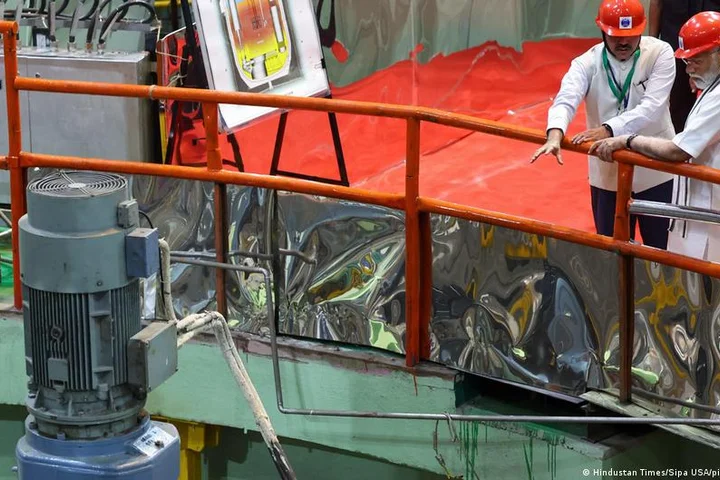
India is advancing its civil nuclear program with its Fast Breeder Reactor at Kalpakkam now able to self-sustain a nuclear chain reaction.
In other news, nine police officers have been sentenced to death.
DW has more.
The blog is now closed, but here is the wrap of the main headlines and latest developments from India on Tuesday, April 7
That's a wrap for our India blog for today.
We will return with headlines on Wednesday.
Meanwhile, we hope you have a lovely evening.
READ: Inside India's courts, AI's growing role sparks concern
The increasing use of artificial intelligence in courtrooms raises worries that the technology may aggravate bias and structural distortions in the legal system.
Read more on how AI is being used in India's courtrooms.
Manipur suspends internet after suspected bomb attack kills 2 children
Internet services were suspended on Tuesday in five districts of the restive northeastern state of Manipur amid protests and a security clampdown following the deaths of two children in a suspected bomb attack.
According to a government order, internet and mobile data services were temporarily suspended for the next three days in Imphal East, Imphal West, Thoubal, Kakching and Bishnupur districts.
Authorities said the move was necessary to maintain public order and curb the spread of misinformation.
The move comes after a five-month-old girl and her five-year old brother were killed while they were asleep after suspected militants attacked their house in Bishnupur district's Moirang around 1 am local time.
The mother of the children was wounded in the attack and is currently receiving treatment in the hospital, reports said.
Manipur has been a hotbed of ethnic violence between the majority Meitei and tribal Kuki communities.
Tuesday's attack triggered a public unrest.
Demonstrators set at least three trucks ablaze and blocked roads, ANI reported.
In one migrant colony in the Indian capital, some workers say they have gone days on an empty stomach.
Others say they are surviving on the most basic, uncooked food.
A political confrontation between Assam Chief Minister Himanta Biswa Sarma and senior Congress Party spokesperson Pawan Khera has intensified just a day before the northeastern Indian state goes to the polls on Thursday.
On Tuesday, Assam Police searched Khera’s residence in New Delhi following a first information report (FIR) filed by Sarma’s wife, Riniki Bhuyan, accusing the Congress leader of defamation and spreading false allegations.
"We have searched his house.
We can’t give more details," Debajit Nath, a deputy commissioner of Assam Police, told reporters.
Khera, who heads the Congress party’s Media and Publicity Department, had alleged at a press conference on Sunday that Bhuyan holds three foreign passports — from the United Arab Emirates, Egypt, and Antigua and Barbuda, a Caribbean island nation.
He also claimed that Sarma’s family has business interests worth 520 billion rupees ($5.6 billion, €5.16 billion).
Sarma, who quit the Congress party in 2015 to join the ruling Bharatiya Janata Party (BJP), has strongly denied the allegations.
He has stated that he will file a defamation case against Khera.
On Tuesday, Sarma accused the Congress leader of evading authorities.
"He ran away from Guwahati yesterday," Sarma was quoted by local media as saying at an election rally, referring to Assam’s largest city.
"I have come to know through the media that the police have gone to his residence in Delhi, but he has run away to Hyderabad.
The law will take its own course."
Jammu and Kashmir has lost nearly half of its lakes since 1967 — report
Nearly three-quarters of Jammu and Kashmir's lakes have either disappeared or shrunk, according to the Comptroller and Auditor General of India (CAG).
A new report on the Conservation and Management of Lakes, and covering the period up to March 2022, found that 518 out of 697 lakes — nearly 74% — have vanished or reduced in size.
The loss has contributed to ecosystem degradation, water scarcity, declining biodiversity, and disruption of natural carbon, nutrient, and water cycles, the audit said.
The Jammu and Kashmir region is famed for its numerous alpine and freshwater lakes that are a major tourist attraction.
According to CAG, 315 lakes — nearly half the total in Jammu and Kashmir — have disappeared since 1967, leading to a loss of 1,537 hectares of water surface over six decades.
A total 203 lakes have shrunk, losing a total of 1,314 hectares, the report said.
The audit warned that the shrinkage of lake area was also one of the causes for the deadly 2014 floods that ravaged the region.
"Lakes are natural flood balancing reservoirs/ defense for the flood regulating system.
Research conducted by scholars from various institutions at State/ UT and National level had also attributed causes of floods to change in land use of Lakes," the report said.
In Kashmir, lotus bloom on Wular Lake brings relief and hope
To view this video please enable JavaScript, and consider upgrading to a web browser that supports HTML5 video
Air India chief Campbell Wilson quits
The Chief Executive Officer and Managing director of Air India , Campbell Wilson, has resigned, the carrier announced on Tuesday.
A statement from Air India said that Wilson had conveyed his intention to step down in 2026 to the airline's Chairman N Chandrasekaran in 2024.
"Since then, [Wilson] has been working to ensure the organization and leadership team is on a stable footing for the transition," it added.
Air India said he will remain in the role until his successor is announced and takes over.
The statement further added that the Air India Board has formed a committee that will find the successor in the coming months.
"It has been a true honour to play a small part in this latest chapter of Air India’s long history, and I will continue to be an enthusiastic supporter of this wonderful organization and its people," Wilson was quoted as saying in the statement.
The airline was founded in 1932 as Tata Airlines by Indian business mogul JRD Tata.
In 1953, it was taken over and nationalized by the Indian government.
The airline returned to the Tata Group in January after being bought for nearly $2.4 billion (€2.07 billion).
In the same year, New Zealand-born Wilson was appointed to the leading position.
He was on a contract for five years but has tendered his resignation before the end of the term, news agency PTI reported earlier.
The CEO's exit comes as the airline faces mounting losses and an increased regulatory scrutiny following the 2025 fatal crash of its Boeing 787-8 Dreamliner which left 260 people dead.
The London-bound flight crashed shortly after take-off on June 12, killing all but one of the 242 people on board and 19 on the ground.
More questions than answers: Report on Air India 171 crash
Tamil Nadu court hands death penalty to nine policemen over father-son custodial deaths
A court in the southern state of Tamil Nadu has sentenced nine police officers to death over the custodial deaths of a trader and his son six years ago.
The Madurai District Court on Monday observed that the case falls under the "rarest of rare" category — the legal threshold under Indian law for awarding the death penalty.
The incident dates back to the COVID-19 pandemic in June 2020.
P Jeyaraj (58) and his son J Benicks (38) from the Thoothukudi district were arrested for allegedly keeping their mobile phone shop open beyond the permitted hours in violation of a coronavirus lockdown.
They were taken to the Sathankulam police station where they were subjected to physical assault, according to the court.
They were later remanded to judicial custody.
The two were subsequently admitted to a government hospital where Benicks succumbed to his injuries on June 22 while his father died a day later.
The incident triggered a nationwide outcry over police brutality and accountability.
The case was eventually probed by India's Central Bureau of Investigation (CBI).
A total of 10 policemen were arrested but one of them died during trial due to COVID-19 complications.
Over 100 witnesses were examined during the course of the trial that lasted five years.
The court on Monday observed that the case was a clear instance of abuse of authority.
The court said the father and son were "stripped and ruthlessly assaulted in front of each other as an act of vendetta," adding that "the heart shudders on reading about it."
India advances nuclear ambitions as Fast Breeder Reactor at Kalpakkam attains criticality
In a landmark achievement for its civil nuclear energy programme, India has announced that its most advanced domestically designed nuclear reactor has reached "criticality" — the point at which a reactor begins a controlled, self‑sustaining nuclear chain reaction.
The milestone involves the Prototype Fast Breeder Reactor (PFBR), a 500‑megawatt electric facility located at Kalpakkam, near the city of Chennai, in India’s southern state of Tamil Nadu.
The development — which was announced by Prime Minister Narendra Modi on Monday night — marks a crucial step towards full operation and generation of power.
It also advances the second stage of the country's three-step nuclear programme.
Modi described the milestone as a "defining" step in India's civil nuclear quest and a "proud moment" for the country.
"The indigenously designed and built Prototype Fast Breeder Reactor at Kalpakkam has attained criticality," Modi wrote on X.
"This advanced reactor, capable of producing more fuel than it consumes, reflects the depth of our scientific capability and the strength of our engineering enterprise," he said.
The prime minister added that it was a "decisive step" towards India harnessing its vast thorium reserves in the third stage of the programme.
Thorium is a potential fuel for nuclear reactors.
In 2024, Modi had taken a tour of the facility to witness the commencement of core loading.
India — the third-largest emitter of greenhouse gases — is on an ambitious journey to expand its nuclear power capacity from the current eight to 100 gigawatts by 2047.
Fast Breeder Reactors are significant because they can generate more fissile material than they use, making them valuable for countries seeking long‑term nuclear sustainability.
Once fully operational, India will only be the second country, after Russia, to have a commercial operating Fast Breeder Reactor.
Good morning!
This is Dharvi Vaid Dhulia from DW's studio in New Delhi, bringing you your daily capsule of news and events making headlines in India.
The capital has woken up to cloudy skies and the weather forecasts predict a light rainfall, thunderstorms and gusts of wind through the day.
Meanwhile, Air India — the country's flag carrier — has found itself in the middle of turbulence and it has nothing to do with the weather.
Reports claim that its CEO Campbell Wilson has resigned amid mounting losses and regulatory scrutiny.
In today's biggest news, India has marked a crucial moment in its nuclear energy program.
The domestically designed and built Prototype Fast Breeder Reactor (PFBR) in Tamil Nadu's Kalpakkam has attained criticality — the point at which a self-sustaining nuclear chain reaction starts.
India is now a step closer to producing its own nuclear fuel.
In another development from the state of Tamil Nadu, nine policemen have been sentenced to death over a 2020 custodial torture and killing of a father and son.
Why were the father and son in detention, you might ask?
For allegedly breaking COVID-19 lockdown rules.
We will look into these stories and more.
Stay with us as we unpack what India is talking about today.
Related Stories



Source: This article was originally published by Deutsche Welle (DW)
Read Full Original Article →
Comments (0)
No comments yet. Be the first to comment!
Leave a Comment