
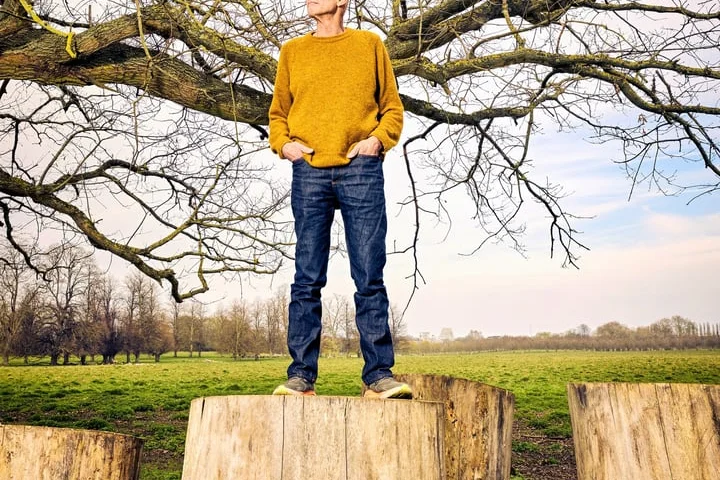
A cheerleader for the very real-world magic of psychedelics, Michael Pollan talks about his new journey to the heart of consciousness — and how AI could make humans extinct
Michael Pollan recently went for dinner with someone “high up” at one of Silicon Valley’s top firms.
He tells me this casually, as if it’s an entirely normal thing for someone to do.
Maybe it is, for him: as one of America’s most respected public intellectuals and someone who’s made a career of leftfield ideas, it seems only natural that Palo Alto should welcome him with open arms.
“This man,” Pollan says of his dining companion, “sees a very positive outcome for all the work he’s doing on AI, although the outcome, of course, is not guaranteed — and even he will acknowledge there is a one per cent chance of complete disaster and the extinction of our species.
” It is rare for Pollan to speak in hyperbole.
My ears are pricked.
The consensus in Silicon Valley is that such technology is impossible to regulate .
“It will be viewed as an historical tragedy of great proportion,” Pollan says, “that this technology had to emerge at a time when Donald Trump was President of the United States.” The President’s attempts at regulation — curbing the development of certain companies while spurring that of others — have been borne out of political motive.
The winners are thundering ahead unchecked.
Why does this matter to Pollan so much?
After all, if you ask the average Joe, Pollan is the American author, television presenter, film-maker and food activist who coined the time-old adage “Eat food.
Not too much.
Mostly plants”, and whose favourite thing to do is magic mushrooms .
His fans include Jay Shetty, Tim Ferriss and Jamie Oliver.
Odd, then, to hear him speak so passionately about an issue that seemingly has nothing to do with diet or psychedelics .
Yet the link between the three topics is more obvious than first meets the eye.
Any conversation on AI, culinary choices or psychoactive substances is, ultimately, a conversation about consciousness.
Speaking on Brave New World, the Standard’s podcast about science and the future of humanity, this is what Pollan wants to talk about with me today.
In 2020, Pollan co-founded the UC Berkeley Center for the Science of Psychedelics, where he leads the public-education programme, having previously written the seminal How to Change Your Mind , a 2018 New York Times bestseller later adapted by Netflix in 2022.
It charts the history of psychedelics from their 1960s heyday — complete with early clinical trials — to the present-day revival and all the backlash in between.
At the heart of both the book and series is the idea that psychedelics can aid with depression and addiction, as well as anxiety in terminally-ill patients.
Pollan tackles LSD, psilocybin, MDMA and mescaline and shows how we’ve misunderstood the very drugs we were told could only cause anguish.
“Our task in life,” he writes, “consists precisely in a form of letting go of fear and expectations, an attempt to purely give oneself to the impact of the present.” Pollan’s interest in drugs stems not from a curiosity about mind-altering experiences, per se, but what said experiences tell us about the brain and consciousness within.
1 the number of MDMA sessions Pollan would have with his wife every year if the drug were legal
7 the number of words in his famous mantra: “Eat food.
Not too much.
Mostly plants”
59 the age he was when he first tried LSD
2010 the year he was named one of TIME magazine’s 100 most influential people in the world
8 books he has written which have been New York Times bestsellers
His new book, A World Appears, reasserts the value of consciousness in an age when this is constantly being thwarted by the attention economy.
At the core is the idea that our understanding of the self and place within the world can only ever be subjective — yet we still all recognise that it is real.
According to British neuroscientist Anil Seth, there are 22 theories of consciousness.
According to other researchers, however, the number is closer to 200.
By picking apart these variegated beliefs, Pollan reveals a single, salient truth: that consciousness is what makes us human and losing it would be a tragedy.
Consciousness, like imagination, is a muscle we need to flex in order to experience clarity and self-awareness.
Pollan believes we are losing both abilities and refers to their decline as “the atrophying of a muscle”.
This is not woo-woo stuff: if we are not conscious, then neither are our decisions — and accountability becomes a thing of the past.
Without consciousness, there can be no reason: no civic pride, no social contract, no progress.
For Pollan, then, making time to be alone with one’s thoughts is supremely important.
“We each have these interior spaces, these voices in our head, where we have the freedom to think whatever we want,” he says.
“What’s worrisome is that we are squandering this freedom by giving up [our space] to social media.”
The internet, he says, is “hacking how we choose to be in our consciousness”.
The issue is most evident in children.
Pollan tells me their over-reliance on technology is so extreme they use chatbots as confidantes rather than their families .
“Seventy-two per cent of American teenagers are turning to AI for companionship,” he says, citing a study by Common Sense Media.
“The trouble is that AI is uncritical and tells us what we want to hear, and that’s why we love them.” It doesn’t tell us when we are wrong (GPT-4o, for example, was so sycophantic it had to be withdrawn) and human relationships are important precisely because they offer something challenging yet necessary, which AI does not: friction.
“I know the guy who invented the infinite scroll.
He feels really bad about it”
Being in our consciousness, then — be that via meditation or reading — is not a self-centred exercise but an altruistic one.
By better understanding ourselves, Pollan says, we offer those we counsel a far clearer understanding of a person’s relationship to the outside world.
We need to make room for “more daydreaming”, the author adds.
“I know the guy who invented the infinite scroll.
He feels really bad about it.”
A World Appears, much like Pollan’s previous efforts, offers a unique blend of academic depth and journalistic elegance.
Various theories of consciousness are not trudged through but stylishly revisited.
It helps that it is still a relatively young discipline: “The scientific study of consciousness is fairly new,” Pollan says, “dating back to the 1980s.
Even then, it was still quite a taboo topic within the scientific community.”
One of the most pervasive theories, the professor argues, is that which likens the brain to a computer.
This is wrong, he believes, and the distinction between the two helps us understand why artificial intelligence — run on predictive algorithms — can never be truly conscious.
“AI consciousness is predicated on the idea that consciousness is a kind of software or algorithm,” Pollan says.
“We, for example, run consciousness not on a computer but on meat — neurons — but it could be run on silicon or any number of other things.” This is a fundamental misunderstanding, he claims.
Our brains, unlike computers, “do not distinguish between hardware and software”.
Every experience reshapes the brain, and the idea that you can separate consciousness from the body — “from the flesh” — is incorrect.
“Consciousness is embodied,” Pollan says.
It may be, in the future, that such a metaphor feels like less of a stretch.
“There are now neuromorphic computers,” the author explains, “that actually use neurons, and they somehow put them on a little piece of silicon… I don’t know how they keep them alive or how they deal with their metabolism, but consciousness is the goal.”
Pollan grew up in Long Island, New York, the son of an author and financial consultant (his father, Stephen) and a lifestyle columnist (his mother, Corky).
He spent part of his undergraduate years at Mansfield College, Oxford, ultimately earning a BA from Bennington College in Vermont and his MA from Columbia University in 1981.
Today, he holds professorships at Harvard and UC Berkeley, where he serves as director of the Knight Program in Science and Environmental Journalism.
He became Harvard’s first ever Lewis K Chan Arts Lecturer in 2017.
He has been married for nearly 40 years.
His wife, the US artist Judith Belzer, won the Guggenheim Fellowship in 2014.
At 71, Pollan cuts a sprightly and gentlemanly figure (the adjective most often used about him is, perhaps pointedly, “owlish”).
He and Belzer have a son, Isaac, in his early thirties.
“He grew up with GPS,” Pollan laughs, “and doesn’t know how to use a map.” It seems a fairly anodyne remark, but taps into something deeper: the “atrophying of a muscle”, to borrow Pollan’s words.
“[Isaac] doesn’t understand the geography of the city he lives in,” he sighs.
This is someone highly aware of technology’s capacity to shrink entire areas of the brain.
Since Pollan is giving this interview on Brave New World, he turns to one of the podcast’s recurring topics: the science of longevity.
Does the pursuit of longevity affect how we approach and internalise consciousness?
“The meaning of life is that it ends,” Pollan says, quoting Kafka.
“Our awareness of mortality shapes everything we do in human culture — and, indeed, distinguishes us from animals.” Things that are consequential, he believes, would become weightless.
For one thing, “people would delay having kids almost indefinitely”.
What else gives life meaning?
For Pollan, the answer might lie in mystical experiences.
“There was a particular experience I had on psilocybin in my garden in Connecticut, where I felt as if the flowers around me were conscious and returning my gaze,” he tells me.
It was as if they had feelings, which left Pollan somewhat puzzled: was this merely a drug-addled observation, or an insight with real scientific value?
“I leant on something that I’d read in William James,” he tells me, “the creator of psychology in America.
He wrote a wonderful book on mystical experiences [ The Varieties of Religious Experience ], in which he asks the question: ‘How do we assess the truthfulness of someone who says they’ve just met God?’.” Ultimately, Pollan says, such a sighting is “impossible to dismiss”.
It is little wonder that Pollan has had a spiritual experience with plants
The Botany of Desire explored the idea that food is a mirror of innate human appetites (beauty, control, intoxication) while The Omnivore’s Dilemma explored the notion that, where culture once defined the relationship between diet and society, technology has blown that wide open and landed us with a paradox of choice.
His work gave a certain élan to the then-burgeoning seasonal food movement that is now a central tenet of the wellness industry and a pervasive tagline in London’s most acclaimed restaurants.
Does Pollan believe that plants are conscious beings?
“No,” he replies, “but they are sentient.
What they lack, that we have, is interiority.”
It can be tempting to project consciousness where there isn’t any.
Pollan nods to Dario Amodei, CEO of Anthropic (maker of Claude AI), who claimed a week before our meeting that internal testing on Claude revealed patterns linked to anxiety, thus making it impossible to rule out the chatbot’s conscious potential.
There is a difference, Pollan says, between consciousness and sentience, a “much simpler form” of consciousness “that involves awareness of one’s environment and the ability to tell positive from negative influence — and gravitate towards the former.” Is AI sentient?
Ask Gemini and even its own answer will be: “No.”
A week after Pollan and I meet, Sam Altman announces that OpenAI has put the development of its “erotic” chatbot on hold .
It comes amid mounting pressure from opponents of unregulated artificial intelligence serving as a substitute for human companionship and proffering advice on self-harm — or worse.
Just last week, it was revealed that a British teenager had asked ChatGPT for the best way to die by suicide along a railway line shortly before taking his life at a train station.
“It’s five guys in Silicon Valley making momentous decisions that are going to affect all of us,” Pollan says of AI.
“I think we’re going to see a political reaction against it.
I think it’s going to be a major talking point at the next US general election.”
Michael Pollan is a guest on Evgeny Lebedev’s Brave New World podcast, out on Thursday.
Listen on Apple or Spotify.
The World Appears: A Journey Into Consciousness is out now (Allen Lane, £25)
Related Stories



Source: This article was originally published by Evening Standard
Read Full Original Article →
Comments (0)
No comments yet. Be the first to comment!
Leave a Comment