
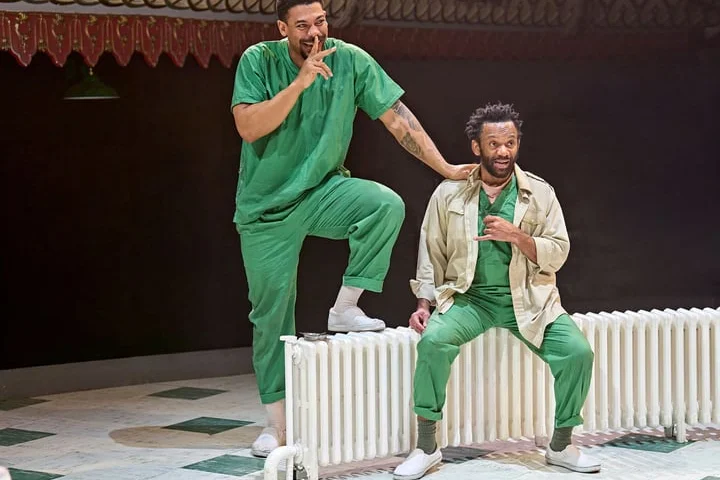
Fine performances from Aaron Pierre, Giles Terera and others illuminate Clint Dyer’s relentless revival of this iconic but problematic counter-cultural artefact.
A 1962 novel, 1963 play, 1975 film and an alluring star vehicle for an actor, One Flew Over the Cuckoo’s Nest uses a psychiatric ward as a metaphor for the controlling state.
Dyer has cast black actors as the patients – and the orderlies - to reflect the enduring fact that black men are far more likely to be committed to an institution, in both the UK and US, than whites.
It works.
Iphigenia review: A clumsy and unnecessary attempt to make Euripides relevant
Meet The Lion King's new leads: 'The Pride Rock prop is older than us!'
A Doll’s House at the Almeida: Romola Garai is wonderfully layered in Ibsen's tragedy
Discover a hidden island paradise in the Indian Ocean
But Dale Wasserman’s stage adaptation, like Ken Kesey’s book, draws a queasy equivalence between madness and liberation.
These inmates become footsoldiers of the 60s revolution, heroically throwing off the constricting bonds of sanity.
Since the forces of (white) authority are primarily vested in Olivia Williams’s autocratic, manipulative and sour Nurse Ratched, a nasty spine of misogyny runs through the story.
Williams stepped into the production late, after Michelle Gomez withdrew, though you wouldn’t know it from her focused, resolutely unsympathetic performance.
The narrative is framed as a battle of wills between Ratched and the charismatic and free-spirited Randle P.
McMurphy (Pierre), who is likely feigning insanity to escape harsher punishment at a prison work farm for battery, gambling and the statutory rape of a 15-year-old.
(The girl said she was 17, he leeringly protests.) Ratched keeps both her charges and the feckless Dr Spivey docile and compliant, exercising an iron will under a veneer of democracy.
The patients supposedly get to vote on ward policy but always toe the line – significantly, most of them are voluntarily incarcerated.
McMurphy, though, is an anarchic lord of misrule, who establishes regular card and basketball games on the ward, gets the rules governing TV access changed, and sexually taunts Ratched.
He coaxes the “half-Injun” Chief Bromden (Arthur Boan), who is apparently deaf and mute and has had 200 electric shock treatments, back to speech and macho “bigness”.
And he decides to get the stuttering, virginal Billy Bibbit (Kedar Williams-Stirling) laid, luring a pair of prostitutes into the ward for a riotous second-act party.
Even the fussy, professorial Dale Harding (Terera) – a closeted gay man, unbalanced because his wife is “well-endowed in the bosom department” – succumbs to McMurphy’s gravitational pull.
One can see the appeal for an actor of this grandstanding role.
Jack Nicholson won his first Oscar as a magnetic McMurphy in Milos Forman’s film, and Christian Slater followed in his acting idol’s footsteps in stagings of the play in Edinburgh and London in 2004 and 2006.
Pierre banishes any lingering memories of either – physically imposing and jacked, with a jumpily amused energy and a Mephistophelean beard.
He’s an electric force onstage.
There’s fine support from Terera, who recalls Groucho Marx in his wry, watchful detachment, and Williams-Stirling, tragically cowed as the mother-fixated Billy.
Boan does as well as he can with the impossible role of Bromden, a symbol of a lost, mythic masculinity and of the founding genocide of European settlement of America.
Dyer’s in-the-round production alludes pointedly to the latter, and to America’s legacy of slavery which the far right is currently attempting to whitewash.
It begins and ends with a contemporary, drum-driven dance set in New Orleans’ Congo Square, a historic gathering place for Native Americans and enslaved people.
An actor representing Bromden’s defeated dad totes a buffalo skull aloft; Terera sings the spiritual Nobody Knows the Trouble I’ve Seen; at one point a Civil War soldier pops up.
Good-time girl Candy (Daisy Lewis) wears 60s hotpants but also a T-shirt for AC/DC’s Highway to Hell (released 1979).
The narrative asides spoken by Bromden are accompanied by torrid representations of mental disturbance on a video screen.
The show is a full-on onslaught with little modulation, compelling but exhausting.
And throughout there’s the creeping awareness that Kesey and Wasserman partly romanticise mental illness and also use it for comic purposes.
Like I say: problematic.
Related Stories



Source: This article was originally published by Evening Standard
Read Full Original Article →
Comments (0)
No comments yet. Be the first to comment!
Leave a Comment