
Concepcion, a second-generation immigrant and a professor at nearby Syracuse University, was so moved by Hernandez’s generosity that he made the 45-minute drive to her store to pay his respects and spend some money.
A burly and gregarious 51-year-old who keeps his hair slicked back, Concepcion wore a black V-neck T-shirt and blue jeans as he perused the aisles filled with pan dulce, tomatillos, and prayer candles.
In front of a refrigerator case, he spotted an African American customer staring at packages of chorizo.
The man mistook Concepcion for an employee.
“I don’t know what any of this stuff is,” the customer said.
“But I saw the thing on Facebook, and I wanted to come in and help and support.”
Maria Hernandez inside her shop.
Before he started teaching multimedia storytelling at Syracuse’s prestigious Newhouse School of Public Communications, Concepcion had worked around the edges of the tech industry for two decades.
So he decided to develop a mobile app meant to teach immigrants how to exercise their constitutional rights when confronted by ICE.
Concepcion's wardrobe, full of identical shirts.
Then, in April, as ICE was ramping up enforcement operations from Maine to California, Concepcion got a panicked message from a chef at one of his favorite Latin restaurants.
The man’s adult son, whom I will call Gabriel, had been heading to a construction job in nearby Oswego when Border Patrol agents stopped his car.
A Mexican native, Gabriel had handed the agents his immigration paperwork, which showed that his asylum case was pending, but they were unmoved.
He was now being held at an overcrowded ICE detention center in Batavia, New York, midway between Buffalo and Rochester.
The distraught chef asked Concepcion, whom everyone at the restaurant called “El Profe,” for advice on how to free his son.
Concepcion loves playing the Good Samaritan for people who feel mugged by the system, so he threw himself into trying to liberate Gabriel.
He found an attorney willing to take the case for $4,000, then wrote to the judge on Syracuse University letterhead to vouch for Gabriel’s character.
After a few anxious weeks, Gabriel was released on $10,000 bail—a rare outcome in 2025, when such releases decreased by 87 percent compared to the year before—and Concepcion volunteered to make the two-hour drive to pick him up.
Concepcion overhauled his app to give it a more aggressive edge.
The new version gave anyone the ability to report ICE activity by dropping pins onto a map.
Users who were close to that pin’s coordinates would then receive a push alert containing detailed information, including photographs, about the agents’ locations and vehicles—information they could use to either organize flash protests or find safe haven.
He called this app DEICER.
When the time came to submit DEICER to Apple’s App Store, Concepcion’s anxiety spiked.
He worried that the government might bully Apple into handing over a list of accounts that had downloaded the app.
But he decided to press forward.
“ICE is looking for millions,” Concepcion stated in a video promoting DEICER’s official launch on July 28.
“What if millions were looking for ICE?”
With that, DEICER joined a small handful of other crowdsourced mapping tools, like ICEBlock and the Stop ICE text-alert network, that had started to emerge in response to the Trump administration’s mass-deportation campaign.
These resources were intended to chip away at ICE’s technological superiority over its motley throng of opponents.
With more than $77 billion to spend, ICE has amassed an array of Palantir-powered tools that can pinpoint human targets.
The resistance, by contrast, has had to rely on the ingenuity of independent operators like Concepcion, a man whose obsessive streak has since sent him colliding with trolls, hackers, right-wing media giants, and the second-richest company in the world.
Concepcion grew up in the South Bronx during the late 1970s and early 1980s, when the area was synonymous with urban blight.
His Puerto Rican father was a janitor who often scavenged for copper so he could treat his seven children to loaves of fresh bread.
His mother was a Mexican immigrant from Puebla.
A rotating cast of her supposed “uncles” and “cousins” crashed in the family’s apartment as they looked for off-the-books work.
Concepcion remembers being amazed that men who’d been engineers back in Mexico were happy to become dishwashers in the US.
A gifted student, Concepcion escaped the Bronx by attending a state university in Plattsburgh, a world away on the frigid shores of Lake Champlain.
He was intent on becoming an English teacher, but his plans changed after he discovered the internet.
He spent much of college toying with the text-based web browser Lynx and the VAX operating system.
That propelled him, after college, into fielding support calls for IBM, then overseeing software training for a German ecommerce company, and finally a long career writing a set of popular guides to Adobe Photoshop.
Concepcion also developed a deep affection for Syracuse, a Rust Belt city of 146,000 notorious for its heavy annual snowfall and its high child poverty rate.
He marveled at how some of Syracuse’s most decrepit neighborhoods were being revitalized by new arrivals from Syria, Burma, South Sudan.
(Between 2000 and 2014, the foreign-born population of Syracuse grew by more than 42 percent.) To bring some of that diversity onto campus, he served multiple terms as chair of the Newhouse School’s DEI committee.
And in 2023, he and his wife became foster parents, taking in a 14-year-old girl who’d been living in a house on Syracuse’s South Side, where drugs were rampant.
One of 13 siblings, the girl had been using one of the house’s closets as a bedroom; Concepcion’s wife, a former ballerina, first met her while teaching a dance class.
As he was putting the finishing touches on DEICER in the early summer of 2025, Concepcion received some bad news from the university.
Three weeks before the semester ended, he says, a dean informed him that a professorship they’d previously discussed was no longer available; he was, however, welcome to apply for a back-office position.
This decision came amid the university’s scramble to comply with the US Department of Education’s insistence that elite institutions rid themselves of all vestiges of DEI.
After DEICER was downloaded more than 3,000 times in the days following its App Store debut, Concepcion received a slew of emailed death threats—so many that he began to shop around for a bulletproof vest.
Syracuse’s student newspaper, meanwhile, published an op-ed calling DEICER a “revolutionary tool for immigrant communities” and airing Concepcion’s fears that he was being squeezed out of the university because of his politics.
Shortly thereafter, Concepcion was informed that he was no longer a candidate for the back-office job.
(A Syracuse spokesperson told me the university is “unable to comment on personnel matters” but that they “appreciate Rafael’s contributions to the Newhouse School and wish him the best in his future endeavors.”) Concepcion was now unemployed for the first time in years.
I initially connected with him shortly after this setback, and we soon began chatting in a series of lengthy phone calls.
On October 2, about two months after DEICER’s launch, the US Department of Justice contacted Apple to demand the removal of all apps that “put ICE agents at risk for doing their jobs.” The next day, Concepcion received an email from the corporation explaining that DEICER, which now had roughly 30,000 users, had been expelled from the App Store on the grounds that its “purpose is to provide location information about law enforcement officers that can be used to harm such officers individually or as a group.” In essence, Apple had declared that ICE agents were a protected class on par with members of a racial and ethnic minority, which meant they couldn’t be targeted with what the App Store’s guidelines describe as “defamatory, discriminatory, or mean-spirited content.” ICEBlock, which US attorney general Pam Bondi had singled out as worthy of criminal investigation, was booted from the App Store at the same time for the same reason.
Apple’s capitulation to the Justice Department revealed how much the company’s priorities had changed over the past decade.
In 2015 and 2016, Apple mounted a fierce legal resistance when the government, then panicked about the rise of ISIS-inspired terrorism, tried to mandate the insertion of security “backdoors” in iPhones.
Now the company appeared to prize warm relations with the Trump administration above all else—a necessary position, perhaps, given its desire to avoid ruinous tariffs and other forms of political retribution.
(Apple did not respond to a request for comment.)
Concepcion would prove harder to rattle than the tech giant.
To appeal the decision, he provided the App Store with a modified version of DEICER that he thought might neutralize its concerns.
Pins on the tweaked app no longer contained any specific information about ICE agents; they instead simply advised people to gather at the flagged locations to “exercise your First Amendment right to constitutional assembly.” The fix did nothing to mollify Apple, which rejected the appeal on the exact same grounds as before.
As he mulled DEICER's next move, Concepcion kept his core product available as a web-only app while ginning up a host of related projects.
He tried quickly creating hyperlocal versions of DEICER whenever federal agents surged into a new city; he built a bespoke web app for Chicago after ICE launched Operation Midway Blitz, and then one for Portland, Oregon, after President Trump dispatched hundreds of National Guardsmen to the two cities.
“It almost feels like I’m just trying to dress DEICER up in a chicken suit to try to get people to use it,” he told me.
“But I don’t really care as long as they use it.”
The chicken suits didn’t really work—in large part because they had no real local networks funneling people toward them.
That promised to change when Concepcion was hired to develop something similar for Siembra NC, a North Carolina immigrant-rights group he’d started talking to soon after DEICER’s release.
Siembra had been studying the emergence of ICE-monitoring tools since the spring, and the group had reservations about their messiness.
“Most of them are rumor mills,” says Andrew Willis Garcés, Siembra’s senior strategist.
“They give people the sense that they’re doing something, and it’s a way to channel anxiety, but they don’t actually help them get better at identifying the patterns, the tactics the administration’s using.
And so they contribute to a generalized anxiety that I think is part of Stephen Miller’s goal.
He would love it if there was maybe a thousand of these, and you couldn’t tell what was real.”
Siembra admired the design of DEICER and enlisted Concepcion to make a North Carolina–specific version called OJO Obrero (“Look out, workers”), which would allow for tips to be moderated.
The idea was for Siembra volunteers to verify user-submitted reports before allowing pins to be created.
This meant the site’s users couldn’t get real-time information about ICE agents’ movements, thus eliminating one of Concepcion’s main reasons for creating DEICER.
But Siembra felt a cautious approach was crucial to developing reliable intelligence about ICE’s enforcement patterns—for example, the times of day its agents are most likely to patrol certain highways and what kinds of vehicles they eye with suspicion.
OJO Obrero had abruptly gone live despite the fact that it was, in Concepcion’s estimation, nowhere near ready to handle a massive influx of traffic.
During the testing phase, he had been making around 3,000 database requests per day to the platform that provided OJO Obrero’s mapping capabilities.
As Charlotte’s Web became national news that day, the requests ballooned to an unmanageable 75 million, crashing the site and resulting in a $8,000 usage bill that Concepcion had to pay himself.
But Concepcion quickly worked out the technical kinks and managed to stabilize OJO Obrero.
Siembra assigned 30 of its most tech-savvy volunteers to vet the deluge of tips.
In a matter of days, the organization was able to get the word out about certain habits, such as federal agents’ affinity for pulling over white work vans.
“You could see day-to-day, OK, this is kind of the pattern that they’re doing yesterday, so probably today might look similar,” says Garcés.
“And so it really helped people think about how to stay safe.”
But Concepcion took little pleasure in OJO Obrero’s success.
He was becoming increasingly troubled by his social media feeds, now jammed with videos of wailing people being dragged into blacked-out SUVs.
Like millions of others, he found himself sucked into what he terms “the algorithmic rage loop.” And he was questioning how work like his could avoid playing into that dismal phenomenon.
Concepcion was accustomed to such skepticism.
In the months since he’d started tussling with Apple, he had come to believe that tools like DEICER were failing to make inroads with his target audience.
He worried they were instead being used by well-intentioned observers whose aim is to record videos of ICE abuses and disseminate them to communities already predisposed to loathing the Trump administration.
Concepcion believes this content is exhausting viewers, to the point that many will retreat from a fight that the algorithms portray as futile.
And so immigrants will keep vanishing, regardless of how many cameras capture their pain.
Concepcion’s proposed solution is for organizations that have spent years building trust within immigrant communities—like Siembra—to start evangelizing the likes of DEICER.
Crowdsourced monitoring tools, he insists, can give immigrants a 20-minute advance warning when ICE is en route.
(Concepcion has no qualms about the legality of such alerts, which he compares to the tips about police activity that are offered by Google Maps.)
But plenty of local groups have been bypassing the open internet altogether.
After lunch, Concepcion and I drove to visit Maria Hernandez, the store owner whose Facebook post had inspired DEICER’s creation.
She said she was still delivering groceries to people in hiding and that the local immigrants she knew weren’t using any sort of monitoring apps coded by outsiders; instead, they apprised one another of ICE’s movements in private WhatsApp groups.
On our way back to Syracuse that evening, Concepcion and I discussed his latest attempt to get DEICER back on the App Store.
This time, he had revamped it so that pins had to be imported from a separate platform, one that he planned to offer to nonprofit organizations that aid immigrants.
Concepcion fully expected this second appeal to be rejected, which is why he’d started talking to lawyers about filing a lawsuit.
But where the creator of ICEBlock had sued numerous Trump administration officials, Concepcion told me he wanted to sue Apple for $100 million.
He couldn’t express much of a legal rationale for such a suit—he only spoke vaguely of punishing Apple for betraying its old values.
“There should be a cost of selling out your consumers,” he said, adding that he intended to donate the money to the National Day Laborer Organizing Network.
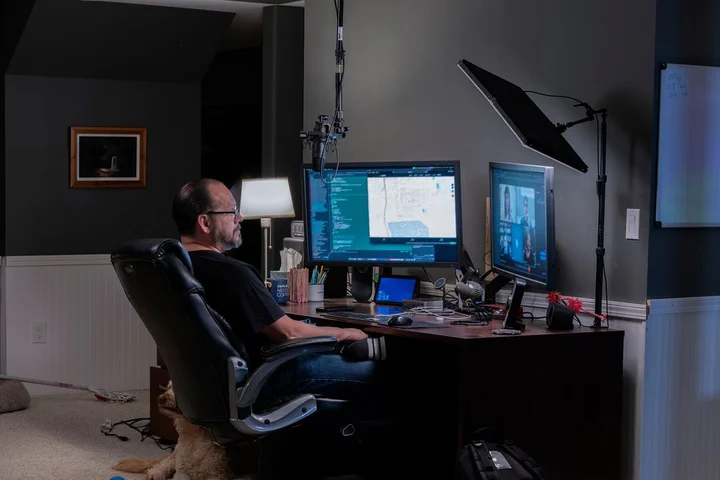
Concepcion's basement workstation.
Listening to this implausible scheme added to my growing sense that Concepcion was fraying around the edges.
Aside from dealing with his routine mental-health issues, he was now under tremendous financial pressure: unemployed, yet on the hook for upwards of $3,000 a month in AI subscriptions and hosting services.
“Last night I just laid down and cried,” he said to me during one vulnerable moment.
“I was like, fuck, this has been a tough thing, this whole not knowing what’s going to happen, not knowing where the next paycheck’s going to come from.”
People in Concepcion’s orbit know he tends to let his better angels blot out his common sense.
Curt Hedges, an executive at a health supplements company who befriended Concepcion years ago, once contributed a large sum to Concepcion’s charitable effort to purchase equipment for a group of Laotian photographers.
“He doesn’t have a moderate switch—it’s either all in or all out,” he says.
Yet Hedges has seen how Concepcion’s passions, however noble, can lead to personal problems, including massive credit-card debt.
And when he started getting 3 am texts from Concepcion about DEICER, Hedges began to worry.
“I’ve been hesitant to rescue him, because when you rescue him it just gets him another six months down further into that situation,” he told me.
“It isn’t as healthy as it should be.”
When ICE swarmed into Minneapolis this winter, its agents came equipped with all manner of sophisticated surveillance tools.
As first reported by 404 Media, for example, ICE was now deploying an app called ELITE that uses Medicaid and other confidential health data to identify potential detainees.
Agents were also increasing their reliance on Webloc, software that can track every cell phone within a multi-block radius.
But the city’s spirited resistance was not without its own technological resources.
In addition to Signal chats, many locals embraced People Over Papers, a crowdsourced mapping tool at IceOut.org that has a lot in common with DEICER.
The site teemed with scores of eyewitness reports about suspected ICE agents staking out schools, chatting with local cops, and eating in taquerias.
I reached out to Concepcion in mid-January to get his take on the situation in Minneapolis and to ask about his continued back-and-forth with Apple—I knew he was now preparing his third appeal of DEICER’s expulsion from the App Store.
But when we connected, he said he had a much more pressing concern on his mind.
On the morning of January 9, ICE had arrested Gabriel’s father.
According to Concepcion, Gabriel’s father had been driving with his wife to the restaurant when they were stopped.
Concepcion said the agents commended the couple on being cooperative, then gave them an agonizing choice: One of them would have to submit to arrest, while the other could go free.
Gabriel’s father volunteered to take the fall and had subsequently been transported to Batavia, the same detention center where his son had spent a few terrible weeks in April.
Concepcion dropped everything to once more provide material assistance to Gabriel’s family.
He arranged a meeting with a lawyer, who noted that bail was highly unlikely given the current environment; he instead recommended filing a habeas petition, a legal maneuver that could take many months to be processed.
(Since January 2025, more than 30,000 people in immigration detention have filed habeas petitions.) Concepcion also drove to Batavia to visit Gabriel’s father, who was in poor health due to the facility’s conditions.
Sections of the center are so underheated during winter that detainees have nicknamed them Las Hieleras—the Iceboxes.
Finally, on January 29, out of the blue, Concepcion received a WhatsApp message.
It was from Gabriel’s father: “Ya estoy en México,” he wrote.
Unable to tolerate Batavia any longer, he had volunteered to be deported.
(Gabriel is still waiting for his next court date to be set; WIRED has obscured his personal information to safeguard the integrity of his legal process.)
As he neared the finish line with those projects, however, yet another catastrophe struck.
On the morning of February 2, Concepcion awoke to discover that all of his anti-ICE coding projects had been hacked.
People who’d registered to use DEICER, which had largely been dormant since November, were sent ominous push alerts.
“Your information has been compromised and sent to the FBI, HSI, and ICE,” the text read.
“RC is a terrible coder.” (Concepcion claims he didn’t store users’ personal data.) One of the alleged attackers posted on X that they had acted to prevent the doxing of federal agents.
Concepcion with his Goldendoodle, Dixie.
Though Concepcion managed to get his sites back online, including the beta version of his Massachusetts app, he was clearly shaken by the hack and its aftermath—an unease that only intensified in early March when US Customs and Border Protection revoked his Global Entry status without explanation.
He sought solace from his mother, who now lives in Florida.
Fearing for her son’s safety after seeing a news story about the hack, she advised him to step away from the immigration fight and become a waiter or dishwasher instead.
But the act of trying to counter ICE has become so central to Concepcion’s sense of self that he seems intent on sticking with his work.
“I told her, ‘Of course I’m afraid.
This is problematic, and it would be so much easier if bills were paid and I didn’t have to worry about things,’” he says.
“There’s just something telling me to try something else, and I can’t explain it.
If I’m completely honest, I don’t want to explain it.
I just want to keep going.”
What Say You?
Let us know what you think about this article in the comments below.
Alternatively, you can submit a letter to the editor at [email protected] .
Related Stories



Source: This article was originally published by Wired
Read Full Original Article →
Comments (0)
No comments yet. Be the first to comment!
Leave a Comment