
Orban’s failing election campaign has been backed by US president Donald Trump and vice president JD Vance
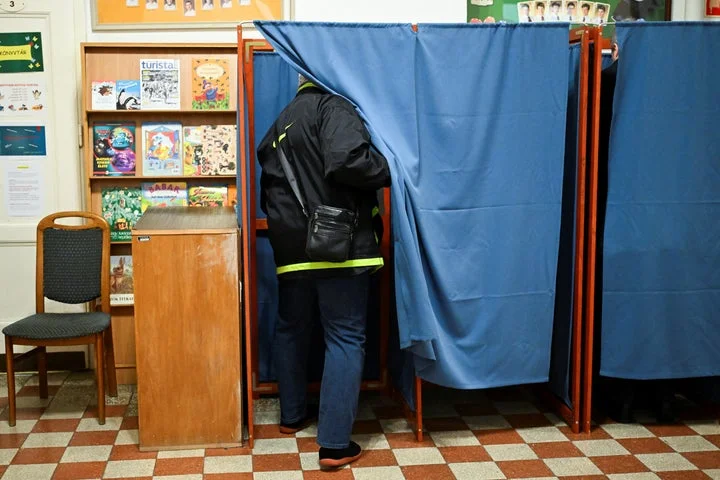
Voters in Hungary will head to the polls on Sunday as nationalist prime minister Viktor Orban faces the toughest opposition of his 16-year tenure.
Opinion polls suggest that Orban and his nationalist Fidesz party will lose power to the centre-right, pro-European Union Tisza party, led by former party loyalist Peter Magyar.
US Vice president JD Vance took time out of a busy schedule amid a fragile ceasefire with Iran to assist Orban with his election campaign, saying the European leader “stands up for the values of western civilisation”.
Orban, a staunch ally of Russian president Vladimir Putin , has drawn widespread criticism across Europe for his support for the invasion of Ukraine .
He previously shrugged off Russian drone incursions into Nato airspace, saying: “So what?” and declared: “Ukraine is not an independent country.”
Polling stations open on Sunday at 6 a.m.
(0400 GMT) and close at 7 p.m.
(1700 GMT).
The results should become clear by late Sunday evening.
Orbán's rural base is still behind the Hungarian leader
István Vároczi, a 63-year-old entrepreneur from the small Hungarian city of Cegléd, says he doesn't believe the polls that show prime minister Viktor Orbán could lose a pivotal election on Sunday.
After 16 years in power and four straight election victories, Mr Orbán is facing an unprecedented challenge from a centre-right opponent — Péter Magyar of the Tisza party — who has sought to whittle away at Mr Orbán's rural support base with months of relentless touring in the countryside.
While most polls show that many Hungarians have abandoned Mr Orbán and his Fidesz party and plan to vote for change, the long-serving prime minister remains deeply popular among large parts of Hungarian society — particularly among older voters and those in the smallest settlements.
You can read the full report below:
Hungarians 'write history' in election that Tisza will win, opposition leader says
Hungarians will write history at an election on Sunday when they choose "between East and West" and the opposition Tisza party will win the vote, party leader Peter Magyar told reporters after casting his vote at a Budapest polling station.
Mr Magyar said that every vote counts in the parliamentary election that could bring record turnout.
He also urged people to report any irregularities they encounter during the voting, adding that "election fraud is a very serious crime".
As polls open in Hungary, Viktor Orban is facing losing his grip on power after 16 years.
The 62-year-old first broke out in Hungarian politics in 1988 as a founding member of the anticommunist Federation of Young Democrats (Fidesz).
He later went on to lead the party, and became prime minister for the first time in 1998.
He was ousted in 2002, but later returned as leader of Fidesz.
After the party won an overwhelming majority in the April 2010 elections, Mr Orban returned to power and pushed through a new constitution with conservative moral and religious themes.
He is now known for his staunch anti-immigration stance and ties to Russia’s Vladimir Putin.
He has continually refused to aid Ukraine in its war with Russia.
'I am here to win,' says Hungary's Orban after voting in election
Hungarian prime minister Viktor Orban said he was "here to win" after casting his vote in the country's parliamentary election at a polling station in Budapest this morning.
What did the polls say in the run up to today's election?
Hungary's centre-right Tisza party leads prime minister Viktor Orban's ruling Fidesz ahead of Sunday's parliamentary election, a poll published by newspaper Nepszava showed on Friday.
Nationalist Orban faces the biggest challenge to his rule in 16 years, although the large number of undecided voters means the outcome of the election is uncertain.
Tisza, led by former government insider Peter Magyar, had the support of 52 per cent of decided voters, while 39 per cent backed Fidesz, the poll conducted by Publicus Institute showed.
The survey, which had a sample size of 1,000, showed 38 per cent support for Tisza among all voters, with Fidesz backed by 29 per cent.
Some 25 per cent of respondents said they had not decided how they would vote.
A poll on Thursday also showed Tisza in front, with 50 per cent of decided voters backing the centre-right party, while 37 per cent backed Fidesz, the poll by Idea Institute showed.
The survey, which had a sample size of 1,500, showed 39 per cent support for Tisza among all voters, with Fidesz backed by 30 per cent.
Some 21 per cent of respondents said they had not decided how they would vote.
In pictures: Polls open across Hungary in pivotal election
Analysis | Potential defeat for Orban may be more symbolic than substantial
Even if Peter Magyar does win, those hoping for sharp policy differences with Orban may be disappointed.
He is less militant about it, but Magyar supports Orban’s stance of no more help for Ukraine and ending the war as soon as possible.
It is not at all clear that he would lift Hungary’s block on the EU’s proposed €90bn aid package for Kyiv.
He is, as any elected Hungarian leader would have to be, opposed to most immigration.
Nor should it be underestimated how far Orban’s outspokenness on these issues has provided a shelter for other EU members who may think, even if they don’t speak, the same way.
Slovakia is aligned with Hungary, as, increasingly, is Czechia; Belgium has been forceful in advocating talks with Moscow; and the prospect of fast-tracked EU membership for Ukraine is strongly opposed by Poland.
A new government in Hungary will not move the political dial in the EU so very much.
It could perhaps be argued that the defeat of Viktor Orban, if that is what happens on Sunday, will be more symbolic than substantial .
But symbolism matters in a vote that has been seen for months as pitting EU cohesion and European values against an increasingly autocratic state with a direct line to Moscow, and now Washington.
For everyone’s sake, it is hoped that the election produces a clear result one way or the other, in which accusations of EU blackmail, US pressure or Russian bots take a remote second place to the clearly expressed will of the voters.
The last thing Hungary, or Europe, needs is for the arguments about outside influence that have so sullied the campaign to rage on after it has ended.
Viktor Orban faces pivotal election after 16 years
Read all you need to know in just five bullet points:
Viktor Victor Orban faces pivotal election after 16 years
Polls open in crucial Hungarian election - all the key timings
The polls have now opened in Hungary, where it has just turned 6am.
The polls will remain open for 13 hours before closing at 7pm local time (6pm BST).
Early results are expected to start coming in within one or two hours of this point.
But some votes could take longer to count, with the count likely to take up to four days for ballots cast abroad.
However, by Sunday night, we should have almost the full picture, with up to 95 per cent of the vote expected to have been counted.
Stay with us throughout the day as we bring you live coverage of what could be a momentous day for European politics.
Peter Magyar led the polls – but critics fear potential for vote manipulation
Polls will open early on Sunday morning, with preliminary results expected to start appearing from around 8pm.
Most voters will cast one vote for a candidate in their constituency and another for a nationwide party list.
Around 95 per cent of both votes are expected to be processed on election night.
The National Election Office will also have to aggregate ballots cast from abroad, meaning in a tight race it could be another week before there is a definitive outcome.
The polls suggest a lead for Peter Magyar, whose party had the support of 52 per cent of decided voters going into the election, according to a poll conducted by the Publicus Institute.
Some 39 per cent of decided voters backed Orbán’s Fidesz.
Still, the election is far from a closed contest.
Around one in five voters are undecided, and historical gerrymandering and a high proportion of ethnic Hungarians supportive of Fidesz casting their vote in neighbouring countries could cause an upset.
Critics have also warned of the potential for vote manipulation.
Join thought-provoking conversations, follow other Independent readers and see their replies
Related Stories


Source: This article was originally published by The Independent
Read Full Original Article →
Comments (0)
No comments yet. Be the first to comment!
Leave a Comment