
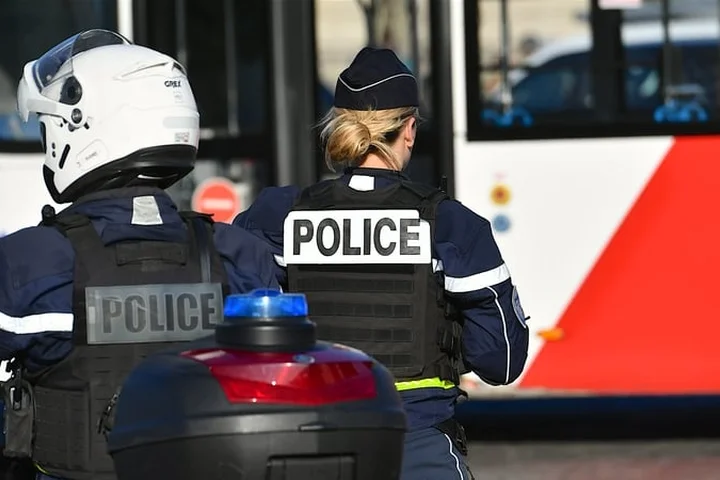
The incident occurred around 3.30am local time (1.30am Irish time) in front of a Bank of America building in the chic 8th arrondissement, a couple of streets from the Champs-Elysees.
Police grabbed the man just after he placed a device, made of five litres of liquid, believed to be fuel, and an ignition system, one of the sources said.
After his arrest, the suspect claimed to both a minor and a Senegalese citizen, according to a police source, who cautioned that the authorities were still verifying his identity.
He was accompanied by a second person, who took flight when officers arrived to arrest the pair.
The ignition component had 650 grams of explosive powder in it, according to an initial assessment.
The whole device was taken to the Paris police's forensics lab for full analysis.
Prosecutors at France's counter-terrorism office told AFP they had immediately taken over the investigation, and confirmed the suspect was in police custody.
It said the probe it had launched was into "attempted damage by fire or other dangerous means in connection with a terrorist undertaking" and a "terrorist criminal conspiracy".
Both the Paris judicial police and France's domestic intelligence service, the General Directorate for Internal Security (DGSI), were involved in the investigation, the office told AFP.
Recruited via Snapchat for €600
According to a police source, the suspect said he had been recruited via the Snapchat app to carry out the bombing in exchange for the sum of €600.
When the patrolling officers arrested him, he was about to ignite the device with a lighter.
A separate police source told AFP that while he was placing the charge, the accomplice stepped back, apparently to take a photo or video of the crime with his mobile phone.
A spokesperson for Bank of America, whose US headquarters is in Charlotte, North Carolina, told AFP they were aware of the situation and were in communication with the French authorities.
France's Interior Minister, Laurent Nunez, on X hailed the speedy action by the police officers, given "the current international situation".
Speaking later to news channel BFMTV, he said he thought the war in the Middle East might have motivated the attack.
"I make a link between the actions carried out in neighbouring countries" and claimed by "small groups that referred to the conflict," he said.
Earlier this month, Dutch officials said they thought four youths arrested on suspicion of detonating an explosive device outside a Rotterdam synagogue might have been recruited by Iran.
And in Britain, a little-known group aligned with Iran claimed responsibility for a London arson attack last week on four volunteer ambulances run by a Jewish organisation.
Since the outbreak of the war of the Middle East, European countries have been on high alert for potential attacks on Iranian dissidents, Jewish places of worship and US-Israeli assets.
Related Stories

Source: This article was originally published by RTÉ News
Read Full Original Article →
Comments (0)
No comments yet. Be the first to comment!
Leave a Comment