
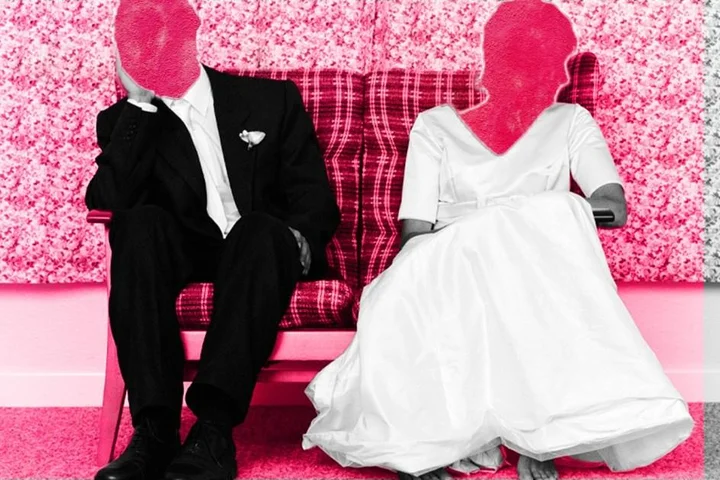
‘It never felt like a goal in my life to get married, like it has been for other people,’ says Hannah James*, 35, from Somerset.
Like 42% of married couples, Hannah’s parents divorced when she was three years old, though the custody battle over her and her siblings, plus fierce debate over their surnames, continued until she was six.
‘Dad was very controlling – of mum, my older siblings, and he had started to be that way with me,’ Hannah tells Metro.
‘My mum chose the divorce.’
Though Hannah spent her teens and twenties uninterested in marriage, something shifted when she met her partner seven years ago.
Now, they’re planning their 2027 wedding.
‘We’re creating our own traditions – for example, we will both be changing our surnames to a new name chosen together,’ she says.
Research suggests adults with divorced parents tend to have more negative attitudes towards marriage and are less optimistic about long-lasting, healthy relationships, but views can change over time.
TV and radio star Jamie Laing recently told Metro he once saw ‘divorce as an option’ before marrying wife Sophie Habboo and having a child.
In an intimate interview, Sophie revealed Jamie used to flippantly say ‘I’m going to divorce you’ during arguments, but that idea ‘doesn’t even cross your mind’ after welcoming son Ziggy in December 2025.
‘My parents got divorced.
When you come from a divorced family, you sort of – this sounds dark – you look at divorce as an option,’ Jamie explained.
‘Family to me is everything now.’
Sex.
Love.
Modern Mess.
Listen to new Metro podcast Just Between Us
X Factor icon Diana Vickers and writer, broadcaster, and LGBTQ+ advocate Jack Guinness dive into your wildest sex, love, and dating dilemmas – every Tuesday.
Listen wherever you get your podcasts or watch on YouTube.
And be sure to follow and subscribe so you never miss an episode.
Psychotherapist and author Lucy Beresford says this theme comes up frequently with clients, often in two distinct ways.
‘If you have divorced parents, you could think that marriages never work, they never last.
People say “I’ve seen it from the inside, I don’t ever want to go through that myself,”’ she says.
‘But actually, what a lot of people say is, “I want to do it differently.
I want to show my partner the love that my father or my mother never showed them.”
‘It almost becomes a goal that they set themselves: “I won’t get divorced.”’
The second mindset resonates with Ashleigh, 36 from Suffolk, who says she ‘longed for marriage’ after her parents’ acrimonious split.
‘I guess I saw it as stability, even though it was “a thing” in my parents’ case,’ she says.
When she was 13, her mum discovered her dad was having an affair, which turned out to be his third instance of infidelity.
‘It was such a vulnerable age that shapes your views of relationships and it shattered mine for a very long time,’ she says.
‘I think I wanted so badly to get married so I could prove to myself I could break the mould.’
Like Jamie and Hannah, it took meeting her partner and slowly building trust over time to shift her mindset.
‘Before, I was scared every partner would leave me,’ she says.
‘The irony is I’m now 36 with a baby and not married, and I’m okay with it.
‘It’s a cliché but the older I get, the more confident I am in my own skin and can see I don’t need a status symbol to feel successful in life.’
According to Lucy, divorce can affect people at any age – how it’s handled matters more.
‘Some children, no matter how old they might be, are often used as pawns in a particularly acrimonious divorce,’ she says.
‘And that can be very damaging down the line.’
Annie, 45, from North London felt the full impact of her parents’ divorce, though it happened when she was in her early twenties.
‘Dad was hard work and constantly critical of Mum and she ended up running off with a family friend who was in a similarly unhappy marriage,’ she explains.
‘I had encouraged Mum to leave for years, but because she did it the messy way, our relationship broke down for a few years.
It was a huge shock.’
Despite the turmoil, she felt impatient to walk down the aisle herself.
‘I know this sounds a bit sad, but I became fixated on getting married as I desperately wanted a happy reason for them to be in the same room, with their ‘new’ partners and be one big dysfunctional family,’ she admits.
‘I had a relationship that felt like it could be that, but he’d been divorced and was really anti-marriage and I think that was a bit of a wedge between us.’
Nearly two decades on, her parents still haven’t been in the same room, but Annie has repaired her relationship with her mother.
‘We are really close now, it took me a long time to realise how she didn’t see leaving as an option until she was in that affair situation,’ she says.
For those who feel their parents’ divorce still affects them in adulthood, Lucy has one key piece of advice: stop blaming your parents and assess your own baggage.
‘For example, a classic belief that people have as a result of divorce is “I’m not lovable.
If I had been lovable, my parents would have stayed together.
I would have been able to fix them.” And if you go into your future relationships into adulthood with that limiting belief, it’s not so much that the parents’ divorce is impacting you negatively, it’s your beliefs about yourself.
Therefore, it’s very important to try and separate the two.’
Therapy can help you to do that, but Lucy acknowledges it’s not affordable or accessible to everyone, so without a guide to help you, ‘just pay attention to where the limiting belief is coming from.’
And of course, divorce doesn’t always have a negative impact.
In some cases, it’s the best outcome for everyone involved.
‘There is a school of thought that divorce can actually be handled very well, and that actually the worst thing is to grow up in a marriage that is clearly unhappy, where the parents are shouting at each other, where perhaps one is abusive or has had infidelity, and the children have to live with that every single day,’ says Lucy.
‘Then they end up having therapy with someone like me, and they often say, “I wish my parents had got divorced.”
‘The idea that divorce is the worst thing that can happen to your child is actually no longer the watertight theory that it used to be.’
*Names have been changed.
Related Stories


Source: This article was originally published by Metro UK
Read Full Original Article →
Comments (0)
No comments yet. Be the first to comment!
Leave a Comment