
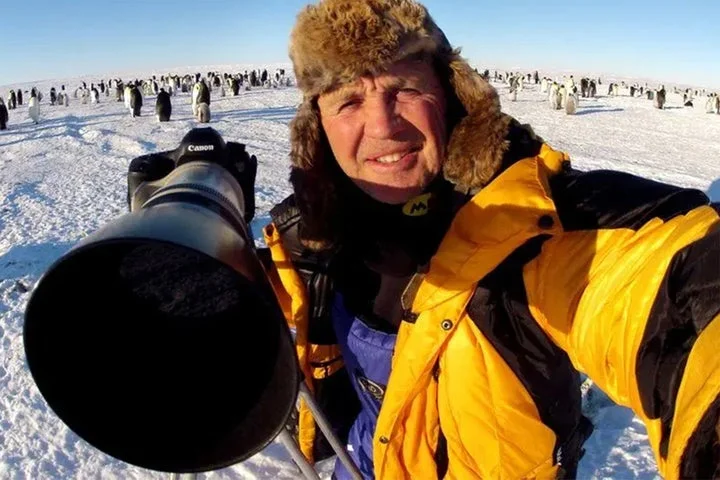
Doug Allan collaborated closely with Sir David Attenborough during his career
Renowned wildlife cameraman Doug Allan, who worked on iconic BBC series including Planet Earth , Frozen Planet and The Blue Planet , has died at the age of 74 while trekking in Nepal.
Often collaborating closely with Sir David Attenborough, Allan was widely celebrated as a “true pioneer” of wildlife filmmaking.
He won multiple Bafta and Emmy awards, and in 2024 he was appointed an OBE for his significant contributions to broadcast media and environmental awareness.
His management company, Jo Sarsby Management, confirmed his death, noting he died “immersed in nature and surrounded by friends”.
“A true pioneer of wildlife film-making, Doug captured some of the most breathtaking and intimate moments in the natural world,” the statement said.
“Doug leaves behind a visual legacy that few could ever match.
His work brought audiences closer to the wonders of our planet, inspiring awe, understanding and deep respect for the planet."
The statement concluded by remembering his “unforgettable kindness and his extraordinary talent”, adding: “It has been an honour and a privilege to represent Doug as his agent and to know him as a friend for over 30 years.
He was a true gentleman and he will be profoundly missed.
“Our thoughts are with his family, friends, colleagues across the wildlife film-making industry and the many people around the world who admired his work.”
Originally from Dunfermline in Fife, Allan’s connection with the natural world began with a marine biology degree from Stirling University in 1973.
His interest in filming wildlife blossomed during his tenure as a research diver at the British Antarctic Survey station on the Antarctic Signy Island in 1976.
He once recounted how a serendipitous encounter with Sir David Attenborough ultimately set him on his path to becoming a celebrated wildlife cameraman.
“When I graduated (from Stirling University) I came out and did various jobs to do with diving, went to the Red Sea to work with some biologists, worked for a year with Bill Abernethy, who was Scotland’s last full-time professional pearl fisherman,” Allan explained in a previous interview.
“Then I went to the Antarctic and that’s when I as a diver discovered photography.”
Describing the moment he decided to pursue wildlife filmmaking, he recalled: “It was a chance meeting with David Attenborough, of all people, in 1981.
He turned up in our base with a small film crew.
“I helped him for a couple of days and quite literally at the end of those two days I looked at the cameraman and thought, ‘You know, you are doing all the things I like doing’.”
He added: “The next trip to the Antarctic I bought a 16mm movie camera and in the wonderful naiveness of youth I went and did some filming of emperor penguins and sold the footage to BBC when I went back.
That’s where it all started.”
Join thought-provoking conversations, follow other Independent readers and see their replies
Related Stories

Source: This article was originally published by The Independent
Read Full Original Article →
Comments (0)
No comments yet. Be the first to comment!
Leave a Comment