
Nature ( 2026 ) Cite this article
Globally, as many as 12 million girls marry before the age of 18 every year; in northern Nigeria, 80% of girls marry before 18 (refs.
1 , 2 ).
Although such marriages may be deemed the best available option by many girls and parents, numerous studies suggest that, when delayed marriage is made possible, it benefits educational attainment, improves health by reducing maternal mortality and morbidity, and leads to many other benefits to girls’ lives 3 , 4 , 5 , 6 , 7 , 8 .
Despite this, little is known about what reduces child marriage, and successful interventions tend to have an impact of just a few percentage points.
We use a paired cluster-randomized trial in 18 communities to rigorously evaluate a locally tailored big-push intervention called Pathways to Choice in northern Nigeria.
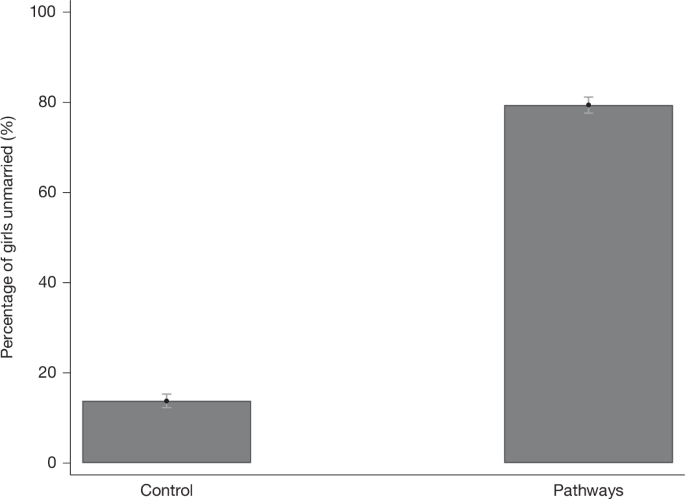
We show that Pathways decreases rates of marriage among adolescent girls from 86% in the control group to only 21% in the treatment group—just over an 80% decrease.
Although a key part of Pathways’ effect is a significant increase in girls re-enrolling in school, education alone cannot explain its effects on child marriage.
We argue that Pathways’ whole-community focus reduces the likelihood of social backlash and contributes meaningfully to its success.
Our results demonstrate that a big push can significantly alter entrenched, normative behaviour around child marriage, and that bundled interventions may be greater than the sum of their parts.
This is a preview of subscription content, access via your institution
Access Nature and 54 other Nature Portfolio journals
Get Nature+, our best-value online-access subscription
Receive 51 print issues and online access
Prices may be subject to local taxes which are calculated during checkout
Fig.
1: Rates of remaining unmarried among adolescent girls measured two years after programme start.
Fig.
2: Effects of the Pathways programme on educational, social and attitudinal outcomes measured two years after programme start.
Fig.
3: Heterogeneity by community and family factors.
Fig.
4: Pathways effects relative to other evaluations.
Exploring the impact of perceived early marriage on women’s education and employment in Bangladesh through a mixed-methods study
Adolescent marriage, maternity, and limited access to education in 106 countries: Bayesian analysis of prevalence, trend, and prediction
Child marriage practice in the eyes of evangelical church leader and elders in the Wonisho district of the Sidama region, Southern Ethiopia
The de-identified datasets corresponding to this study are available in the Harvard Dataverse at https://doi.org/10.7910/DVN/899DIN .
All analysis for this paper was conducted using StataSE 18.
Replication files and de-identified data are available via the Harvard Dataverse at https://doi.org/10.7910/DVN/899DIN .
Asadullah, M.
N.
& Wahhaj, Z.
Early marriage, social networks and the transmission of norms.
Economica 86 , 801–831 (2018).
Field, E.
& Ambrus, A.
Early marriage, age of menarche, and female schooling attainment in Bangladesh.
J.
Political Econ.
116 , 881–930 (2008).
Hicks, J.
& Hicks, D.
L.
Lucky late bloomers?
Consequences of delayed marriage for women in rural western Kenya.
Preprint at SSRN https://doi.org/10.2139/ssrn.2622189 (2019).
We the Children: End-Decade Review of the Follow-Up to the World Summit for Children (United Nations, 2001).
Parsons, J.
et al.
Economic impacts of child marriage: a review of the literature.
Rev.
Faith Intl Affairs 13 , 12–22 (2015).
Schaffnit, S.
B., Wamoyi, J., Urassa, M., Dardoumpa, M.
& Lawson, D.
W.
When marriage is the best available option: perceptions of opportunity and risk in female adolescence in Tanzania.
Glob.
Publ.
Health 16 , 1820–1833 (2021).
Obstetric Fistula Needs Assessment Report: Findings From Nine African Countries (Engender Health, 2003).
Raj, A.
When the mother is a child: the impact of child marriage on the health and human rights of girls.
Arch.
Dis.
Child.
95 , 931–935 (2010).
Chari, A.
V., Heath, R., Maertens, A.
& Fatima, F.
The causal effect of maternal age at marriage on child wellbeing: evidence from India.
J.
Dev.
Econ.
127 , 42–55 (2017).
Sekhri, S.
& Debnath, S.
Intergenerational consequences of early age marriages of girls: effect on children’s human capital.
J.
Dev.
Stud.
50 , 1670–1686 (2014).
Buchmann, N., Field, E., Glennerster, R., Nazneen, S.
& Wan, X.
Y.
A signal to end child marriage: theory and experimental evidence from Bangladesh.
Am.
Econ.
Rev.
113 , 2645–2688 (2023).
Aloud, M.
E., Al-Rashood, S., Ganguli, I.
& Zafar, B.
Information and Social Norms: Experimental Evidence on the Labor Market Aspirations of Saudi Women Working Paper 26693 (NBER, 2020).
Archambault, C.
S.
Ethnographic empathy and the social context of rights: “rescuing” Maasai girls from early marriage.
Am.
Anthropol.
113 , 632–643 (2011).
Schaffnit, S.
B., Hassan, A., Urassa, M.
& Lawson, D.
W.
Parent–offspring conflict unlikely to explain ‘child marriage’ in northwestern Tanzania.
Nat.
Hum.
Behav.
3 , 346–353 (2019).
Jain, S.
& Kurz, K.
New Insights on Preventing Child Marriage: A Global Analysis of Factors and Programs (USAID, 2007).
Mathur, S., Greene, M.
& Malhotra, A.
Too Young to Wed: The Lives, Rights, and Health of Young Married Girls (ICRW, 2003).
Rosentein-Rodan, P.
N.
Problems of industrialization of Eastern and South-Eastern Europe.
Econ.
J.
53 , 202–211 (1942).
Murphy, K.
M., Shleifer, A.
& Vishny, R.
W.
Industrialization and the big push.
J.
Political Econ.
97 , 1003–1026 (1989).
Banerjee, A.
et al.
A multifaceted program causes lasting progress for the very poor: evidence from six countries.
Science 348 , 1260799 (2015).
Banerjee, A., Duflo, E.
& Sharma, G.
Long-term effects of targeting the ultra poor program.
Am.
Econ.
Rev.
Insights 3 , 471–486 (2021).
Banerjee, A., Karlan, D., Osei, R., Trachtman, H.
& Udry, C.
Unpacking a multi-faceted program to build sustainable income for the very poor.
J.
Dev.
Econ.
155 , 102781 (2022).
Perlman, D., Adamu, F.
& Wodon, Q.
Understanding and Ending Child Marriage: Insights from Hausa Communities (Centre for Girls Education, 2017).
Northern Nigeria Initiative: Results of the Early Grade Reading Assessment (EGRA) in Hausa (RTI International, 2011).
Nigeria Demographic and Health Survey 2018 NGIR7BFL.DTA (National Population Commission and ICF, 2019); https://www.dhsprogram.com/pubs/pdf/FR359/FR359.pdf .
Perlman, D.
et al.
in Women’s Empowerment and Global Health: A Twenty-First Century Agenda (eds Dworkin, S.
et al.) Ch.
3 (Univ.
California Press, 2016).
Bhuwania, P., Huh, K.
& Heymann, J.
Impact of tuition-free education policy on child marriage and early childbearing: does secondary matter more?
Popul.
Dev.
Rev.
49 , 43–70 (2023).
Addaney, M.
& Azubike, O.-O.
Education as a contrivance to ending child marriage in Africa: perspectives from Nigeria and Uganda.
Amst.
Law Forum 9 , 110 (2017).
Acharya, A., Blackwell, M.
& Sen, M.
Explaining causal findings without bias: detecting and assessing direct effects.
Am.
Pol.
Sci.
Rev.
110 , 512–529 (2016).
Caeyers, B.
& Fafchamps, M.
Exclusion bias in the estimation of peer effects.
J.
Hum.
Resour.
https://doi.org/10.3368/jhr.1120-11337R2 (2020).
Collin, M.
& Talbot, T.
Are age-of-marriage laws enforced?
Evidence from developing countries.
J.
Dev.
Econ.
160 , 102950 (2023).
Greene, M.
E., Siddiqi, M.
& Abularrage, T.
F.
Systematic scoping review of interventions to prevent and respond to child marriage across Africa: progress, gaps and priorities.
BMJ Open 13 , e061315 (2023).
Article PubMed PubMed Central Google Scholar
Baird, S., McIntosh, C.
& Ozler, B.
Cash or condition?
Evidence from a cash transfer experiment.
Quart.
J.
Econ.
126 , 1709–1753 (2011).
Duflo, E., Dupas, P.
& Kremer, M.
Education, HIV and early fertility: experimental evidence from Kenya.
Am.
Econ.
Rev.
105 , 2757–2797 (2015).
Ashraf, N., Bau, N., Low, C.
& McGinn, K.
Negotiating a better future: how interpersonal skills facilitate intergenerational investment.
Quart.
J.
Econ.
135 , 1095–1151 (2020).
Bandiera, O.
et al.
Women’s empowerment in action: evidence from a randomized control trial in Africa.
Am.
Econ.
J.
Appl.
Econ.
12 , 210–259 (2020).
Buehren, N., Goldstein, M., Gulesci, S., Sulaiman, M.
& Yam, V.
Evaluation of an Adolescent Development Program for Girls in Tanzania (World Bank, 2017).
Field, E., Glennerster, R., Buchmann, N.
& Murphy, K.
Cost–Benefit Analysis of Strategies to Reduce Child Marriage in Bangladesh (Copenhagen Consensus Center, 2016).
Jensen, R.
Do labor market opportunities affect young women’s work and family decisions?
Experimental evidence from India.
Quart.
J.
Econ.
127 , 753–792 (2012).
Angrist, J., Bettinger, E., Bloom, E., King, E.
& Kremer, M.
Vouchers for private schooling in Colombia: evidence from a randomized natural experiment.
Am.
Econ.
Rev.
92 , 1535–1558 (2002).
Anderson, M.
Multiple inference and gender differences in the effects of early intervention: a reevaluation of the Abecedarian, Perry Preschool, and Early Training Projects.
J.
Am.
Stat.
Assoc.
103 , 1481–1495 (2008).
Article MathSciNet CAS Google Scholar
Zimet, G.
D., Dahlem, N.
W., Zimet, S.
G.
& Farley, G.
K.
The multidimensional scale of perceived social support.
J.
Pers.
Assess.
52 , 30–41 (1988).
Waszak, C., Severy, L.
J., Kafifi, L.
& Badawi, I.
Fertility behavior and psychological stress: the mediating influence of gender norm beliefs among Egyptian women.
Psychol.
Women Q.
25 , 197–208 (2001).
Bruhn, M.
& McKenzie, D.
In Pursuit of balance: randomization in practice in development field experiments.
Am.
Econ.
J.
Appl.
Econ.
1 , 200–232 (2009).
Abadie, A., Athey, S., Imbens, G.
W.
& Wooldridge, J.
M.
When should you adjust standard errors for clustering?
Q.
J.
Econ.
138 , 1–35 (2023).
Cameron, A.
C., Gelbach, J.
B.
& Miller, D.
L.
Bootstrap-based improvements for inference with clustered errors.
Rev.
Econ.
Stat.
90 , 414–427 (2008).
Roodman, D., Nielsen, M.
Ø., MacKinnon, J.
G.
& Webb, M.
D.
Fast and wild: bootstrap inference in stata using boottest.
Stata 19 , 4–60 (2019).
Athey, S.
& Imbens, G.
in Handbook of Economic Field Experiments (eds Duflo, E.
& Banerjee, A.) 73–140 (Elsevier, 2017).
Benjamini, Y., Krieger, A.
M.
& Yekutieli, D.
Adaptive linear step-up procedures that control the false discovery rate.
Biometrika 93 , 491–507 (2006).
Article MathSciNet Google Scholar
Anderson, M.
L.
Stata code to compute “sharpened” False Discovery Rate (FDR) adjusted q-values.
berkeley.edu https://anderson.are.berkeley.edu/downloads/fdr_sharpened_qvalues.do.zip (2025).
Montenegro, C.
E.
& Patrinos, H.
A.
Comparable Estimates of Returns to Schooling Around the World (World Bank Group, 2014).
We thank all of those who provided invaluable feedback and guidance on this paper, including seminar audiences at Northwest Development Workshop, the Pacific Conference for Development Economics, the Center for Studies of African Economies, Advances with Field Experiments, the New England Universities Development Consortium, the California Polytechnic State University and Brown University.
We also thank E.
Field, A.
Griffith, J.
Kerwin, E.
Nix, R.
Thornton, E.
Riley, A.
Voena, R.
Pande, M.
Lowe and many others for their helpful comments and suggestions.
We gratefully acknowledge the work of the Centre for Girls Education in Abuja, Nigeria and funding from the Ford Foundation, the MacArthur Foundation, and the Center for Studies in Demography and Ecology at the University of Washington.
We also gratefully acknowledge OASIS ( www.oasissahel.org ; formerly L’Initiative OASIS in partnership with the University of California, Berkeley) for providing both financial support and technical assistance in the implementation and learning process of the Pathways to Choice programme evaluated in this research.
We thank J.
Wang and F.
Santamarina for excellent research assistance.
This paper has previously circulated under the title ‘Pathways to Choice: Delaying Marriage and Increasing Education via Safe Spaces’.
The views presented are our own, and do not necessarily represent the views of any organization.
All errors are our own.
University of Washington, Seattle, WA, USA
Centre for Girls Education, Abuja, Nigeria
Bixby Center for Population, Health and Sustainability, University of California, Berkeley, Berkeley, CA, USA
Search author on: PubMed Google Scholar
I.C.
was responsible for data cleaning and analysis, and wrote the majority of the paper.
M.A.
implemented the Pathways programme at the Centre for Girls Education, provided essential background information and helped to clarify issues that arose during data cleaning and analysis.
M.A.
was not otherwise directly involved in the design, analysis or writing of the paper, and she (and the Centre for Girls Education more broadly) reviewed but did not influence the findings.
D.P.
spearheaded the design of the Pathways programme, and wrote the paper, which drew on his experience with girls’ programming and his knowledge of northern Nigeria.
He was otherwise not directly involved in the data analysis.
Correspondence to Isabelle Cohen .
I.C.
declares no competing interests.
M.A.
is an employee of the Centre for Girls Education.
D.P.
has consulted for the Centre for Girls Education and served as its first director until 2016.
Nature thanks Paula González, Margaret E.
Greene and the other, anonymous, reviewer(s) for their contribution to the peer review of this work.
Publisher’s note Springer Nature remains neutral with regard to jurisdictional claims in published maps and institutional affiliations.
Extended data figures and tables
The Theory of Change of the Pathways to Choice Programme as described by the Centre for Girls’ Education.
Extended Data Fig.
2 Assessing Enumerator Demand.
Extended Data Fig.
3 Treatment Effects by Age.
This figure presents rates of remaining unmarried among adolescent girls measured two years after programme start.
Girls are pooled by baseline age within treatment and control communities.
The analysis includes the 1,051 girls who answered questions on marital status during the study endline and reported being between ages 11 and 16 at baseline; it excludes five girls who reported being age 17 at baseline.
Data are presented as mean +/− s.e.m.
Extended Data Table 1 Effect of Pathways on Marital Status Full size table
Extended Data Table 2 Effects on Educational, Social and Attitudinal Outcomes Full size table
Extended Data Table 3 Effects on Younger Siblings’ Schooling Full size table
Extended Data Table 4 Balance Table Full size table
Extended Data Table 5 Marital Status Prediction by Imbalanced Covariates Full size table
Extended Data Table 6 Effect Heterogeneity on Marital Status Full size table
Extended Data Table 7 Mediated Effects of Pathways Full size table
Extended Data Table 8 Effects by Community Heterogeneity Full size table
Supplementary Information (download PDF )
Supplementary Fig.
1 and Tables 1 and 2.
Reporting Summary (download PDF )
Springer Nature or its licensor (e.g.
a society or other partner) holds exclusive rights to this article under a publishing agreement with the author(s) or other rightsholder(s); author self-archiving of the accepted manuscript version of this article is solely governed by the terms of such publishing agreement and applicable law.
Version of record : 11 March 2026
DOI : https://doi.org/10.1038/s41586-026-10206-2
Related Stories



Source: This article was originally published by Nature News
Read Full Original Article →
Comments (0)
No comments yet. Be the first to comment!
Leave a Comment