
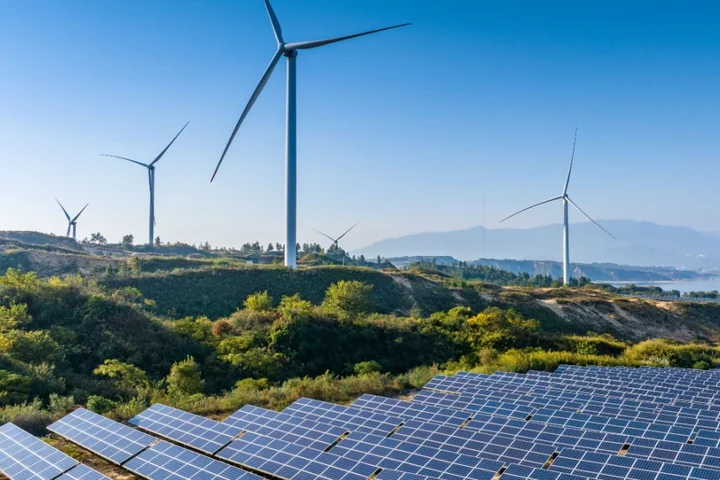
Cool, but fossil-fuel additions and AI-era power demand still muddy the climate math
It was a strong year for renewable power expansion in 2025, with solar installations helping push renewables to nearly half of global electricity capacity, but that does not mean the world is yet on pace to meet its renewable energy commitments.
The International Renewable Energy Agency's (IRENA) 2026 Renewable Capacity Statistics report , published on Wednesday, found that renewables dominated new power additions last year, accounting for 85.6 percent of global capacity expansion.
Solar, in turn, was the dominant renewable technology, accounting for nearly three-quarters of last year's renewable capacity additions.
Those additions totaled 692 GW in 2025, lifting installed renewable capacity by a record 15.5 percent year over year, IRENA noted.
By the end of last year, renewables accounted for 49.4 percent of global installed electricity capacity, while variable renewable sources such as solar and wind represented roughly 35 percent of total capacity.
For reference, it was only in 2023 that renewable energy sources crossed the threshold of generating 30 percent of the world's electricity.
As IRENA notes in a press release , renewable energy is back in the spotlight amid the US conflict in Iran causing a spike in fuel prices and energy (i.e., oil) instability.
According to IRENA Director General Francesco La Camera, conflicts like the Iranian mess are a perfect reason to push for more renewable adoption.
Accelerating adoption is all well and good, but IRENA itself still isn't convinced last year's gains will be enough: Yes, the overall trend in renewable deployment shows renewables outpacing fossil fuel expansion, but not entirely.
"At the global level, 2025 also saw a sharp rebound in non-renewable additions, which nearly doubled compared to 2024," IRENA noted.
China led that drive, with 100 GW of non-renewable capacity added last year, most of which was coal.
If you've been watching the datacenter and AI space, it's no surprise that non-renewable energy projects have been popular.
Natural gas energy projects nearly tripled in the US last year, putting America ahead of China when it comes to total gas power projects, while coal has been seeing a resurgence too.
In both cases, you can thank AI datacenter projects for much of that growth, along with the US government's policy of promoting AI development over sustainability .
World leaders pledged at COP28 in 2023 to triple installed renewable energy capacity to more than 11 TW by 2030.
As of the end of 2025, the world is at 5.15 TW of renewables; along with the push to expand fossil fuels in recent years, IRENA is worried that goal won't be reached.
"Significant acceleration will be required to meet the goal adopted at COP28 to triple installed renewable power capacity to more than 11 TW by 2030," the agency concluded.
®
Related Stories


Source: This article was originally published by The Register
Read Full Original Article →
Comments (0)
No comments yet. Be the first to comment!
Leave a Comment