
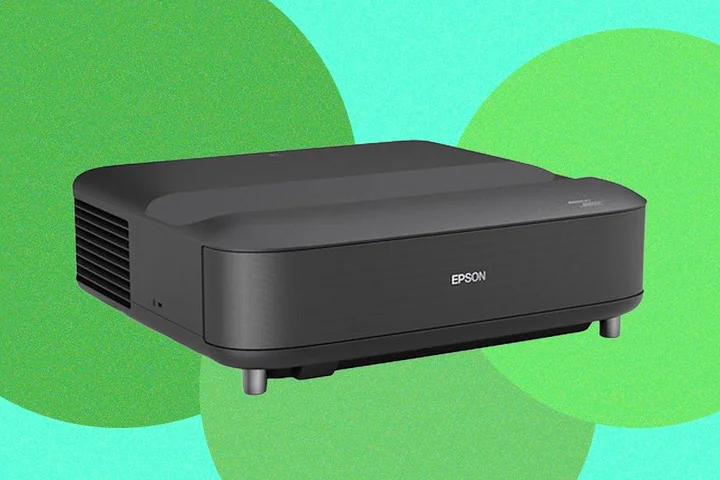
Ultrashort-throw (UST) projectors offer more flexibility than traditional (long-throw) models.
No one can ever step in front of one and block the projection, since the unit doesn’t require distance and can sit up close to the screen rather than at the back of the room.
This also lets all your streaming gear, a soundbar, and a game console connect close to the screen.
At $3,800, the Epson Lifestudio Grand Plus (LS970) short-throw projector has a higher price tag than the Epson Lifestudio Grand released last year.
The Grand Plus specs are a big leap forward over that model as well: a 150-inch image instead of 120 inches, and 4,000 lumens of brightness instead of 3,600.
I won’t mince words: The setup process is confusing.
The Grand Plus is big, heavy, and fussy about where you place it—usually about a foot away from the wall or screen.
I had to experiment with the placement until it was just right, and even then, the image setup is cumbersome and time-consuming.
In comparison, the Leica Cine Play 1 and the Soundcore Nebula P1 auto-keystoning software instantly adjust the picture with virtually no manual setup—turn it on, and you’re done.
The Grand Plus’ software feels outdated, and I also didn’t like how easy it was to bump the power button on the side and turn it off.
I first set up the projector in my family room with a flat white wall, since that is where I keep most of my audio gear.
The Grand Plus kept trying to correct itself for slight variations on the wall, to no avail.
The test pattern still looked wavy, even after doing a hard reset and starting over.
Only when I moved the projector to my windowless testing room with a professional screen did it finally auto-adjust both the keystoning and size correctly.
(Epson reps told me this is not normal, but my final view is that the Grand Plus works best with a projector screen.)
The Grand Plus can sit only about an inch (for an 80-inch image) or about 11.2 inches (for a 150-inch image) away from the wall.
I had to compromise a little since my projector screen is 120 inches, but I was still able to test the unit at a 150-inch image size against a white wall (even with the keystoning issue).
While the Grand Plus’ picture is bright, clear, and vibrant at all of these projection sizes, the Epson Pro Cinema LS9000’s colors are slightly more vivid.
That’s because the LS9000 has a better optical lens and a separate processor (the ZX) to handle dynamic contrast.
In fact, the LS9000 has an aperture with a 2 to 3 f-stop, whereas the Grand Plus' is f/1.8; this allows for a clearer focus across the whole image and darker blacks, based on my testing.
When I tested the LS9000, I found better contrast and focus across the entire image.
The Leica Cine Play 1’s blues and purples popped more in games, movies, and shows, although the Grand Plus is brighter and clearer.
The Grand Plus has three HDMI ports, one of which supports eARC for a soundbar or AV receiver.
I found the ports a little hard to access, tucked away on the corner of the unit, and since the projector sits on the floor, it can be hard to bend down and connect the cables.
The Grand Plus remote reminds me of an Amazon Fire TV remote.
There are four dedicated buttons at the bottom (for YouTube, Netflix, Amazon Prime, and free television channels).
The layout is logical: The back button is on the lower left, and the volume buttons are easy to find on the right.
Epson even has dedicated brightness buttons for quick adjustments.
The remote is not backlit, and pairing only works within 3 to 4 feet from the unit.
I was eager to start testing movies and shows once the Grand Plus was up and running.
I streamed an entire movie called Sirāt using the Hulu app on my iPad.
The apocalyptic road film looked hyperrealistic at 120 inches, with deep reds and browns; the characters' sun-creased faces had a pronounced texture thanks to the high dynamic contrast ratio.
I used the projector’s filmmaker mode for a more cinematic look, which made the deep blacks and reds appear even richer.
I also streamed the boxing movie Christy via the HBO Max app.
After some initial frustrations getting the projector to accept the streaming cast, everything worked fine.
Once the movie started playing, there were no hiccups, like stuttering or pausing.
Skin tones looked particularly realistic thanks to the high brightness and contrast, but not so much that the actors look washed out.
Overall, the colors looked incredibly vibrant, but not quite as impressive as the Leica Cine Play 1.
Next, I suffered through the entire survival thriller Thrash on Netflix to test surround sound using the Grand Plus’ built-in soundbar.
Dolby Atmos worked perfectly, and during several dark scenes, I could see the action thanks to the exceptional contrast ratio.
Blacks had variance, tone, and even depth.
The built-in soundbar in the Grand Plus is a nice bonus, offering 20 watts of power.
While the surround sound during Thrash was not nearly as convincing as the Focal Muso Hekla soundbar I tested recently, it’s certainly thunderous.
For music playback, the song “Bovine Excision” by Samia sounded fine but didn’t quite shake the sheetrock in my living room enough for my tastes, compared to a more capable speaker like the Cambridge Audio Evo One .
I’m still playing through the main campaign of Crimson Desert , my current go-to game for testing graphics and refresh rates.
On the Grand Plus, I connected a gaming laptop at 120 Hz, and the gameplay looked smooth and realistic, but not quite as vibrant as the Epson LS9000.
Still, at this massive size, you feel transported into the game world.
During a forest scene, you can see individual leaves shaking in the wind—something that is less obvious on a 65-inch TV.
Switching over to the sci-fi game Pragmata , I came to appreciate another Grand Plus spec.
The Epson Grand Plus shines when connected to a computer at 4K resolution.
My Windows desktop ran at 4K as well, and Pragmata looked crystal clear even at 120 inches.
During one dark battle scene, I could see all of the action clearly, and the main character looked massive on my test screen.
Other than the outdated setup process and a few glitches, I found the Epson Lifestudio Grand Plus to be a highly capable projector, with Google Gemini support as a handy bonus.
Related Stories



Source: This article was originally published by Wired
Read Full Original Article →
Comments (0)
No comments yet. Be the first to comment!
Leave a Comment