
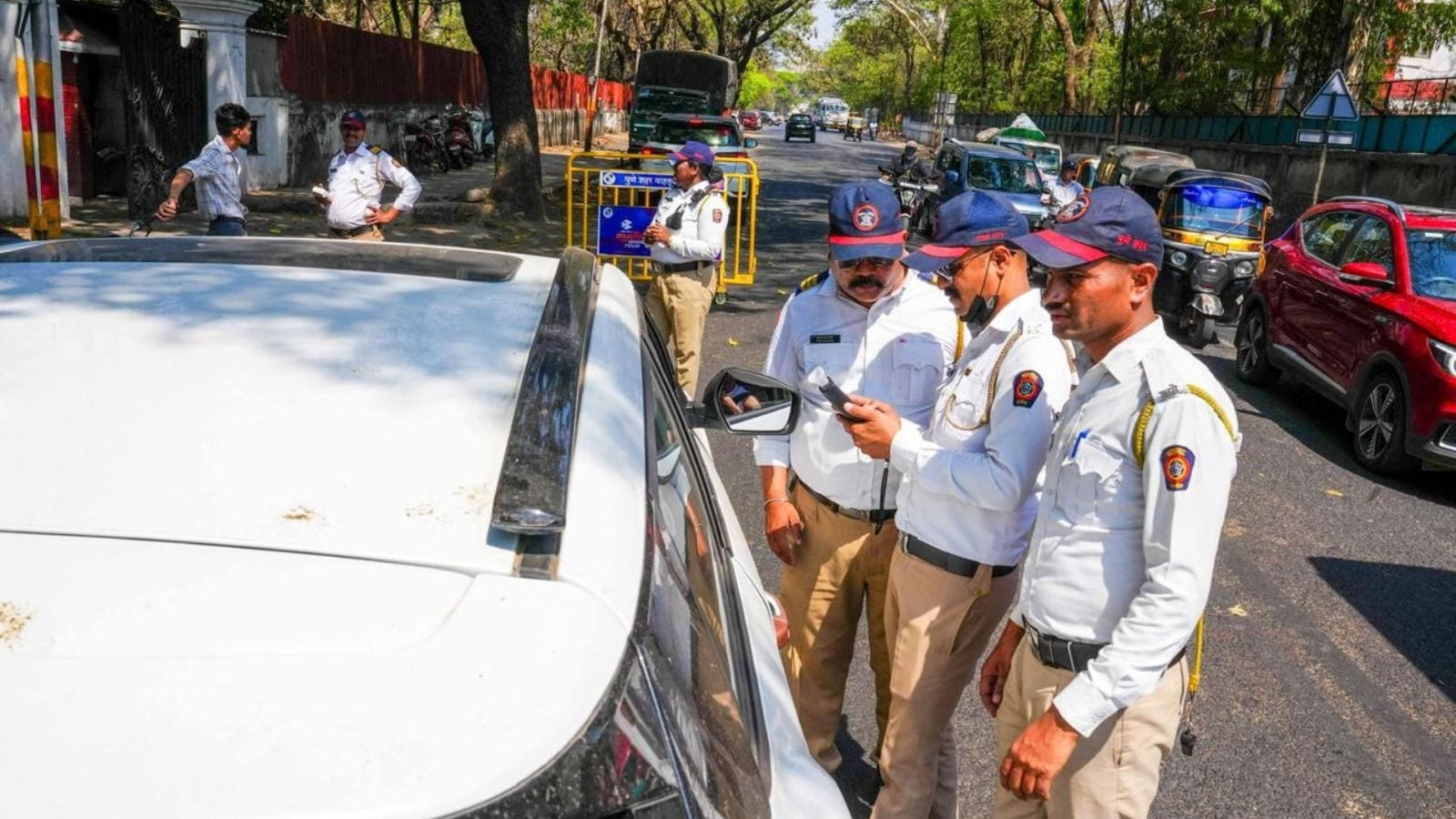
By the time most Punekars step out for work – cooled by fans or air conditioners – Subhash Nanaware has already been standing at a road junction in Yerawada for hours.
A traffic assistant sub-inspector with 33 years of service, Nanaware knows what summer on Pune’s roads feels like better than most others.
“In the morning hours, it is manageable, but by noon, the road feels like a furnace.
The heat comes from everywhere – the sun above, the asphalt below, and vehicles all around,” he said.
WithPune’s mercury nudging 40 degrees Celsius and summer still far from its peak, the city’s roughly 1,800 traffic police personnel are bearing the brunt of a season that is, by their own account, getting harsher each year.
Traffic police personnel typically work 12-hour shifts, with around 10 of those hours spent outdoors managing vehicle flow.
The schedule runs in two halves – roughly 7 am to 12.30 pm, and 4 pm to 10 pm – with a midday reserve period in between that coincides with peak afternoon heat.
But the breaks offer only partial relief.
“Personnel posted far from their residence struggle to travel home, rest, and return on time.
And unlike police stations, traffic divisions lack dedicated rest spaces,” said Purnima Bansode, a traffic constable posted at Shivajinagar.
“Some shade structures or traffic booths at road junctions would help, but the heat radiates from everywhere,” Nanaware said.
‘We drink less water to avoid washroom breaks’
For female traffic personnel, the ordeal carries additional dimensions.
Bansode described the compounding difficulties – standing for hours without access to shade, water, or restrooms.
“Drinking too much water means frequent washroom visits, which isn’t possible for us, so we drink less.
That sometimes causes dehydration,” she said.
During VIP visits and high-security events like the recently held Pune Grand Tour event, she added, the situation worsens as personnel are expected to remain on their feet all day, sometimes surviving only on a vada pav.
The physical toll accumulates over the years.
Bansode said prolonged exposure to heat and vehicular pollution has given her an allergic cough and asthma-like condition.
“My haemoglobin has dropped to 8 g/dL, and I have lost weight.
Also, intense heat by evening causes burning sensations, blisters, and bacterial infections in the feet,” she said.
“The extreme heat used to usually start from March-end, but in recent years it feels like May heat by February-end,” she said.
“Rotational, shorter shifts during extreme heat conditions would help a great deal.”
Dr Neha Patil, an MBBS practitioner based in Akurdi, said prolonged exposure to direct sunlight can trigger heat exhaustion and heat stroke, leading to dizziness and loss of consciousness.
“There is also a risk of skin-related conditions such as heat rashes and burns that, over time, may aggravate the risk of skin cancer.
Respiratory problems can worsen into asthma.
Electrolyte imbalance caused by sweating and dehydration can lead to muscle cramps, headaches, and weakness,” she said.
What the department offers and what it can’t
Deputy Commissioner of Police (Traffic) Himmat Jadhav toldTheIndian Expressthe department has taken steps within its means.
“Traffic officers are issued caps as part of their uniform, UV-protective sunglasses are being arranged, and booths at several junctions allow personnel to rest during reserve time.
Officials are also advised to stay hydrated,” he said.
He added that the peak-hour traffic load – around 70 per cent of daily volume – is managed by traffic police, while marshals and volunteers help during reserve periods.
Shubham Kurale is a journalist based in Pune and has studied journalism at the Ranade Institute.
He primarily reports on transport and is interested in covering civic issues, sports, gig workers, environmental issues, and queer issues.
X:@ShubhamKurale1...
Read More
Related Stories



Source: This article was originally published by The Indian Express
Read Full Original Article →
Comments (0)
No comments yet. Be the first to comment!
Leave a Comment