
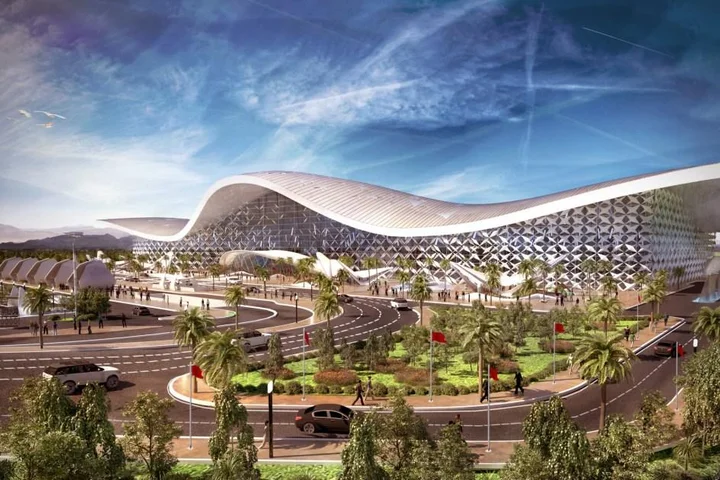
Morocco’s capital has unveiled a futuristic new airport terminal that’s about to open – and Ryanair is a big part of the story.
The expansion of Rabat-Salé Airport comes ahead of the 2030 FIFA World Cup, which Morocco will co-host with Spain and Portugal.
The Moroccan government is ploughing £2.1billion ($2.8billion) into its airports as part of a large-scale national strategy to promote tourism and infrastructure in the run up to the event.
It is hoped the changes will accommodate the expected surge in traffic leading up to Morocco’s hosting.
Rabat, a coastal city and the country’s administrative capital, is close to finishing the expansion of its terminal that will quadruple the amount of passengers from around 1.5 million to 5 million each year.
The terminal, which spans 69,000 square metres, will have state-of-the-art facilities including a two-level car park with 1,300 spaces, six telescopic boarding bridges that will help travellers to embark and disembark more efficiently, and parking space for additional aircraft.
Best of Metro Deals
Get deal now
Get deal now
Get deal now
That’s where Ryanair comes in.
The Irish budget carrier will open a new base in Rabat later this month, with two planes stationed there.
Ryanair already flies direct from the UK and Ireland to Rabat, operating four flights per week from Dublin and Manchester and 10 per week from London Stansted.
From Stansted, return fares are as little as £35.
In recent years, Michael O’Leary’s airline has invested in Morocco in a major way.
It now serves a total of 13 airports, including a widely criticised route to Dakhla, which is part of contested territory in Western Sahara.
Meanwhile, Ryanair has cut dozens of routes across Europe, affecting major destinations including Spain, France, Germany, Portugal and beyond.
Airline bosses have blamed high air traffic control (ATC) and security fees, as well as high aviation taxes and rising airport changes for this decision.
It has slammed the German government for stifling competitiveness.
‘Germany’s sky-high access costs are in stark contrast with countries such as Ireland, Spain and Poland which have no aviation taxes, or Sweden, Hungary and regional Italy, where aviation taxes are being scrapped alongside reduced access costs to boost traffic, tourism, jobs and economic recovery,’ an airline spokesperson said.
‘As a result, Germany remains among the worst recovered air traffic markets in Europe, operating at just 88% of pre-Covid levels.’
Ryanair also called out the German government for backtracking on its promises to lower aviation taxes, unlike other major EU nations.
Such taxes are, partially, in place to account for the devastating climate impact of flying, and to encourage travellers to take greener modes of transport such as trains.
The airline has revealed that it plans to move capacity out of Germany and other high-tax states to countries with more affordable costs.
Regional airports in Spain are among the worst hit, with some 1.2 million seats culled from Ryanair’s Spanish summer 2026 schedule.
This includes stopping all flights to Asturias, as well as Vigo.
The airline will also close its base at Santiago de Compostela, while continuing to reduce capacity for Santander and Zaragoza and slashing connections to the Canaries.
Routes from Girona will also be reduced.
When Metro contacted Ryanair about this, a spokesperson directed us to a press release about the Rabat expansion and did not provide further comment.
Related Stories


Source: This article was originally published by Metro UK
Read Full Original Article →
Comments (0)
No comments yet. Be the first to comment!
Leave a Comment