
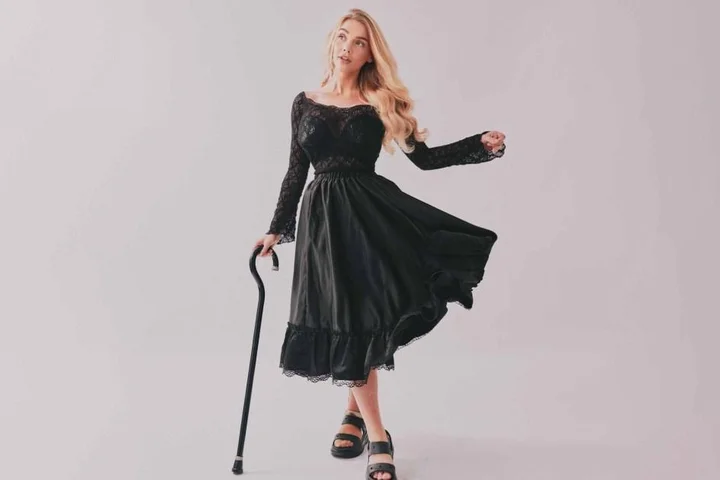
It was never Lucy May Dawson’s plan to become a model.
She was 20 and studying criminology at the University of Leicester with the aim of getting a job in victim support, when she was struck down in 20216 with a blinding headache that lasted for months.
‘If something is really traumatising, your brain can block it out.
But my brain was so diseased, it didn’t really know what was happening.
I had no control, no capacity whatsoever.
I was really, really ill.’
While Lucy was in the hospital she was given electroconvulsive therapy (ECT), which caused a seizure that propelled her from her bed onto a radiator pipe that burned through her sciatic nerve.
The damage was so bad that her left leg was paralysed below the knee.
When Lucy was finally discharged from hospital she was diagnosed with autoimmune encephalitis – an acute and sometimes deadly inflammation of the brain that can cause permanent damage.
It turned out that she never needed ECT or to be sectioned, after all.
However, the damage had already been done and Lucy now had to learn to live with an acquired brain injury and an orthotic leg.
‘When I came out of hospital, I was so ill.
I could barely stay awake.
I had no idea who I was or who my family were.
I couldn’t speak, couldn’t walk, couldn’t read, couldn’t write anything,’ Lucy recalls.
For months after her release from hospital, while learning how to live again and abandoning her studies, she had to process all she had been through.
‘I completely lost everything.
I had no direction and I had to grieve an entire life.
As I recovered, I discovered all the barriers that disabled people face, and I was navigating them all whilst also dealing with a brain injury.’
While the hosptial trust later apologised, the experience left Lucy deeply depressed and wishing she had never woken up, while struggling to find employment and independence.
‘I was trying to get a job and was on Personal Independence Payments, navigating disability benefits – and it was all just dehumanising, demoralising,’ she remembers.
The idea of finishing her degree was also impossible at the time – ‘I couldn’t even finish a sentence, let alone write a dissertation’, so Lucy got a job at a perfume counter at a department store where she was forbidden from sitting at a stool during shifts and was told to put away her crutches ‘because they looked untidy on the shop floor’.
After experiencing discrimination while out in public, such as being berated on a bus for using the priority seat and criticised for parking in a blue badge zone, Lucy’s sister Hannah suggested she blog about what she was going through.
Calling her website Lucy in the Sky with Encephalitis, she set about raising awareness about the condition that she hadn’t even heard about when she was diagnosed, and all the discrimination she faced as a disabled woman.
‘The amount of people that stop you and say they will pray for you, or that you have sinned and that is why you have this disability.
What a cruel thing to say,’ says Lucy, who has recently been diagnosed with complex post traumatic stress disorder.
Opening up her Instagram too, she posted online about all the remedies people have suggested for her permanent disability, including yoga, crystals, turmeric and exorcism.
Lucy says that not only does she have people asking personal health questions in public, but she also has to deal with unwanted sexual advances, both in person and online.
She’s frequently bombarded with crude messages online, with men fetishising her disability and making deeply offensive remarks.
SCOPE AWARDS 2026
Metro is proud to be the official media partner of 2026 Scope Awards, taking place on 30 April 2026.
The ceremony at London's Kia Oval will be hosted by wheelchair basketball athlete and broadcaster Ade Adepitan and celebrate the work disabled people and organisations are doing to bring about important change.
There are 38 nominees for the nine Scope Awards, where unsung heroes, amazing achievements and the incredible accolades of the disabled community are being honoured.
The shortlist includes: Celebrity Role Model, Colleague Network, Community Group, Customer Inclusion, Local Service, Media Moment, Purple Pioneer, Social Media Influencer and Workplace Champion.
‘So many think it’s appropriate to open a conversation with – “Does the stick come into the bedroom?” Or, “Oh, you’re the perfect girl.
You can’t run away,”’ says Lucy.
Unsurprisingly, Lucy has sworn off dating, focussing instead on the things that make her happy; fashion and her three cats Penny, Terrence and Kenneth.
Since launching herself on social media, she has amassed nearly a million followers across Instagram and TikTok where, modelling corsets, vintage dresses, and, at the latest count, 27 different walking sticks to match her wardrobe, she posts about living with disability – and people’s response to it.
It’s part of her mission to ‘live joyfully’ after being struck down by the rare and devastating brain disease that changed her life ten years ago.
‘I know I look like a bit of a Barbie doll and not everybody is able to take me seriously.
The comments I get online can be absolutely atrocious because of the way that I look,’ says Lucy.
‘But it’s important for people to see someone who loves pink and cats and being silly whilst being, boldly and proudly disabled.
That matters.
‘Someone once sent me a shot of a group chat where a boy was saying that he was trying to sleep with me so he could tick off having a disabled woman.
That is not just something that happens to me, it is very common.
‘Experiences like that can be really inhuman.
Disabled people are generally portrayed as either a burden or object of pity or the flip side is that we’re portrayed as inspiration porn to give non-disabled people warm, fuzzy feelings,’ she adds.
‘Very rarely is the content out there in the world actually accurate.
Disabled people are some of the most creative and funny – because dark humour can be a coping mechanism, yet we’re all shown the same way.’
While Lucy did later complete her degree, she now works as a model,influencer and disability advocate, and has been nominated for Social Media Influencer of the year award in the Scope 2026 Awards, which Metro is proud to partner.
She says the nomination is a welcome nod to representation and admits that her disability, which changed the course of her life, has now opened doors she never knew existed.
‘I am one of the most lucky, unlucky people out there.
Because who knows what my life would have become if I hadn’t got ill,’ she explains.
‘If my posts affect just one person’s life, if something I’ve said could help one person get the correct diagnosis, then that’s more than I could ever have dreamed of or wished for.
‘It gives me a reason why I had to go through everything I did, because I was given a second chance at life when so many people with this illness are not.’
Related Stories
Source: This article was originally published by Metro UK
Read Full Original Article →
Comments (0)
No comments yet. Be the first to comment!
Leave a Comment