
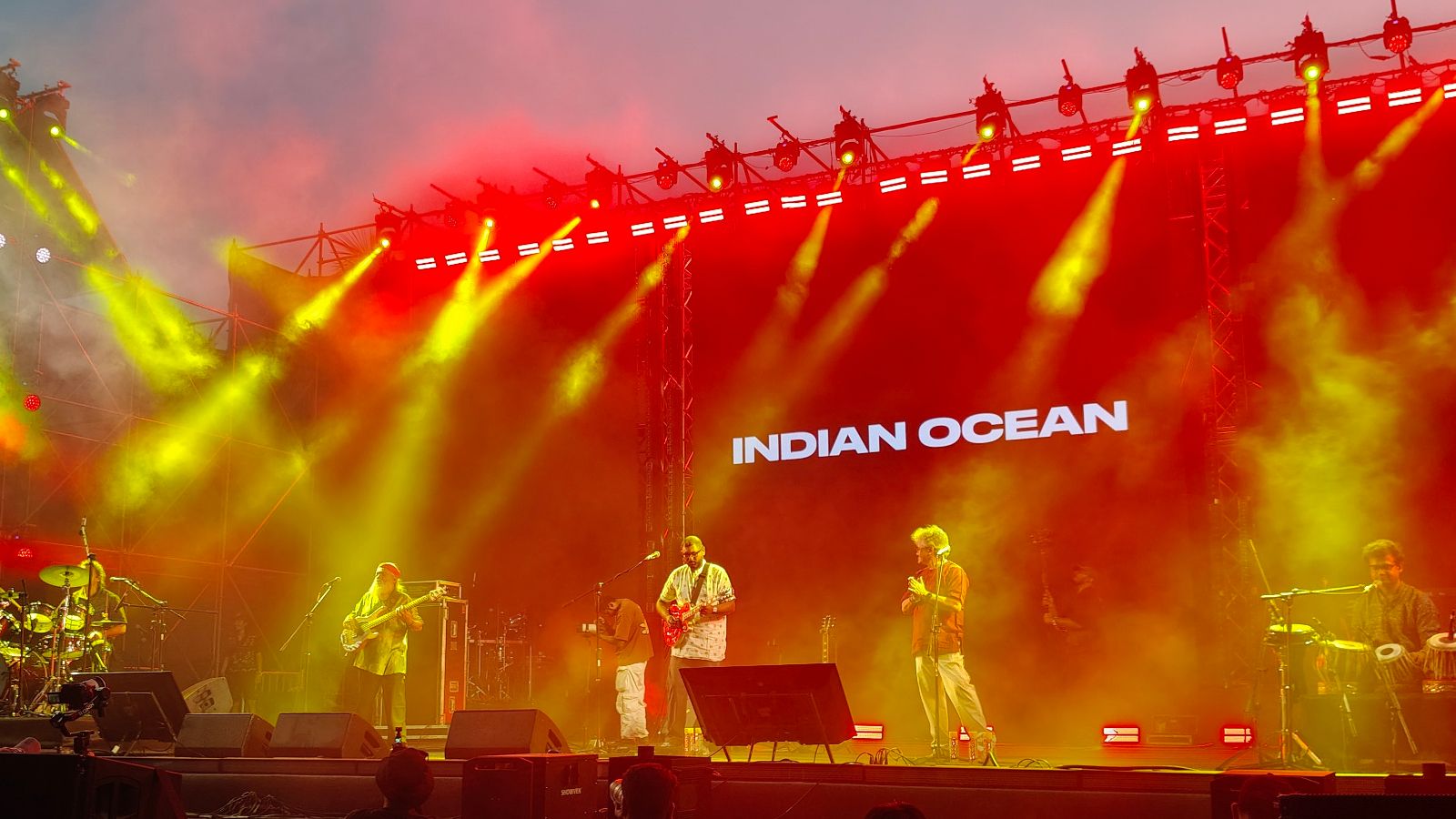
“Ab hum chalte hai Bhartiya rail ki taraf,” said Rahul Ram of Indian Ocean, and the audience exploded in excitement.
Everyone knew what would follow: Tu Kisi Rail Si Guzarti Hai from Dushyant Kumar’s ghazal, immortalised in a song in the movieMasaan.
The rock band’s performance at NH7 Weekender in Pune on Saturday made the audience swing to everything from the two-decade-old hit Bandeh to an unreleased song.
After their performance, members Rahul Ram and Amit Kilam spoke toTheIndian Expressabout new work, selection of films, self-censorship, and reel music.
Q:You recently released a song, Aashiqana, with Chaar Diwari.
What was your experience working with him like, and how did you like the song?
Amit Kilam:I really liked the song.
I think the experience was awesome because I really like the artist.
He is a bit quirky as well.
No one knew what he would make; we ourselves didn’t know what we had to make.
We just committed that we will do; later we got to know what we would do.
Luckily, he had an idea.
He came up with the entire song.
Q:Your music tookMasaanto the next level.
When you are offered a film, what factors do you consider before accepting it?
Amit Kilam: We don’t get offered so many films that we will choose what we will do.
But there is a difference in how a film is finally made versus how it is offered to us.
We read the script, and if we like it, we accept it.
No one can know how it will finally be made.
Rahul Ram:No, but you can make something out of the script.
We love to read the script.
We don’t just say yes.
We are not struggling to make it in Bollywood.
People who are struggling to make it have to say yes.
If they say no, the word spreads.
When we were in that space, the good guys came to us.
Anurag (Kashyap) came to us withBlack Friday.
What a first major Bollywood film to get!
We really lucked out.
There is one film I regret not doing:Newton.
They had asked us to come and see, but later it didn’t work out.
I loved that film.
Q:Censorship in movies is a big topic these days.
A lot of filmmakers are at loggerheads with the censor board.
Does this somehow affect music also, and do people self-censor in music as well?
Rahul Ram:Self-censorship in music because of what?
The film has to pass the CBFC.
What do we have to pass?
Amit Kilam:But I think the times have changed.
You have to really tread very carefully.
Self-censorship is very important.
Who knows who might take offence at something from somewhere?
It is a very big problem.
Some of it is okay, some of it is rightly done, and some of it is a bit over the top.
You have to tread carefully about which word you are using, etc.
Q:It is said that music these days is tailored for reels.
15 seconds, 30 seconds, 1 minute catchy phrases.
What is your view on that kind of a shift?
Rahul Ram: It won’t last.
It is fine, if you want to do it…
Amit Kilam:It is the current thing that is working.
People always make things that work.
If you keep doing only what is currently working, then newer forms of art and newer music will collapse slowly over a period of time.
Someone has to make something new; people won’t keep listening to the same thing.
At the start, it seems good that it is working on reels: five seconds, 10 seconds, 15 seconds.
Then someone is copying that.
If the same continues for two years, then people will ask, “what now?”Rahul Ram:If you want us to say reels are bad, then we won’t.
We say whatever works works.
But if someone asks me to make it, then I have not studied it.
Maybe if I study, if someone asks me… I think they themselves will feel embarrassed to ask us.
Soham Shah is a Correspondent with The Indian Express, based in Pune.
A journalism graduate with a background in fact-checking, he brings a meticulous and research-oriented approach to his current reporting.
Professional Background
Role: Correspondent coverig education and city affairs in Pune.
Specialization: His primary beat is education, but he also maintains a strong focus on civic issues, public health, human rights, and state politics.
Key Strength: Soham focuses on data-driven reporting on school and college education, government reports, and public infrastructure.
Recent Notable Articles (Late 2025)
His late 2025 work highlights a transition from education-centric reporting to hard-hitting investigative and human-rights stories:
1.
Investigations & Governance
"Express Impact: Mother's name now a must to download birth certificate from PMC site" (Dec 20, 2025): Reporting on a significant policy change by the Pune Municipal Corporation (PMC) following his earlier reports on gender inclusivity in administrative documents.
"44-Acre Mahar Land Controversy: In June, Pune official sought land eviction at Pawar son firm behest" (Nov 9, 2025): An investigative piece on real estate irregularities involving high-profile political families.
2.
Education & Campus Life
Faculty crisis at SPPU hits research, admin work: 62% of govt-sanctioned posts vacant, over 75% in many depts (Sept 12, 2025): An investigative piece on professor vacancies at Savitribai Phule Pune University.
"Maharashtra’s controversial third language policy: Why National Curriculum Framework recommends a third language from Class 6" (July 2): This detailed piece unpacks reasons behind why the state's move to introduce a third language from class 1 was controversial.
"Decline in number of schools, teachers in Maharashtra but student enrolment up: Report" (Jan 2025): Analyzing discrepancies in the state's education data despite rising student numbers.
3.
Human Rights & Social Issues
"Aanchal Mamidawar was brave after her family killed her boyfriend" (Dec 17, 2025): A deeply personal and hard-hitting opinion piece/column on the "crime of love" and honor killings in modern India.
"'People disrespect the disabled': Meet the man who has become face of racist attacks on Indians" (Nov 29, 2025): A profile of a Pune resident with severe physical deformities who became the target of global online harassment, highlighting issues of disability and cyber-bullying.
Signature Style
Soham is known for his civil-liberties lens.
His reporting frequently champions the rights of the marginalized—whether it's students fighting for campus democracy, victims of regressive social practices, or residents struggling with crumbling urban infrastructure (as seen in his "Breathless Pune" contributions).
He is adept at linking hyper-local Pune issues to larger national conversations about law and liberty.
X (Twitter): @SohamShah07...
Read More
Related Stories


Source: This article was originally published by The Indian Express
Read Full Original Article →
Comments (0)
No comments yet. Be the first to comment!
Leave a Comment