
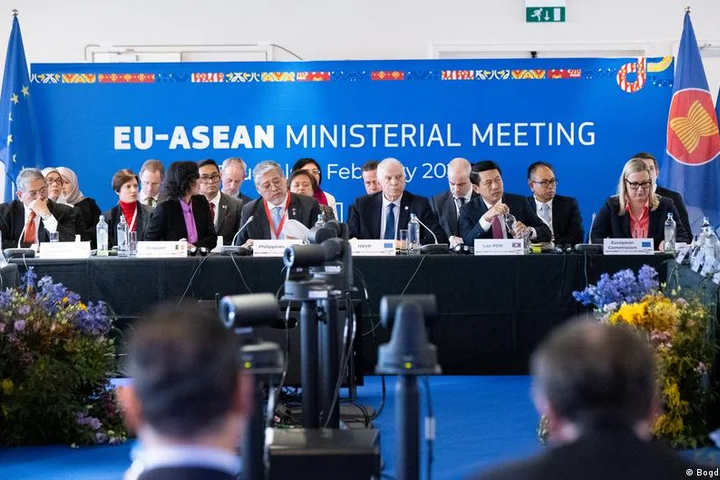
Southeast Asia increasingly sees the European Union as a trusted hedge against US-China rivalry, but analysts say Brussels will need stronger political engagement to turn growing goodwill into real strategic influence.
Europe's standing in Southeast Asia has improved over the past year, a regional survey released this week has found.
For the sixth consecutive year, the European Union emerged as the region's most preferred "third party" to hedge against US-China rivalry, according to the latest State of Southeast Asia survey, an annual poll published by the ISEAS-Yusof Ishak Institute.
Some 37.7% of respondents, up from 36.3% last year, said the EU is ASEAN's preferred and trusted strategic partner.
The survey also found that 19.2% of respondents saw the EU as the main champion of the global free trade agenda, ahead of the United States, though still behind ASEAN itself and China.
According to the survey, 55.9% of respondents said they trusted the EU to "do the right thing" to contribute to global peace, security, prosperity and governance, up from 51.9% last year.
Over the same period, distrust fell from 27.8% to 22.3%.
The EU is ASEAN's third-largest trading partner, after the US and China , and the bloc's second-largest source of foreign direct investment.
The Philippines is chair of ASEAN — these are its goals
To view this video please enable JavaScript, and consider upgrading to a web browser that supports HTML5 video
The findings show that Southeast Asian confidence in the EU is "growing but remains limited, anchored more in its normative appeal than in its strategic weight," Melinda Martinus, a lead researcher at ISEAS and one of the survey's authors, told DW.
The EU already has free trade agreements in force with Singapore and Vietnam and concluded negotiations last year on a major trade deal with Indonesia, Southeast Asia's largest economy.
Brussels is also seeking to finalize agreements with the Philippines, Malaysia and Thailand, viewing bilateral deals as building blocks toward an eventual region-to-region trade agreement with ASEAN.
The rise in trust and fall in distrust suggest the EU is increasingly valued as a predictable partner amid uncertainty over US leadership, Martinus said, adding that its "strong association with international law, multilateralism and climate leadership reinforces its image as a stabilizing and non-coercive actor."
"However, lingering doubts about the EU's internal unity and its ability to act decisively on the global stage point to a gap between its reputation and real-world impact," she added.
Indonesia stands out as an exception.
The survey found it was the only ASEAN country where distrust of the EU outweighed trust over the past year.
Even so, Indonesia remains among the regional countries most inclined to see the EU as a useful hedge against US-China rivalry , with 40.7% of Indonesian respondents selecting the bloc as ASEAN's preferred third-party strategic partner.
US, China or none of the above?
Analysts say what was once often framed in Southeast Asia as a primarily economic or normative partnership is becoming more strategic.
This shift is not because the EU has suddenly become a hard-power actor, but because the region is searching for dependable partners as confidence in US leadership weakens and concerns about China's growing weight persist .
The same survey identified respondents' top geopolitical concern as US leadership under President Donald Trump, whose administration's unilateral and unpredictable foreign policy has "only made it more clear to the EU and Southeast Asian countries that they should diversify ties and do so quickly," Hunter Marston, a non-resident adjunct fellow at the Center for Strategic and International Studies (CSIS), told DW.
ASEAN head signals optimism on stabilizing South China Sea
That logic cuts both ways.
Southeast Asian states want more options as Washington appears more erratic and as China's economic centrality becomes increasingly unavoidable.
For Europe, Southeast Asia is also becoming more important as part of a wider effort to diversify supply chains, reduce dependence on China and show that the EU remains a relevant player in the Indo-Pacific.
"As the two strongest regional organizations in the world, they have a strong incentive to collaborate more closely to defend the rules-based order," he told DW.
Even so, the ISEAS survey was not wholly flattering for Brussels.
The EU ranked only third as a potential champion of global free trade, behind ASEAN and China, and also placed third on maintaining the rules-based global order, behind ASEAN and the United States.
In recent months, the EU has faced criticism for failing to send senior officials to key ASEAN meetings.
Chris Humphrey, executive director of the EU-ASEAN Business Council, cited the EU's absence from a meeting of ASEAN digital ministers in Vietnam in January, which was attended by senior representatives from Washington, Beijing and Moscow.
"We're not turning up at the ministerial meetings when others are turning up, and it gets noticed and gets commented on," Humphrey told Euractiv late last month, adding that while countries such as China send delegates to almost all ASEAN meetings, "Europe's just not interested."
Speaking to DW, Humphrey said that while trade ties have developed well in recent years, there are many other areas where the two blocs should be working more closely, particularly in today's turbulent geopolitical environment.
He pointed to EU support for the ASEAN Power Grid and the energy transition as one way to deepen cooperation, as well as closer engagement at senior levels on digital issues.
"The good news is that Brussels does seem to be taking more of an interest, and we are hopeful that there will be more Commissioner-level involvement in ASEAN meetings this year," Humphrey said.
A more significant test will come next year, when ASEAN and the EU mark the 50th anniversary of their relations.
The milestone offers Brussels a clear opportunity to show that its Indo-Pacific ambitions are more than rhetoric.
"Europe really does need to step up to the plate more and demonstrate publicly that it takes the relationship seriously, wants to deepen it, and work with ASEAN on areas of mutual interest, of which there are many," Humphrey said.
Related Stories

Source: This article was originally published by Deutsche Welle (DW)
Read Full Original Article →
Comments (0)
No comments yet. Be the first to comment!
Leave a Comment