
Important topics and their relevance in UPSC CSE exam forMarch 14, 2026.If you missed the March 13, 2026, UPSC CSE exam key from the Indian Express, read it here.
Preliminary Examination:Current events of national and international importance.
Mains Examination: General Studies-I, II, III:Geography, Effect of policies and politics of developed and developing countries on India’s interests, Indian Economy and issues relating to planning, mobilisation of resources, growth, development.
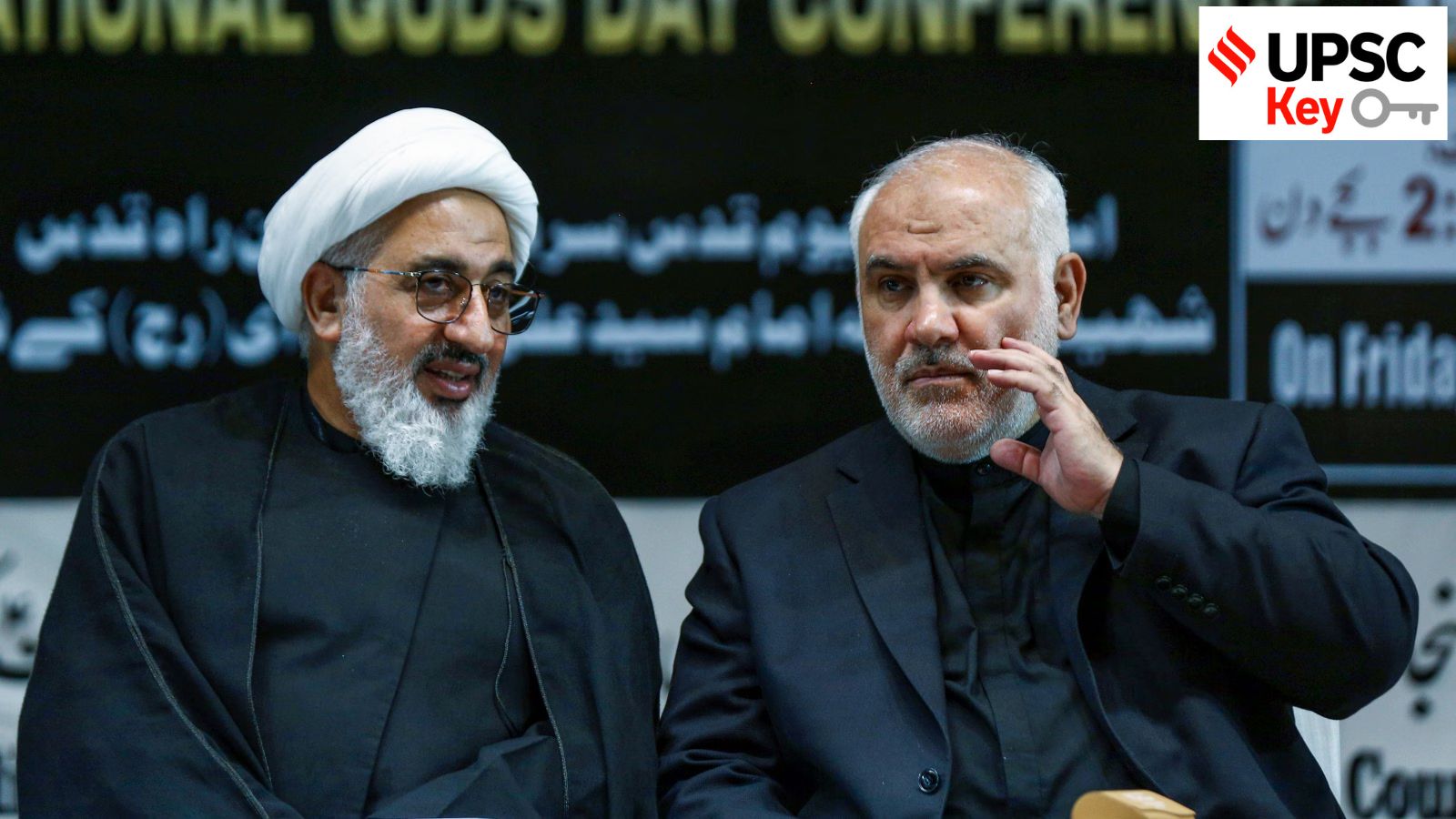
What’s the ongoing story:Signalling headway inDelhi’s efforts to persuade Tehran to let India-bound fuel ships transit the Strait of Hormuz, Mohammad Fathali, Iran’s Ambassador to India, said Friday “we will try our best to remove the problems” and “I think you can expect good news in the near future”.
— Know about the US-Israel vs Iran War
— BRICS: Know about it in detail.
— How do tensions in West Asia affect India’s energy security?
— What is the strategic significance of the Strait of Hormuz?
— Know the portfolio of India’s crude oil, LPG and LNG imports.
— What role does the Essential Commodities Act play in ensuring the availability of essential fuels in India?
— Know about the UN Security Council in detail.
— What does ‘seafarer abandonment’ mean?
— Why are Indian seafarers more susceptible to abandonment?
— What is Maritime Labour Convention (MLC) 2006 ?
— What diplomatic challenges can India face in balancing its ties with Israel, the US and Iran?
— What is India’s Middle East policy?
— What are the efforts taken by the government for energy security amidst conflict in West Asia?
— Map work:Locate Iran, the Strait of Hormuz, Israel, Bab Al Mandab, the Horn of Africa, and other places in the news related to the US-Israel attack on Iran on the map.
— The Reuters news agency reported that Iran had allowed two Indian-flagged LPG carriers to sail through the Strait of Hormuz.
Quoting sources, it identified the vessels as Shivalik and Nanda Devi.
— Speaking to reporters in NewDelhiafter an event to mark the Al-Quds Day, Fathali, on being asked whether Iran would allow India-bound ships safe transit through the Strait of Hormuz, said, “Yes.
Because India and I are friends.
You can see the future, and I think after two or three hours… Because we believe that.
We believe that Iran and India are friends.
We have common interests, we have common faith.”
— Sources in the government said there have been “multiple conversations at multiple levels” and “layers of conversation” between India and Iran over the past 24 hours.
And, the negotiations are “delicately poised” since the lives of so many Indians are at stake.
— Sources said it is “work in progress” and the intent is to get as many Indians out of the blocked waterway – there are around 800 Indian seafarers on 28 ships stranded in the Strait of Hormuz.
— While Iran maintains Tehran has not closed the Strait, sources said that insurance companies have not been guaranteeing the movement of ships in the last two weeks because of the volatile situation.
From the Front Page-“As BRICS chair, condemn attacks on Iran: Tehran’s message to New Delhi”
— Tehran is learnt to have reached out to Delhi to take the lead in issuing a statement on behalf of the BRICS, currently chaired by India, condemning the US and Israeli strikes against Iran in the last two weeks.
— This has putDelhiin a diplomatic pickle since it has stayed away from taking sides in the ongoing conflict.
— Prime Minister Narendra Modi has spoken to leaders of the countries in the region targeted by Iran, condemned the attacks and thanked them for looking after the Indian community “in these difficult times”.
— On Thursday night, Modi spoke to Iran’s President Masoud Pezeshkian and expressed “deep concern over the escalation of tensions and the loss of civilian lives as well as damage to civilian infrastructure”.
— The BRICS grouping has Brazil, Russia, India, China and South Africa (the original five), along with Egypt, Ethiopia, Iran, Saudi Arabia, the UAE and Indonesia.
Saudi Arabia and the UAE, which host US bases and personnel, have been targeted by Iranian missiles and drones.The fact that all three countries are in the BRICS has made diplomatic navigation difficult for India.
— India, which holds the rotational presidency of the grouping for 2026, is expected to host the summit of BRICS leaders later this year.
From the Explained Page-“To compute the true costs of Iran conflict, look at the past”
—The United States and Israel attacked Iran on February 28, and initial estimates suggest a heavy running cost for this war.
— Last week, the Israeli Finance Ministry claimed that thecountry is spending $3 billion per weekas it attacked Iran, and defended itself from Iranian missiles.
In the US, the costs are reportedly even higher.
According to a briefing by the Department of Defence (or War, as the Trump Administration calls it) to the US Congress on March 11, the US government had spent $11.3 billion in just the first six days of the war — that’s close to $2 billion a day and $14 billion a week.
— For perspective, $1 billion is roughly equal to Rs 9,000 crore.
In other words, in the first six days starting February 28, the US and Israel had spent over Rs 1.3 lakh crore.
Another way to look at this is to compare it with India’s entire defencebudgetfor 2026: Rs 7.8 lakh crore.
So, at the going rate, in just six weeks, which is one of the many timelines US PresidentDonald Trumphas given since the start of the war, US and Israel would have spent on this war as much as India hopes to spend in the coming year on its defence.
— Crude oil prices have shot up by almost 50% since the start of the war.
That increase will now feed inflation across the world, worsening the so-called cost of living crisis that started in the wake of the Russia-Ukraine war in 2022.
— But even such inflationary bumps fail to truly capture the real cost of war.
For instance, what is the opportunity cost of any such war?
Opportunity cost refers to the “money which could have gone towards societally beneficial expenditures such as infrastructure improvements, educational investments, and environmental protection” instead of military spending.
Beyond the economic costs, are the human costs — again far more difficult to assess.
— Lastly, there are environmental costs because “military jets and vehicles consume petroleum-based fuels at an extremely high rate, and the vehicles used in the war zones produce tons of carbon monoxide, nitrogen oxides, hydrocarbons, and sulfur dioxide in addition to CO2”.
From the Explained Page-“Amid oil supply crunch, the big winner–Russia”
—This war has no winners, except maybe one that is not even fighting in it.
As Iran effectively chokes off theStrait of Hormuzin its escalating response to the US and Israel’s attacks,Russia is making a windfallon the back of the increased demand for crude oil as well as its spiralling prices.
— According to aFinancial Timesreport, Moscow is estimated to have earned around $150 million a day in extra oil revenue since the effective closure of the narrow transit passage for a fifth of the world’s energy supplies.
— Till a few days back, millions of barrels of Russian crude were languishing on the high seas with few willing buyers, thanks to US efforts to starve Moscow of oil revenues that could fund the Ukraine war.
— Now, America’s own war against Iran has taken precedence.
After issuing a30-day “waiver” to Indianrefiners last week for buying Russian crude that is already sitting in tankers on water, the US has now extended it to other countries too.
— The easing of sanctions, which will be in place for a month, means that the US will have no problem if countries import Russian crude that was loaded on or before 12:01 am eastern daylight time, or 9:31 am India time, on March 12.
— While this move could help other countries secure some oil supplies, it is likely to help NewDelhias well as the India-specific waiver was for oil loaded on tankers before March 5.
— According to industry watchers, the US could be forced to ease sanctions further on Russian crude if the disruption to the global oil supplies via the Strait of Hormuz persists for an extended period.
— The West Asia war has led to a spurt in crude oil prices, which remain extremely volatile.
At noon on Friday, Benchmark Brent crude was around $100 per barrel, almost 37% higher than nearly $73 per barrel just before the US and Israel launched military strikes on Iran on February 28.
So, like any other oil producer who is able to sell crude in this market, Russia gains from higher oil prices.
From the Explained Page-“Strait of Hormuz crisis spotlights a growing risk for Indian seafarers: Abandonment”
— Thewar in West Asia, in which a number of tankers and merchant vessels near the Persian Gulf have come under attack, is throwing light on the risks faced by commercial sailors, especially Indians.
— At least three Indian seafarers have beenkilled so farin attacks on three vessels.
As the war continues, and ships continue to find themselves stranded near theStrait of Hormuz, industry stakeholders are warning of the increasing risk of “abandonments” — when shipowners cease all support to their crew and ships.
— Indians, who make up about 15% of the world’s seafarer workforce — the second biggest share by nationality — top the list of “abandoned seafarers”.
— Seafarer abandonment refers to a scenario where shipowners cut off all support to their crew, leaving them stranded without pay, food, shelter, medical care or a way home, either aboard a vessel or in a foreign port.
Under the Maritime Labour Convention (MLC) 2006 — a key international treaty ratified by more than 100 countries — abandonment is defined as the failure of shipowners to fulfil these core obligations.
— For many seafarers, especially those from low-income backgrounds, disembarking abandoned vessels without a salary is impossible — they often would have already shelled out hefty sums of money to agents for jobs or training certifications.
Additionally, port or visa restrictions may prevent them from going ashore, leaving them with no option but to remain on board in the hope that their pleas would be heard by owners or authorities.
— When faced with soaring operational costs, unpredictable freight rates, mounting debt, bankruptcy, or even war and strife, ship owners may opt to cut ties altogether rather than pay wages, cover repatriation or maintain ageing vessels.
But enabling these abandonments is the notorious “flag of convenience” (FOC) system.
— Each commercial vessel needs to register with a country’s flag so that it has a legal nationality.
This determines the laws a vessel must follow and the protections its crew receives on board.
— But since international rules allow flagging anywhere, ship owners pick countries (called Flag States) that allow them to bypass safety standards, avoid taxes, and skirt laws protecting labour conditions and wages.
— The FOC system also conceals the true ownership of a vessel, enabling fly-by-night operators.It is little surprise, then, that FOC vessels dominate abandonment.
Panama was the Flag State that had the most abandonments in 2025 (68, up from 43 in 2024).
— Abandonments happen typically in unstable or high-traffic maritime zones, particularly Turkey, the UAE, and the broader Gulf region.
These areas, gateways toconflict-ridden waters, see spikes due to port arrests, sanctions, and economic flux.
West Asia and the Persian Gulf dominate recent incidents.
Over 100 Indians were repatriated from 14 vessels in places like Sharjah (UAE), Tartus (Syria), Shinas (Oman), and Qatar in 2025-2026.
— Indian seafarers top abandonment lists owing to a mix of socioeconomic pressures, systemic flaws in recruitment, and a surge in fraudulent practices.
Other Important Articles Covering the same topic:
📍Knowledge Nugget | US-Israel war on Iran: 10 must-know tidbits for UPSC Exam
📍UPSC Issue at a Glance | How did the Israel-Iran conflict escalate?
A look from history to its impact
UPSC Prelims Previous year and Practice Questions Covering similar theme:
(1) In the context of global oil prices, “Brent crude oil” is frequently referred to in the news.
What does this term imply?
(UPSC CSE 2011)
1.
It is a major classification of crude oil.
2.
It is sourced from the North Sea.
Which of the statements given above is/are correct?
(2) Which of the statements about the Strait of Hormuz isnotcorrect?
(a) It is a critical region for international oil and gas supplies.
(b) It is a narrow waterway between Bahrain and Qatar.
(c) It connects the Persian Gulf with the Gulf of Oman and the Arabian Sea.
(d) Disruption of shipping in this strait can significantly affect global energy prices.
Main Examination: General Studies-II:Appointment to various Constitutional posts, powers, functions and responsibilities of various Constitutional Bodies.
What’s the ongoing story:Citing charges including “partisan and discriminatory conduct” and “obstruction of investigation into electoral fraud and SIR” (Special Intensive Revision of electoral rolls), the Opposition on Friday submitted notices in both Houses of Parliament for an impeachment motion against Chief Election Commissioner (CEC) Gyanesh Kumar.
— Know the constitutional provisions related to the Election Commission of India.
— What is the process of selection of CEC?
— How is the CEC different from the other Election Commissioner?
— How does the Chief Election Commissioner and Other Election Commissioners Act, 2023, elaborate the selection of the CEC?
— How does the constitution provide for the independence of the Election Commission?
— A senior TMC MP toldTheIndian Expressthat 120 Lok Sabha members and 73Rajya Sabhamembers had signed the notices.
“A total of 17 Opposition parties have supported the notice.
It has been submitted in both Houses,” the MP said.
— As per procedure, the notice has to be signed by at least 100 members if moved in the Lok Sabha and 50 members in the Rajya Sabha.
This is the first time a notice is being moved for the removal of a CEC.
— However, the Opposition’s move is largely symbolic, given the ruling NDA’s clear numerical advantage in both the Lok Sabha and Rajya Sabha.
But it has political significance as it comes days before the EC is expected to announce the Assembly election schedule for the states of West Bengal, Assam, Kerala andTamil Nadu, and the Union Territory of Puducherry.
— According to sources, the Opposition has listed several charges against the CEC, including “proven misbehavior”, “partisan and discriminatory conduct”, “SIR exercise and mass disenfranchisement”, “compromised appointment”, “obstruction of investigation into electoral fraud and SIR”, “contempt of Supreme Court”, and “failure to maintain independence”.
— The process for seeking the CEC’s removal is similar to that of impeaching a Supreme Court judge.
Article 324 (5) of the Constitution states that “the Chief Election Commissioner shall not be removed from his office except in like manner and on the like grounds as a Judge of the Supreme Court and the conditions of service of the Chief Election Commissioner shall not be varied to his disadvantage after his appointment”.
— The grounds for the removal of the CEC and other election commissioners (ECs) are also laid down in Section 11 (2) of the Chief Election Commissioner and other Election Commissioners (Appointment, Conditions of Service and Term of Office) Act, 2023, which regulates the appointment, conditions of service, and term of office of the CEC and the ECs.
— The procedure for the removal of a Judge is laid down in the Judges (Inquiry) Act, 1968.
It stipulates that a complaint against a judge is taken up if it is signed by at least 100 members in the Lok Sabha and 50 members in theRajya Sabha.
Once the motion is submitted, the presiding officer of the House takes a call on whether to accept or reject it.
— If the motion is admitted, the Speaker or the Chairman of the House constitutes a three-member investigative committee.
— The committee then frames charges based on which the investigation is conducted.
After concluding its investigation, the committee submits its report to the Speaker or Chairman, who then has to lay the report before the relevant House.
If the report records a finding of misbehaviour or incapacity, the motion for removal is taken up for consideration and debated.
— For the motion to go through, at least two-thirds of those “present and voting” in both the Lok Sabha and the Rajya Sabha must vote to remove the judge, and the number of votes in favour must be more than 50 per cent of the “total membership” of each House.
Once both Houses adopt the motion by a special majority, it is sent to the President of India.
— The Part XV of the Constitution of India deals with Elections.
It has the following articles (Articles 324–329) to empower the Election Commission and provide insight into the potential roles and functions of the commission.
— Article 324 says, The superintendence, direction and control of the preparation of the electoral rolls for, and the conduct of, all elections to Parliament and the Legislature of every state and of elections to the offices of President and Vice-President.
📍Impeaching the CEC: The law, and the process
Previous year UPSC Prelims Question Covering similar theme:
(3) Consider the following statements: (UPSC CSE 2017)
1.
The Election Commission of India is a five-member body.
2.
Union Ministry of Home Affairs decides the election schedule for the conduct of both general elections and bye-elections.
3.
Election Commission resolves the disputes relating to splits/mergers of recognised political parties.
Previous year UPSC Mains Question Covering similar theme:
Discuss the role of the Election Commission of India in the light of the evolution of the Model Code of Conduct.
(UPSC CSE 2022)
Preliminary Examination:Current events of national importance, Polity and Governance.
Mains Examination:General Studies-I, II:Women, Social Empowerment, Issues related with health, Government policies.
What’s the ongoing story:The Supreme Court on Friday reiterated its concern that makingmenstrual leave for women employeesmandatory could disadvantage women, as it could make employers wary of recruiting them.
— What are the constitutional principles underlying gender equality?
— Should menstrual leave be a statutory right in India?
— What are the arguments for and against paid menstrual leave?
— What is the role of the Executive in adopting an effective menstrual leave policy?
— What is the role of affirmative action in promoting gender equality in the workplace?
— What are the Various Government Schemes to Promote Menstrual Hygiene Management?
— A bench of Chief Justice of India (CJI) Surya Kant and Justice Joymalya Bagchi said it was better left to the government to take a call on the matter.
— “Affirmative action in respect of women is constitutionally recognised.
But look at the practical reality in the job market.
The more unattractive the human resource, the less is the possibility of consumption in the market.
These are also factors to be looked into…You are right, we will see it from the rights regime.
But look at it from the business model.
Will an employer be happy with the competing claims of other genders?” said Justice Bagchi.
— The bench initially questioned the locus standi of the petitioner, Shailendra Mani Tripathi, and wondered why no woman had approached the court.
— Tripathi had moved the court twice in the past.
The first one was disposed of in February 2023, allowing him to give a representation to the Centre.
He moved the court again in 2024, contending that the government had not responded to his representation.
The court then asked the government to take a policy decision.
— On Friday, the CJI said, “You are not a bona fide petitioner.
This is only to create a type of impression in young women thatyou still have some natural issues, and you are not at par with male persons, and you cannot work like them during a particular time.”
—Appearing for the petitioner, senior advocate M R Shamshad said Bihar, Karnataka, and Odisha had menstrual leaves while Kerala had allowed it in schools.
He added that some private institutions, too, had allowed it.
— The CJI said it was excellent if they were giving leave voluntarily.
“That is a very good thing…But the moment you introduce it as a law, as a compulsory condition, you do not know the amount of damage you will do to their career.
Nobody will give them responsibilities.
Not even in judicial services, a normal trial will be assigned to them,” he added.
Creating a right to take leave for two days every month may deter the entire private sector, the CJI said.
— Saying that the right to menstrual health is a part of the right to life under Article 21 of the Constitution, the Supreme Court recently directed all States and Union Territories to put in place Menstrual Hygiene Management (MHM) measures, including gender-segregated toilets and free sanitary napkins, in all government as well as private schools.
📍‘Menstruation not a handicap, but still debilitating’: Why women say they need paid menstrual leaves
📍‘In judiciary, no one will give women long trials’: Supreme Court pulls up petitioner over mandatory menstrual leave policy
What are the continued challenges for women in India against time and space?
(UPSC CSE 2019)
Preliminary Examination:Indian Polity and Governance-Constitution, Political System, Panchayati Raj, Public Policy, Rights Issues, etc.
Mains Examination: General Studies-II:Constitution, Government policies and interventions for development in various sectors and issues arising out of their design and implementation.
What’s the ongoing story:The Supreme Court on Wednesday (March 11) ruled that income cannot be the sole criterion to decide the creamy layer among Other Backward Classes (OBCs), and settled the long-pending question of equivalence between PSUs and private sector employees and those in the government sector.
Those included in the ‘creamy layer’ are not entitled to OBC reservation benefits.
— What are the constitutional provisions related to the OBCs?
— Read about the Mandal Commission, its recommendations and landmark verdict in Indra Sawhney vs Union of India (1992).
— Know the article 14, 15 and 16 of Constitution of India.
— What is the concept of ‘creamy layer’?
— What is the Economically Weaker Sections (EWS) quota?
— Read about the National Commission for Backward Classes.
— The Supreme Court on Wednesday delivered a verdict reserved on October 30, 2025.
The division Bench of justice PS Narasimha and justice R Mahadevan held that, “The object of excluding the creamy layer is…not to create artificial distinctions between equally placed members of the same social class….
unequal treatment of similarly placed OBC candidates would not only be legally erroneous but constitutionally impermissible.”
— The Bench was hearing petitions arising due to an October 14, 2004 letter issued by the Department of Personnel and Training (DoPT) with regard to the creamy layer criterion, clarifying an Official Memorandum (OM) issued long back in September 1993.
— The court noted that while the OM excluded income from salary and agricultural income from the income/ wealth test for determination of creamy layer status, the letter dated October 14, 2004 directed inclusion of salary income of PSU and private sector employees, and this resulted in hostile discrimination between the wards of government servants and those of PSU/private sector employees.
— The court ruled, “…in other words, treating the children of those employed in PSUs or private employment, etc., as being excluded from the benefit of reservation only on the basis of their income derived from salaries, and without reference to their posts (whether Group A or B, or Group C or D) would certainly lead to hostile discrimination between parties who are similarly placed and would amount to equals being treated unequally, thereby attracting the rigour of the equality doctrine under Articles 14, 15 and 16…”
— Following the landmark 1992 SC ruling inIndra Sawhney vs Union of India, also known as the Mandal verdict, the concept of ‘creamy layer’ within the OBCs was introduced.
— On September 8, 1993, the DoPT issued a circular clarifying who is classified as OBC and who belongs to the creamy layer among them.
— For those in government jobs, the ‘creamy layer’ specifies groups such as persons occupying constitutional posts; Group-A/Class-I officers of All India Services, Central services and state services; Group-B/Class-II services of Centre and state; employees of PSUs; officers of Armed Forces; professionals and those from trade and industry; property owners; and an income/wealth test.
— In a nutshell, if either parent is a direct recruit of Group-A, or is promoted before the age of 40, their children cannot take advantage of the OBC quota.
Similarly, if both parents are Group-B direct recruits, their children will be covered under the creamy layer.
— For Armed Forces, officials up to the rank of Lieutenant Colonel can avail the OBC quota, but higher ranks are in the creamy layer.
The criterion for those not in the government sector was set at Rs 1 lakh per annum in 1993.
It was revised in due course and since 2017, this income limit is Rs 8 lakh.
—The DoPT issued a “Clarification on Creamy Layer among OBCs” on October 14, 2004, saying in para 9 that “the creamy layer status of sons and daughters of persons employed in organisations where equivalence or comparability of posts vis-à-vis posts in Government has not been evaluated is determined as follows: Income of the parents from the salaries and from the other sources (other than salaries and agriculture land) is determined separately.
If either the income of the parents from the salaries or the income of the parents from other sources (other than salaries and agricultural land) exceeds the limit of Rs 2.5 lakh per annum (that time this was ceiling for creamy layer for private persons) for a period of three consecutive years, the sons and daughters of such persons shall be treated to fall in creamy layer.”
— The DoPT letter was not implemented effectively till 2014.
It was implemented effectively from the Civil Service Examination (CSE) 2015 (batch 2016), with the DoPT verifying caste certificates based on this clarification.
—Since the 2016 batch, there have been around 100 OBC candidates who were issued caste certificates from various authorities and cleared the CSE, but were rejected during the DoPT scrutiny.
In fact, while they qualified other exams as OBC candidates, the DoPT rejected their claim in the CSE.
—In the September 1993 circular, it was categorically stated that income from “salary” or “agriculture” would not be counted for the test of income and wealth for deciding the creamy layer status.
— During the hearing on petitions against reservation for Economically Weaker Sections introduced by the Narendra Modi government in 2019, when the Supreme Court asked why the income criterion for EWS categories and for OBCs was the same at Rs 8 lakh, the counsel, based on the committee headed by then Revenue Secretary Ajay Bhushan Pandey, submitted, based on the same 1993 circular, that while computing income for “Creamy Layer among OBCs”, the “income from salaries or agricultural land” was “excluded”, but in cases of EWS, this was “included.”
— National Commission for Backward Classes (NCBC) was initially constituted by the Central Govt by the National Commission for Backward Classes Act, of 1993.
The act has been repealed through the National Commission for Backward Classes (Repeal) Act, 2018.
— The NCBC has been accorded Constitutional Status through “The Constitution (One Hundred and Second Amendment) Act, 2018, whereby Article 338-B has been inserted, forming a Commission for the socially and educationally backward classes to be known as National Commission for Backward Classes.
📍Can’t decide creamy layer solely on basis of income: SC
(4) Consider the following organizations/bodies in India: (UPSC CSE 2023)
1.
The National Commission for Backward Classes
2.
The National Human Rights Commission
4.
The National Consumer Disputes Redressal Commission
How many of the above constitutional bodies?
Mains Examination: General Studies-I, II, III:Effects of globalisation on Indian society, Government policies and interventions for development in various sectors and issues arising out of their design and implementation, Awareness in the fields of IT.
What’s the ongoing story:Angelina Dash writes- “On March 6, Karnataka Chief MinisterSiddaramaiahannounced a ban on social media use for children under the age of 16 years during the state’s annualbudgetpresentation.
In parallel, the Andhra Pradesh government announced intentions to introduce measures to restrict social media access for children below the age of 13.”
— Know about the Digital Personal Data Protection (DPDP) Act, 2023.
— Why is social media called a double-edged sword?
— What is the regulatory framework for social media in India?
— How is social media impacting different sections of the society, especially children?
— What are the criticisms related to the social media ban for children?
— What measures should be taken for better regulation of social media?
— “This comes amid the broader discourse surrounding social media bans and the restriction of children’s online access, both globally and in India.
Australia set a landmark precedent in 2025 by banning social media use for children under 16.
Since then, countries including France, Germany and Indonesia have also expressed plans to ban social media for children, albeit with differing age thresholds.
More recently, French President Emmanuel Macron, during his keynote address at the India AI Impact Summit, urged India to “join the club” and consider banning social media for children.”
— “To replicate such a ban in India may pose new challenges, including questions on whether it is a state or the Centre that introduces legal measures, as well as the feasibility of a blanket ban on social media access.”
— “With law-making power relating to internet and communications governance typically falling under the purview of the Central government under the Union List, it is unclear whether states can, in fact, regulate children’s access to social media through legislation.”
— “Furthermore, fragmented approaches to social media bans can present challenges in applicability and precisely, in the case of non-uniform age thresholds across states.
It is also unclear how different states may intend to assign the onus.”
— “Additionally, online age verification raises several privacy concerns, with studies finding that more accurate mechanisms often contravene data protection principles through the collection of excessive data.
This would be particularly concerning since social media bans for children would result in virtually every individual trying to use social media needing to verify their age through mechanisms that have not been fully specified.”
— “Moreover, a ban also fails to account for challenges such as shared device usage, a reality in India.
Such a move may also further limit online expression for girls and young women, whose access to digital spaces is already curbed by gender norms… A ban may also inhibit the articulation of personal identity for LGBTQIA+ communities, including children, for whom online spaces are critical for self-expression.”
— “Moreover, social media bans, coupled with existing parental consent requirements under data protection frameworks, may shift the narrative entirely towards restricting children’s access, whereas the real question is how we can safeguard children from very actual harms that present themselves online.
This can result in the crux of the problem remaining unaddressed, with children continuing to be exposed to inherent platform design choices that can foster safety harms such as addiction and mental health challenges”
— “Social media platforms are often a critical avenue for children’s self-expression, and children must therefore be empowered to navigate these platforms safely.
Rather than restricting access, policies and legal frameworks should instead enable safer online spaces for children.”
— “It would also be important to acknowledge factors such as India’s multilingual diversity.
This is crucial because it may not only impact how platforms detect children’s accounts, but can also dictate the accuracy with which safety measures used by platforms (such as automated content moderation) work.”
— “Further, a narrow focus on social media platforms alone ignores safety challenges that may present themselves on gaming platforms such as Roblox and Minecraft, as well as through AI tools such as ChatGPT.
Upcoming policies and legal frameworks must therefore also safeguard the best interests of children in a manner that accounts for emerging technologies and India’s unique challenges.”
📍Let’s talk protection, not control
📍UPSC Issue at a Glance | Social Media, the double-edged sword: 4 Key Questions You Must Know for Prelims and Mains
(5) In India, it is legally mandatory for which of the following to report on cyber security incidents?
(UPSC CSE 2017)
Select the correct answer using the code given below:
Previous year UPSC Mains Questions Covering similar theme:
Social media is triggering ‘Fear of Missing Out’ amongst the youth, precipitating depression and loneliness.
(UPSC CSE 2024)
What are social networking sites and what security implications do these sites present?
(UPSC CSE 2013)
Mains Examination: General Studies-II:Indian Economy and issues relating to planning, mobilisation of resources, growth, development and employment.
What’s the ongoing story:Abhishek Anand, Joshua Felman, Arvind Subramanian write- “Recently, the government released a new series of GDP numbers.
They did so for two main reasons.
First, the weights of the various goods and services needed updating, a step that was long overdue as India’s economy has gone through tremendous changes since the weights were last established in 2011-12.
Second, shortcomings in the methodology for estimating GDP needed to be addressed.”
— Know about various terms associated with GDP: Real GDP, Nominal GDP, GSDP, GVP, GDP deflators.
— How is GDP calculated?
What is the significance of GDP?
— What are the major criticisms of India’s GDP estimation methodology introduced in 2015?
— What is the ‘double deflation’ method in GDP estimation?
— What is the significance of rebasing a country’s GDP series?
— How did the revision of India’s GDP base year to 2022-23 affect the nominal GDP figures and growth estimates?
— Know about the Ministry of Statistics and Programme Implementation.
— What is the index of industrial production?
— Read about the wholesale price index.
— “The process of changing the methodology has been commendably consultative, for which the Ministry of Statistics and Policy Implementation (MoSPI) deserves credit.
But assessing whether the shortcomings have been substantively addressed will take time.
And it will ultimately depend on the quality and plausibility of the new numbers.”
— “Prima facie, while there have clearly been improvements, some oddities remain.
For example, goods inflation (as measured by the manufacturing GVA deflator) is strangely negative for 10 quarters, which has led to an unusual jump in the sector’s real growth rate.
Also, import deflators are radically different from those in the previous series, which has produced sharp changes in real import growth.”
— “But before we can fully assess the new methodology, we need to understand: What were the problems with the old methodology?..
Start with the manifestation of the problem.
Until a decade ago, there was a close relationship between the GDP numbers and the standard macro-indicators that economists monitor to gauge the health of the economy: Exports, credit, taxes, electricity consumption, sales and the index of industrial production.
These relationships broke down, however, after the methodology was radically revised in January 2015.”
— “A key problem was the use of inappropriate data sources, notably proxying the performance of the informal sector by using data from the formal sector.
This may have been a reasonable approach in normal times.
But after 2015 the informal sector was hit disproportionately by three severe shocks: Demonetisation, the introduction of the GST and Covid.
As a result, the methodology overstated informal sector performance — a serious problem, since informal enterprises accounted for over 45 per cent of the economy in 2011-12.”
— “The other major problem was the use of inappropriate deflators.
Much attention has been paid to the lack of “double deflation”.
But the bigger issue was the use of inappropriate price indices, most notably the use of the wholesale price index (WPI), to deflate services production even though the WPI doesn’t really capture service prices.
This was a particularly acute problem over the past decade when the WPI plunged, driven largely by the collapse in the price of oil.
As a result, inflation was understated and real growth was overstated.”
— “Growth was overstated by about 1½-2 percentage points on average between 2011-12 and 2023-24, with inappropriate data and deflators contributing roughly equally.
As a result, we estimate the economy grew at 4-4 ½ per cent on average instead of 6 per cent over these 12 years.
Estimates of India’s potential growth need to be re-calibrated accordingly.”
— “This misreading complicated macroeconomic policy: At various periods the data signalled strength when the economy was weak, and in others, it suggested that policy should be eased when growth was strong.
It also attenuated the urgency for reforms, especially in the period between 2014-15 and 2019-20.
After all, why change the policy framework when it was already producing world-beating growth?”
— “In recent years, there have been frequent invocations of puzzles.
If growth is strong, why is private investment so weak?
Why is net FDI declining?
Why are capacity utilisation, wage growth, employment growth so tepid?
More recently, why was there pressure on the rupee if real growth was so much greater than anywhere in the world?
Each puzzle elicits its own complex and different explanation.
But in the spirit of Occam’s Razor, there is one simple, albeit partial, explanation for all of them: Growth has been less strong than it appears!”
— India has taken considerable pride in being amongst the fastest growing economies in the world.
According to IMF data, India has been the fourth-fastest growing major economy between 2011 and 2023.
But even on our revised estimates, India will remain amongst the top seven or eight fastest growing economies.
National pride may yet be warranted but it does not require a statistical crutch.”
— “Our analysis is both complimentary and complementary to the latest effort by MoSPI.
Complimentary because MoSPI has now attempted to address the challenges identified by our analysis and other scholars.
Complementary because while the new methodology will apply to future estimates, our research is about the past, focusing on correcting the historical record.”
— GDP is the sum of the market value of all thefinal goods and servicesproduced within the geographical boundaries of a country each year.
The value of GDP measured in current prices is called Nominal GDP but it might not be a good measure of production because the increase in value may result from an increase in prices and not output.
— Economists rely on three approaches to accurately measure GDP: Expenditure, Income, and Product.
GDP calculated from all these approaches should give the same value.
However, GDP measurement also depends on the structure of the economy.
1.
Expenditure approach:It is a sum of four key components – personal consumption expenditure (C), investment expenditure (I), government expenditure (G), and net exports (X-M) by the rest of the world sector (ROW).
2.
Income approach:It is simply calculated as income earned from all sources and includes wages and salaries, proprietors’ income (earnings from self-employment and unincorporated businesses), rental income, corporate profits, and net interest earned (interest earned minus interest paid).
Additionally, the concept of GDP also includes net indirect taxes, statistical discrepancy, depreciation, and net payments made to the ROW.
3.
Product approach:Also known as the output method or value-added method, it adds up the market value of all goods and services produced, excluding the goods used in the intermediate stages of production
📍Knowledge Nugget: New series of GDP estimates with base year 2022-23 released.
What you need to know for UPSC exam
UPSC Prelims Practice Question Covering similar theme:
(6) Consider the following statements:
1.
The new base year for the GDP series is 2023-24.
2.
The GDP series is released by the RBI.
Industry bodies and think tanks have written to the Commerce Ministry, Petroleum and Natural Gas Ministry and the department of pharmaceuticals under the Ministry of Chemicals and Fertilisers, seeking exemptions such as the ones seen during the Covid pandemic — allowing manufacturing to continue considering them to be essential commodities.
The government on Monday invoked the Essential Commodities Act to divert natural gas to “priority sectors”.
Essential commodities as defined by the Act include cattle fodder, coal, its derivatives, automobile components and accessories, cotton and wool textiles, drugs as defined in Section 3 of the Drugs and Cosmetics Act, foodstuffs, iron and steel, raw cotton, raw jute and any other product listed by the Centre via a notified order.
This, in essence, is why Foreign Portfolio Investors (FPIs) have continued to dump Indian shares amid the war in West Asia and volatile crude oil prices, dragging down the Indian rupee, which hit a new all-time low of 92.48 per dollar on Friday.
The exit of foreign money from Indian shores has not been limited to thestock market.
Foreign Direct Investments (FDI) — seen as a more stable form of foreign investment than in thestock market— into India saw net outflows in three of the last four months of 2025 as per latest available data from the Reserve Bank of India (RBI) — well before the conflict began in West Asia.
🚨Click Hereto read the UPSC Essentials magazine forFebruary 2026.Share your views and suggestions in the comment box or at manas.srivastava@indianexpress.com🚨
Roshni Yadav is a Deputy Copy Editor with The Indian Express.
She is an alumna of the University of Delhi and Jawaharlal Nehru University, where she pursued her graduation and post-graduation in Political Science.
She has over five years of work experience in ed-tech and media.
At The Indian Express, she writes for the UPSC section.
Her interests lie in national and international affairs, governance, the economy, and social issues.
You can contact her via email: roshni.yadav@indianexpress.com....
Read More
Related Stories



Source: This article was originally published by The Indian Express
Read Full Original Article →
Comments (0)
No comments yet. Be the first to comment!
Leave a Comment