
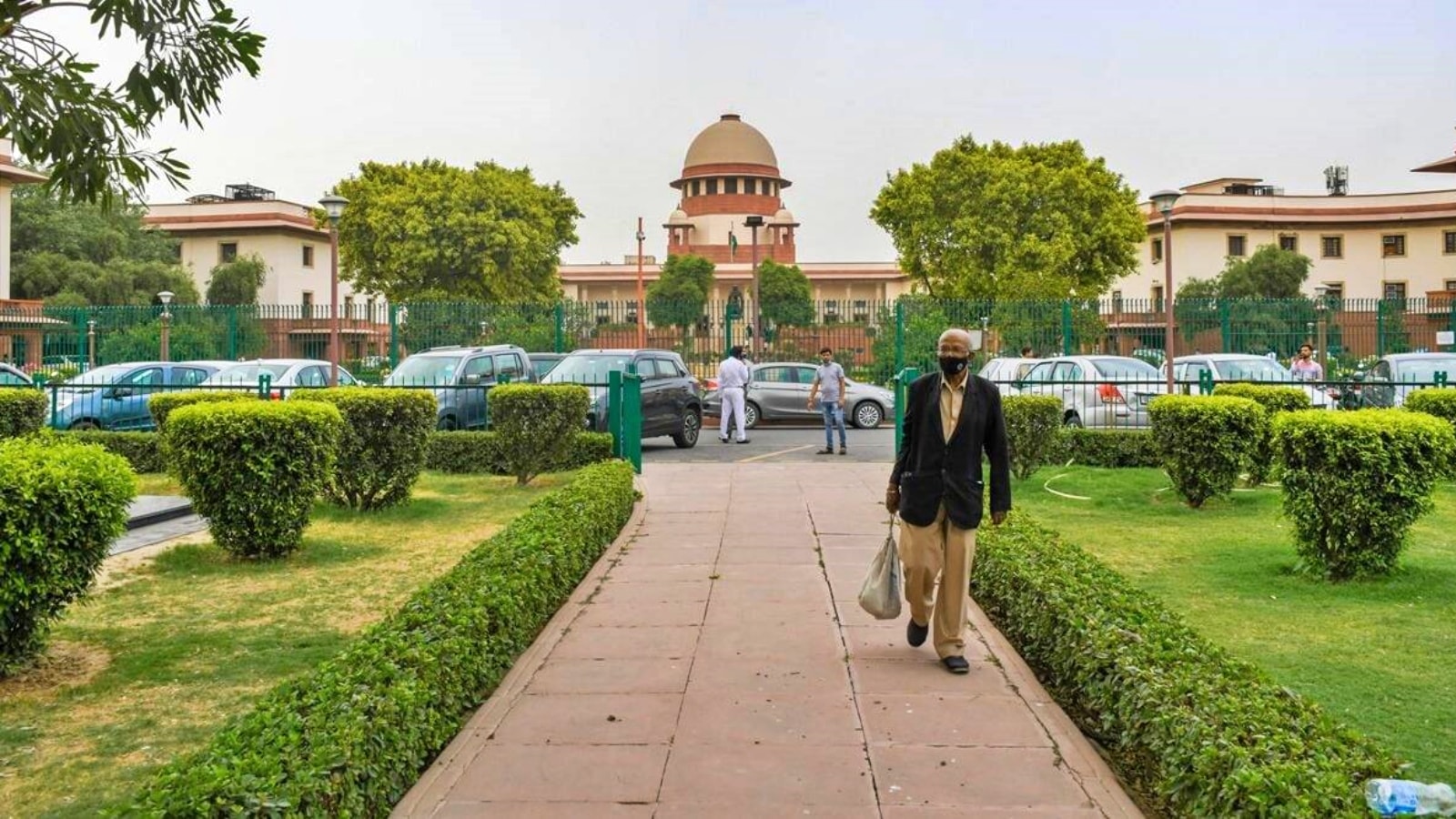
The Supreme Court on Friday asked the Centre to call a meeting of stakeholders to revisit the import policy for yellow peas with focus on incentivising farmers for diversifying from water-intensive crops like rice and wheat to pulses.
A bench of Chief Justice of India Surya Kant and Justice Joymalya Bagchi said this while hearing a PIL filed by Kisan Mahapanchayat against the Centre allowing import of yellow dal without any duty, which it contended was hurting local farmers by denying them a level-playing field.
Appearing for the petitioner organisation, Advocate Prashant Bhushan said this had resulted in crashing the price of locally produced pulses and farmers getting less than the Minimum Support Price.
Additional Solicitor General N Venkataraman said there has been a steep decline in production because of a disease.
He added that the production was 273 lakh tonnes in 2021-22, but fell to 261 lakh tonnes in 2022-23 and 242 lakh tonnes in 2023-24.
The CJI sought to know if the Department of Agriculture examined the reasons for the decline.
Bhushan said the the Commission on Agricultural Costs and Prices (CACP) had given two reports on this and had underlined the need for “ensuring remunerative prices to farmers” in its 2025 report.
The counsel added that the Commission had also recommended a ban on import of yellow dal.
The CJI said “the point is very simple.
You have an MSP for wheat, you have an MSP for paddy, and you have an MSP for some pulses now also.
The moment you make sure the farmer will get this price, you will see how it (production) will rise.
Unfortunately, this aspect probably has not been really addressed”.
CJI Kant added that there is an issue of productivity gap.
While an acre of wheat can yield up to 100 quintals, pulses may yield only 10 quintal per acre.
He added that there is also the issue of finding a market for the produce.The CJI told the ASG to ask the Agriculture Ministry to work on solutions.
While acknowledging that the decision to import would be to meet consumer demands amidst shortfalls in production, the bench said that India has a much higher production of rice and that a part of it could be diversified to grow pulses.
“Do we require as much paddy for consumption as we are producing?
We need some good quality for export, like Basmati rice, because that brings in FDI.
But with normal paddy, the production is likely much more than our consumption.
So, if you divert—and the paddy plantation area is reduced—and that area is diverted for pulses, it will balance that,” he said.
This will also help address concerns of falling water tables, the CJI said.
“We impress upon the Union of India to convene a meeting of relevant stakeholders and explore revisiting the existing policy framework to find a better substitute under which farmers are incentivised for diversification from conventional crops to pulses, along with certain benefits … We hope and expect that the ministries will effectively resolve this issue with a new policy regime,” the court said.
Related Stories


Source: This article was originally published by The Indian Express
Read Full Original Article →
Comments (0)
No comments yet. Be the first to comment!
Leave a Comment