
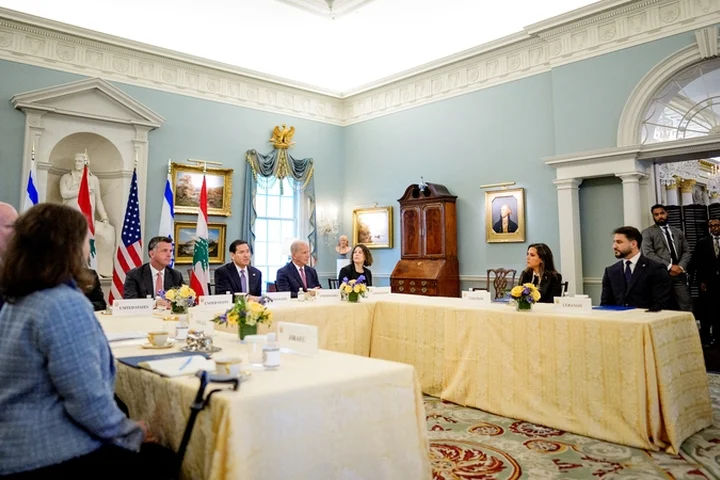
The divisions over today's talks between Israel and Lebanon were visible on the streets of Beirut before the diplomats had even taken their seats in Washington.
Protesters have gathered in the capital in recent days to make their opposition clear - and loud.
For many here, the very notion of direct talks with Israel is a betrayal, especially because there is talk of a "normalisation" of relations between the two countries.
Hezbollah's Secretary General Naim Qassem called them "futile" - a "free concession" to Israel and the United States.
The group has been urging the Lebanese government to pull out entirely.
And yet the talks went ahead.
Israel's ambassador to the US Yechiel Leiter and Lebanon's ambassador Nada Hamadeh met at the State Department under the chairmanship of Secretary of State Marco Rubio - the most direct bilateral engagement between the two countries since 1983, and by some measures the most significant since the establishment of the State of Israel in 1948.
They lasted just over two hours.
No breakthrough was expected, and none came.
But Lebanon's Culture Minister, Dr Ghassan Salamé told RTÉ News today in Beirut that this was always just meant to be a "preliminary meeting".
"It is a way of trying to produce a pause in the fighting - and on the other hand, to start thinking about the negotiation.
The negotiations as such will start much later than today," he said.
That candour captures where Lebanon finds itself.
The government went to Washington not with confidence of success, but because it felt it had no other option.
Israel has killed more than 2,000 people here since March, destroyed an estimated 40,000 housing units in just 35 days, and is pursuing what it calls a security zone in southern Lebanon - a zone that, in practice, has involved flattening villages, blowing up bridges over the Litani River and cutting the south off from the rest of the country.
It is far from a precision operation against Hezbollah.
The gap between the two sides going in was stark.
Israel's ambassador reportedly arrived under instructions not to agree to a ceasefire.
Lebanon's priority, by contrast, was exactly that - a ceasefire as a precondition for any further talks.
Lebanon and the United States have reportedly asked Israel for a "pause" in fighting, with some Israeli officials indicating Israeli Prime Minister Benjamin Netanyahu might agree to a short tactical halt on airstrikes.
Read more stories from the Middle East
There is also the fundamental question of who is missing from the room.
Hezbollah holds 15 seats in Lebanon's parliament.
It has its own military wing, its own power structures, its own social welfare network.
It is, in every practical sense, more powerful than the Lebanese army.
The Lebanese government cannot deliver Hezbollah's disarmament - which is Israel's stated precondition for any meaningful agreement - on its own.
And that is not the only issue.
"The larger challenge is that Hezbollah does not make its own decisions," said Paul Salem, Senior Fellow at the Middle East Institute, who has spent his life observing Lebanon's cycles of conflict up close.
His father served as Lebanon's foreign minister in the 1980s.
"It's not a sovereign militia.
It belongs to the [Islamic Revolutionary Guard Corps], and Tehran makes the decisions," he said.
That is precisely why, Mr Salem argues, that what happens between the United States and Iran matters as much for Lebanon as anything agreed in Washington.
"It's very important that, as the US sits down with the Iranians, they also insist that Iran walks away from the strategy it has pursued for 40 years - arming militias in various Arab countries to protect Iran.
That is not an acceptable strategy for any country," he added.
There is some cautious reason for hope.
With the Assad regime gone, Iran weakened, and Hezbollah battered, the Lebanese government is trying to chart its own course in a way it has not been able to for decades.
Mr Salem called today's direction "the first of its kind since the establishment of the State of Israel in 1948".
The Culture Minister speaks of producing, at minimum, a pause in the killing.
But the obstacles are formidable.
Mr Netanyahu apparently views the talks as a tactic to buy time without stopping the fighting.
And Israel has said explicitly it will not discuss a ceasefire with Hezbollah - nor does Hezbollah have any intention of sitting down across the table from Israel.
Dr Ali Hamie, a Hezbollah-linked strategic analyst, was blunter still.
Talks with Israel, he told RTÉ News, were simply not something Hezbollah would countenance.
"Talks with the Israelis?
No way.
No way," he said.
"We still have the bloodshed on the ground and so many murders in Lebanon.
We've been defending ourselves for 75 years against Israeli aggression," he said, noting that Israel would at the very least have to withdraw from Lebanon.
Israel, he said, has not adhered to any previous agreements or UN resolutions.
"So that's why I don't think Hezbollah will ever, ever sit across the table from the Israelis," he said.
"Not now, not ever."
But Hezbollah's absence from the table does not necessarily doom any agreement.
The group has agreed to ceasefires before - in 2006, in 2022 and in 2024 - without being directly party to the negotiations.
Back channels exist, particularly through parliament speaker Nabih Berri, who remains in close contact with both the Lebanese government and Hezbollah's leadership.
"To the degree that their acquiescence is needed on anything," Mr Salem said, adding: "The back channel exists, and they can be talked to."
But two hours of talks at the State Department will not have been enough time to resolve any of that.
Yet, still, there is hope.
We can't live without hope," Minister Salamé said.
"If you have a child who needs hospital care, you take him to the hospital.
You don't wait asking yourself what the chances of remission are," he said.
In other words, sometimes you act not because success is guaranteed, but because doing nothing is not an option.
For Lebanon, that has always been the calculation.
And it remains so today.
Related Stories


Source: This article was originally published by RTÉ News
Read Full Original Article →
Comments (0)
No comments yet. Be the first to comment!
Leave a Comment