
Older items: 2023 : ( J F M A M J ), 2022 : ( J F M A M J J A S O N D ), 2021 , 2019 , 2018 , 2017 , 2016 , 2015 , 2014 , 2013 , 2012 , 2011 , 2010 , 2009 , 2009 , 2008 , 2007 , 2006 , 2005 , 2004 , 2003 , 2002 , 2001 , 2000 , 1999 , legacy html
For a rather more polished write-up, complete with pretty
pictures please see TDF
ejects its core developers .
Here is a more personal take.
My feeling
is that this action has been planned by the TDF rump board's majority
for many months, if not for some years.
While we have tried to avoid this
outcome, it has been eventually forced on us.
There are many great ways to contribute to FLOSS projects and coding is
only one of them - let me underline that.
However - coding is the primary
production that drives many of the other valuable contributions: translation,
marketing, etc.
We have been blessed to have many excellent developers around
LibreOffice but coder's board representation has been declining.
This means
losing a valuable part of the board's perspective on the complexity of
the problem.
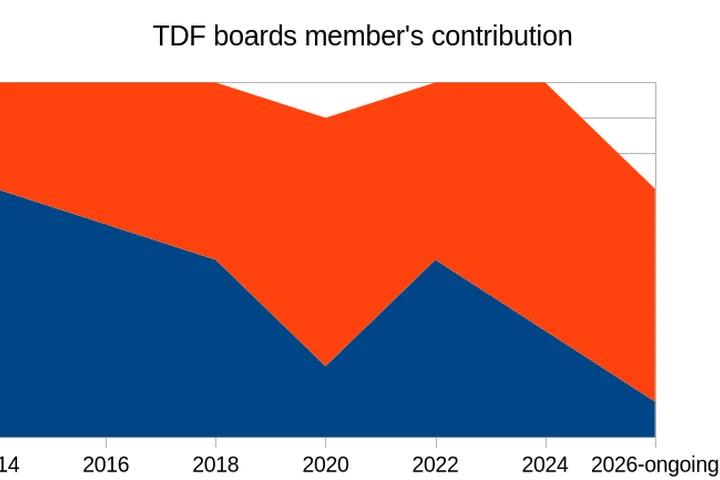
The elected board is (typically) ten people - seven full board
members, and three deputies as spares if needed, here is how that looks:
Another way of looking at board composition is
to look at board members' affiliations over time.
Of course affiliations change -
sometimes during a board term, but this is the same graph broken down by (rough) affiliation:
One of the major surprises of the 2024 election is the 'TDF' chunk in
which I bucket paid TDF staff, and those closely related to them.
The
current chair of the TDF board (Eliane) who manages the Executive Director
(ED) is curiously related to a staff member who is managed by the (ED) -
arguably an extremely poor governance practice.
Having three TDF
affiliated directors is also in contradiction of the statutes.
It is also worth noting that for over two years, no Collaboran or any of
our partners have been on the TDF board.
It was hoped that this would give
ample time and space to address any of the issues left from previous
boards.
TDF is defined as a meritocracy in its statutes.
Why is that ?
the
experience we had from the OpenOffice project was that often those who
were doing the work were excluded from decision making.
That made it
hard to get teams to scale, and to make quick decisions, let leaders
grow in areas, and also gives an incentive to contribute more among
many other reasons.
Some claim that the sole manifestation of the statute's requirement
for meritocracy is a flat entry / membership criteria (as every other
organization has).
This seems to me to be near to the root of the
problems here.
Those used to functioning FLOSS projects find it hard to
understand why you wouldn't at least listen to those who are working
hardest to improve things in whatever area.
These days some at TDF
seem to emphasize equality instead.
It is interesting then to see the (controversially appointed)
Membership Committee overturning the last election - ejecting
people without any thanks or apology who have contributed so very much over
so many years.
We built
a quick tool to count those.
This excludes the long departed Sun Microsystem's
release engineers who committed many other people's patches for them - and
it struggles to 'see' into the CVS era where branches were flattened; but ...
as far as git and gitdm-alias files can easily tell this is the picture of
the top committers to the largest 'core' code repository over all time.
It is a humbling privilege for me to serve in such a dedicated team of people who
have contributed so much.
Take just one example - Cáolan has worked from
StarDivision to Sun to Oracle to RedHat to Collabora; 37000 commits in ~25 years
- ~four per day sustained, every day.
By grokking his commits quickly you can
see that this is far more than a job - over 6000 of those were at the weekend,
and of course commits don't show the reviews, mentoring, love and care and more.
That is just one contributor - but the passion scales across the rest of the team.
While writing this a response from TDF showed up.
While there are things to welcome, it seems that this speculative concern about
individual contributors is at the core of the concern:
"people made decisions in the interest of their employers rather than in the interest of The Document Foundation."
Really!?
the primary privilege that members of TDF have is voting for their
representatives in elections, and this right is earned only by
contribution.
Elections are secret ballots.
So it seems the most
plausible reason for disenfranchising so many is a unhealthy fear of
the electorate.
Is it possible that the board majority want to avoid
accountability for their actions at the next election (which is
already delayed without adequate explanation), like this:
I have no idea how our staff voted in past elections - but I have to
assume they did this with integrity and for the best for TDF as they
saw it at the time.
It seems that a more plausible reason to remove
such long term contributors is electoral gerrymandering.
After 15+ years of service with LibreOffice, it is unfortunate to be ejected.
It is possible to imagine a counter-factual world where this might actually be
necessary.
But even in this case - to do so with no thank-you, or apology is
unconscionable.
It is great to see the team making up for that by publicly thanking
their colleagues as they are kicked out.
I found it deeply encouraging
to remember and celebrate all the fantastic work that has been contributed,
let me add my own big thank you to everyone!
Well much more can be said, perhaps I'll update this later with more details
as they emerge,
but for now we're re-focusing on making Collabora
Office great, getting our gerrit and CI humming smoothly, and starting to
dung-out bits we are not using in the code-base.
If you're interested in getting
involved have a wave in #cool-dev:matrix.org and join in, we welcome anyone to join us.
Thanks for reading and trying to
understand this tangled topic !
My content in this blog and associated images / data under images/ and data/ directories are (usually)
created by me and (unless obviously labelled otherwise) are licensed under
the public domain, and/or if that doesn't float your boat a CC0 license.
I encourage linking back (of course) to help people decide for
themselves, in context, in the battle for ideas, and I love fixes /
improvements / corrections by private mail.
In case it's not painfully obvious: the reflections reflected here are my
own; mine, all mine !
and don't reflect the views of Collabora, SUSE,
Novell, The Document Foundation, Spaghetti Hurlers (International),
or anyone else.
It's also important to realise that I'm not in on the Swedish Conspiracy .
Occasionally people ask for formal photos for conferences or fun .
Related Stories


Source: This article was originally published by Hacker News
Read Full Original Article →
Comments (0)
No comments yet. Be the first to comment!
Leave a Comment