
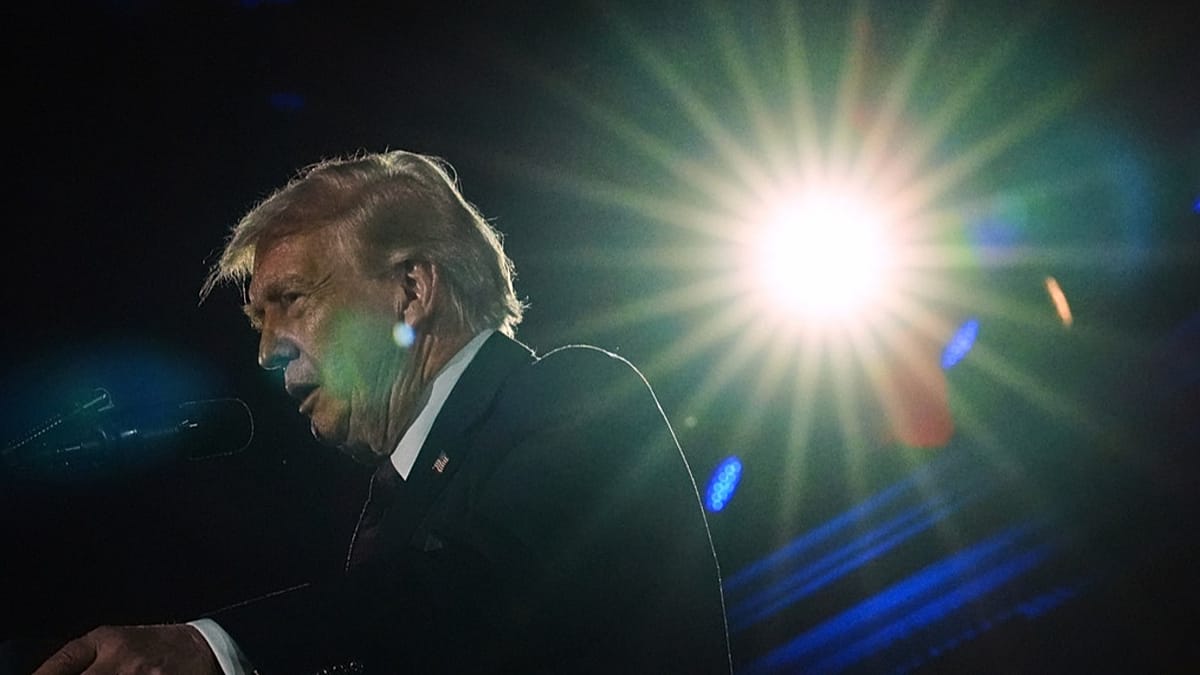
President Donald Trump speaks at the National Republican Congressional Committee's (NRCC) annual fundraising dinner, Wednesday, March 25, 2026, at Union Station in Washington
-
Copyright
AP Photo/Julia Demaree Nikhinson
Copyright AP Photo/Julia Demaree Nikhinson
By Malek Fouda & Aleksandar Brezar
Published on 26/03/2026 - 5:49 GMT+1•Updated
12:05
Copy/paste the article video embed link below:
Donald Trump said on Thursday that Iran is “begging” for a deal as both sides trade demands, amid intensifying airstrikes and the Strait of Hormuz closure continuing to drive oil prices higher.
US President Donald Trump said on Thursday that Iranian negotiators are "begging" the US to make a deal, after Tehran had dismissed his 15-point plan and issued its own sweeping counter-demands to stop the war as it launched a fresh round of attacks against Israel and neighbouring Gulf Arab states.
"The Iranian negotiators are very different and 'strange,'" Trump said in a post on his Truth Social platform on Thursday
"They are 'begging' us to make a deal, which they should be doing since they have been militarily obliterated, with zero chance of a comeback, and yet they publicly state that they are only 'looking at our proposal.' Wrong," the US president added
"They better get serious soon, before it is too late, because once that happens, there is no turning back, and it won’t be pretty."
Earlier on Wednesday, Pakistan, which has emerged as a possible mediator to the war, said it had presented the US demands to Iranian officials to kickstart diplomatic processes aimed at restoring order and peace to the region.
Speaking broadly on Washington’s demands, Pakistani officials familiar with the Trump proposal said the deal included sanctions relief, a rollback of Iran’s nuclear programme, limits on missiles, and the reopening of the crucial Strait of Hormuz, through which a fifth of the world’s oil normally passes.
Responding to the proposal, Iran — through state-run broadcasters — rejected the White House’s demands and instead issued its own list of demands, which included reparations for the war, guarantees that no further wars could be launched against it, a halt to killing of its officials and sovereignty over the strategic waterway.
They also maintained that Iran had not engaged in any sort of direct or indirect negotiations aimed at ending hostilities with the United States, rebuking Trump claims.
“No negotiations have happened with the enemy until now, and we do not plan on any negotiations,” said Abbas Araghchi, Iran’s foreign minister.
'They want to make a deal so badly'
Trump insisted at a Republican fundraiser on Wednesday night that talks were ongoing with Iranian leaders.
“They are negotiating, by the way, and they want to make a deal so badly, but they’re afraid to say it because they figure they’ll be killed by their own people,” said Trump.
Trump dances after speaking at the National Republican Congressional Committee's (NRCC) annual fundraising dinner, Wednesday, March 25, 2026, at Union Station in Washington
Julia Demaree Nikhinson/Copyright 2026 The AP
His comments come as US and Israeli strikes across Iran have appeared to pick up in intensity as the Iran war enters day 27
Trump had earlier on Wednesday warned that he is ready to “unleash hell” if Tehran failed to enter into a deal with the US, threatening to hit them “harder than they’ve ever been hit before”.
Activists in Isfahan reported major strikes early on Thursday in the city, located some 300 kilometres south of Tehran, which hosts some of the country’s biggest air bases and military sites, as well as one of the nuclear sites bombed by the US in June.
A semi-official Iranian news outlet, close to the elite Revolutionary Guard (IRGC), described the attacks as targeting “two residential areas,” without elaborating
Several explosions were also reported in the eastern city of Mashhad.
Meanwhile, sirens sounded across Tel Aviv and central Israeli cities, warning of an incoming missile salvo
It was not immediately clear as officials did not specify whether Iran was responsible for the latest launch or whether the barrage was fired from its Lebanon-based proxy Hezbollah.
People take cover in a bomb shelter as air raid sirens warn of incoming Iranian missile strikes in Bnei Brak, Israel, Wednesday, March 25, 2026
Ohad Zwigenberg/Copyright 2026 The AP
Tehran is also continuing to fire fleets of drones and missiles at its neighbouring states in the Gulf region, most of which host US bases, in attacks that have targeted military sites, but also civilian areas and energy infrastructure.
Shipping and oil exports also remain suspended through the chokepoint of the Strait of Hormuz, exacerbating a dire crisis that has seen oil prices spike globally
Brent crude, the international standard, traded at around $104 a barrel on Thursday, a 60 per cent surge from pre-war figures.
The death toll in the war continues to climb, with the latest figures coming out of Iran indicating that it has surpassed 1,500
Tehran's death toll cannot be independently verified.
In Israel, the death toll has risen to 20, while US deaths remain at 13, all service members
At least 22 people have also died in Iranian strikes across the Gulf states.
Iran rejects Washington's 15-point plan and escalates attacks on Israel and Gulf
What we know and do not know about the Iran war negotiations
Iran escalates strikes across Middle East after Trump signals possible deal
Related Stories



Source: This article was originally published by Euronews
Read Full Original Article →
Comments (0)
No comments yet. Be the first to comment!
Leave a Comment