
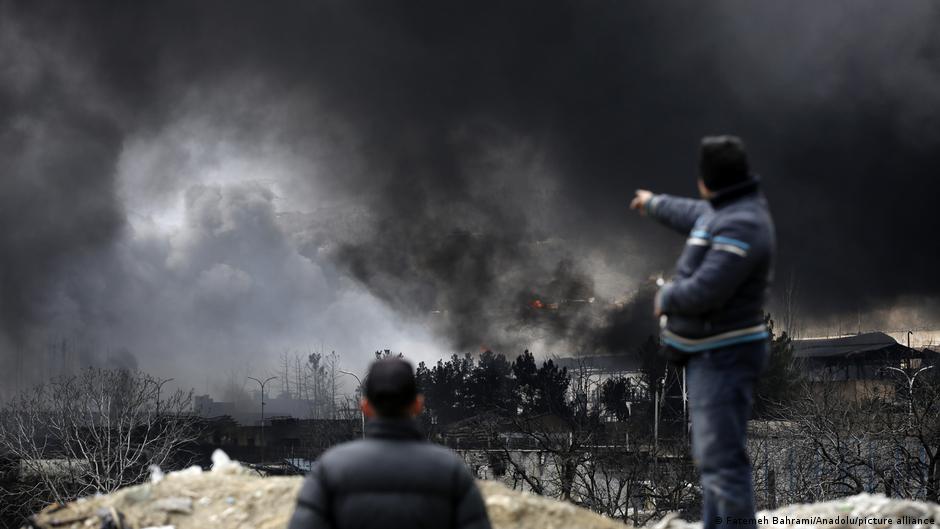
The fallout from fighting in the Middle East, from burning oil refineries to sunken ships, threatens lasting repercussions for the health of the region's people, water and food supplies, and ecosystems.
Strikes on oil facilities and missile bases in the US-Israeli war with Iran are raising concerns among experts about a toxic legacy for human health and the environment that could linger long after the fighting ends.
Since the conflict began, UK-based nonprofit Conflict and Environment Observatory (CEOBS) has identified more than 300 incidents of potential environmental harm — from strikes on missile bases to attacks on oil tankers in the Persian Gulf.
But the researchers say that figure likely captures only a fraction of the damage.
"That's just the tip of the iceberg," CEOBS director Doug Weir told DW.
"The US are claiming that they've hit 5,000 sites.
So right now, we're just scratching the surface."
The United Nations has also warned that recent strikes on oil facilities could risk "serious environmental consequences across the region, with immediate possible impacts on safe water, on air that people need to breathe, and on food."
One sign of those risks came when "black rain" — a mix of oil and precipitation — covered the streets of Tehran following Israel's weekend strikes on multiple oil facilities.
The smoke likely included pollutants, "including fine particulate matter and sulfur dioxide, but also toxic volatile organic compounds and other hazardous combustion by-products," said Zongbo Shi, professor of atmospheric biogeochemistry from the UK's University of Birmingham.
Such particles can penetrate deep into the lungs and are associated with increased risks of respiratory and cardiovascular illness, particularly among infants, older adults and people with pre-existing health conditions, added Shi.
UN: Iran war raises 'serious environmental concerns'
To view this video please enable JavaScript, and consider upgrading to a web browser that supports HTML5 video
Beyond immediate air pollution, experts warn that bombed military and energy sites can leave behind contamination that persists in the environment for years.
When oil facilities are bombed — as they have been in Iran, and other Gulf states — they can release plumes of toxic pollutants that may spread to nearby communities and accumulate on roads, roofs, soils and croplands, the CEOBS said.
Attacks on military sites like missile bases can also be extremely dangerous, as fires and blasts spread toxic contaminants such as fuels, heavy metals, PFAS, and explosives.
Some of those substances can linger long after fighting stops.
For example, TNT, which is used in munitions and is classified as a possible human carcinogen by the US Environmental Protection Agency (EPA), can remain in the soil, harming vegetation and human health.
Assessing the scale of contamination, however, remains difficult without on-site testing.
"There's so little transparency or certainty around what is in these sites that have been hit," said Weir.
"We know in general terms that they may contain military materials, some of which are toxic like propellants and fuels for missiles, but we don't really have any particular detail or data on what is there and what has been destroyed."
Weir's group can only use satellite imagery, radar damage maps, social media, and news reports to assess the potential environmental risks from afar.
Strait of Hormuz, the world's most critical oil chokepoint
US-Israeli attacks on Iran's navy and Tehran's strikes on vessels seeking to travel through the Strait of Hormuz also increase the risk of oil spills.
"That's a dimension we don't necessarily see that much in most conflicts," Weir said.
"We have also seen a number of coastal sites attacked by Israel, where there's a high likelihood of pollutants entering the coastal environment."
The US said Wednesday it had struck more than 60 Iranian ships during the fighting.
Sunken ships can become long-term sources of pollution if fuel and other hazardous materials leak into surrounding waters, Weir said.
An Iranian frigate torpedoed during the conflict is now leaking a kilometers-long oil slick off Sri Lanka, he added.
"It's not just the Persian Gulf which has been at risk," noted Weir.
"These environmental impacts have now gone all the way around to Sri Lanka."
Another way the environmental fallout can spread beyond conflict zones: the massive amounts of planet-warming carbon emissions caused by waging war.
The first three years of Russia's war in Ukraine, for example, produced at least 230 million tons of CO2 equivalent, according to nonprofit Initiative on GHG Accounting of War.
That's comparable to the combined annual emissions of Hungary, Austria, Czechia and Slovakia.
Militaries themselves are huge fossil fuel guzzlers.
If the world's militaries were a country, they would have the fourth biggest carbon footprint in the world, accounting for roughly 5.5% of global emissions.
Yet countries are not required to include military emissions in the national totals they report as part of their obligations to limit global heating under the Paris climate agreement.
When it comes to the environmental legacy of war, the focus is often on the tangible, said Weir.
"We see fires, we see the explosions, we see cratering, we see military vehicle movements, we see millions of kilometers of fiber optic cable spread over forests, along the front lines — as we're seeing in Ukraine at the moment," he said.
How the military keeps its CO2 footprint secret
Recovery in the aftermath of war
Iran was already facing severe environmental pressures, including chronic water shortages, worsening air pollution and the degradation of major ecosystems, exacerbated by climate change and state mismanagement.
The war is deepening those challenges.
Conflict is often followed by weak governance, with environmental protection taking a backseat in transitions from war to peace, Weir noted.
Weir believes that would likely be the case in Iran, a country he said, "has typically been very secretive and closed around environment and environmental degradation."
If the Iranian regime stays in place, Weir added it's not clear how open it would be about the need for a cleanup, or how much support would be forthcoming from the international community.
"We are seeing a lot of environmental damage, but there's also potentially a high likelihood that we will have very little transparency around it in the future and very limited capacity in terms of cleaning up or managing any damage that's been caused."
Related Stories


Source: This article was originally published by Deutsche Welle (DW)
Read Full Original Article →
Comments (0)
No comments yet. Be the first to comment!
Leave a Comment