
In the village of Aintoura, in the mountains above Beirut, there is a building that was once a school.
It has not been a school for some time.
Omar Toni Azar is here with his mother and father, helping to run the shelter they have opened inside it.
You could call it a family business except they do this for free.
"There are around 160 people here now," Omar told RTÉ News.
"I hope there will not be more, because some rooms are divided between two, three, four families.
There are two rooms with six and seven families - around 30 people per room.
It is hard for them," he said.
This centre first opened its doors in 2006, during another war between Israel and Lebanon.
But the country has been through so many crises since then that it has rarely been empty for long.
The people sheltering here today are not just fleeing this war.
Many of them feel like they have been fleeing something their entire lives.
Inside, daily life carries on as much as it can.
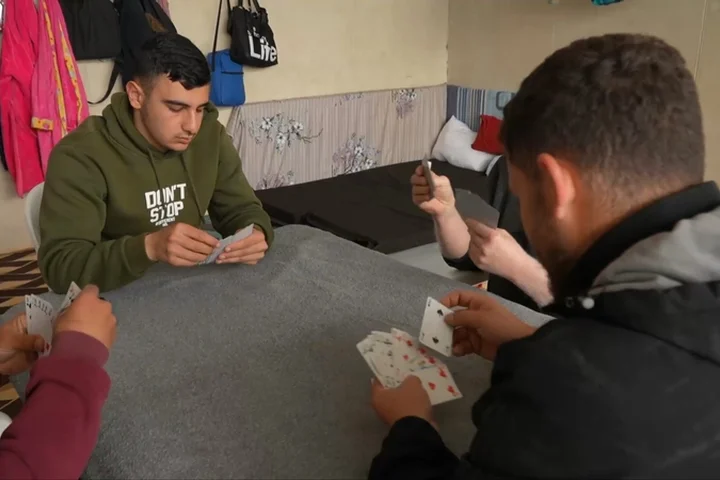
In one room, a group of men found a small distraction - a game of cards, a few hours of forgetting.
Elsewhere, children move through corridors, food is prepared on makeshift hobs, and conversations drift between the mundane and the unbearable.
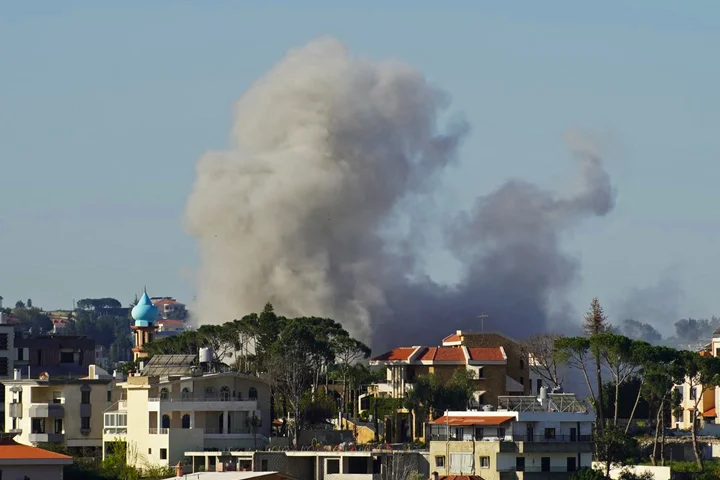
"This is my village that Israel strikes in the day and in the night and kills civilians," he said.
"My friends died.
About 20 of my friends."
Israel has ordered the evacuation of roughly a fifth of Lebanon's territory, displacing more than 1.2 million people - almost one in five of the country's entire population.
The evacuation zone extends to the Zahrani River, 40km north of the Israeli border.
Israel says it intends to hold a so-called security zone up to the Litani River indefinitely - some 30km inside Lebanese territory.
That, in effect, amounts to an open-ended occupation of sovereign Lebanese land.
When news of the US-Iran ceasefire broke in the early hours of Wednesday morning, there was joy in this shelter.
People here had gone to sleep not knowing whether they would wake to more bombs or to peace.
They woke to the news of a deal.
Wednesday became the single bloodiest day of this war in Lebanon.
More than 300 people were killed as Israel launched over 100 strikes in 10 minutes - hitting not just the south, but central Beirut, the seafront, residential neighbourhoods that had felt, until that morning, removed from the fighting.
Israel said the ceasefire did not apply to Lebanon.
The United States agreed.
Tala Hijazi has been sheltering in Aintoura since 2023 - through two wars with Israel.
She described what it felt like when hope arrived, and then was taken away within hours.
"But then, no, it didn't stop.
And it was a horrible day because we were happy and then suddenly sad.
The energy was up and then down.
We just want to go back.
We hope to go back.
We don't know when."
It is a hope that, for now, has nowhere to go.
Related Stories


Source: This article was originally published by RTÉ News
Read Full Original Article →
Comments (0)
No comments yet. Be the first to comment!
Leave a Comment