
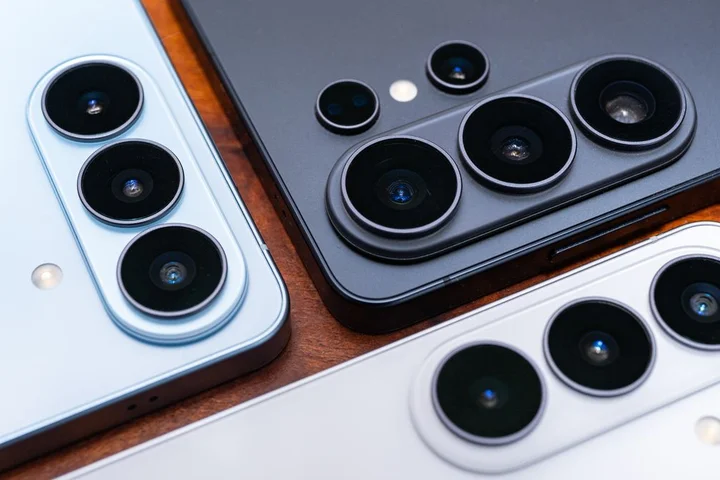
There's the iPhone, and then there are Samsung Galaxy phones—those are the two most popular phone brands in the US.
But whereas Apple is the sole company behind the iOS mobile operating system, even the best Samsung phones face stiff competition in the Android world.
(And yes, Galaxy phones are Android phones , though Samsung calls its layer over Android “One UI.”)
Google's Pixel phones are my favorite Android devices , but Samsung's offerings are just as great and often have better hardware.
Alongside Google, Samsung promises the longest software support for its cheap and high-end devices.
That means you don't have to upgrade your phone as often, as it will stay up-to-date, secure, and bug-free for longer.
But the Korean giant has many, many models at varying prices.
What's the best Samsung phone?
I sort it out here in this guide.
I also have tips and tricks to get the most out of your shiny new hardware.
Check out our mobile guides, including the Best Samsung Galaxy S25 Cases , Best Galaxy S24 Cases , Best Android Phones , Best Cheap Phones , Best Pixel Phones , and Best Folding Phones .
Updated March 2026: We've added the entire Galaxy S26 series and mentioned Samsung's upcoming Galaxy A37 and Galaxy A57.
The best part of being in the world of Android is choice of hardware.
Want a phone with a headphone jack?
Sure !
Want a phone that fast-charges in around 30 minutes?
It exists .
So why stick with the stalwart Samsung?
In my experience and research, Samsung's smartphones have a track record of reliability, and because it's a major player, it has a wider network of authorized repair centers than competing Android manufacturers.
Yes, I remember the Galaxy Note 7 fiasco and even the issues with the first-gen Galaxy Fold , but Samsung now has a customer satisfaction score equal to Apple, according to the American Customer Satisfaction Index .
That said, I haven't read great things about the company's US customer support team.
With its flagship phones, you're getting top-of-the-line specs and exceptional build quality with long software support.
I primarily pick Pixel phones over Samsung because I prefer Google's software experience, but there are plenty of people who like Samsung's take on Android.
As always, keep an open mind and consider all the other options available to you.
Samsung announced the Galaxy S26 series on February 25 at a Galaxy Unpacked event in San Francisco.
If you're after the best Samsung phone, now's a good time to buy.
It's worth keeping the company's launch time frames in mind if you want the latest and greatest.
Consider these dates as you shop, because you may want to hold off and wait for the new model, or it can help inform you on when to expect the best discounts.
How Long Are Samsung Phones Supported?
Android phones used to have disastrously poor software support .
Two years after you bought your $1,000 phone, it would no longer receive software updates.
Thankfully, Google began promising longer software update cycles to its Pixel phones , which ended up pushing Samsung to match it.
The following Samsung phones will receive 7 years of software updates from their release date, which includes Android operating system updates and monthly security patches.
The latter keeps your phone secure, and new OS versions can bring new features to your phone.
Samsung's Galaxy A-series phones, from the A16 and up, will receive 6 years of updates.
Most other older Samsung devices, like some in the Galaxy A series or older flagships, will receive four years of OS updates and five years of security patches starting from the date of release.
Some of this varies, as Samsung has kept changing its policy year over year, but there's a little more helpful information here .
To find out if your Samsung phone has a pending update, go to Settings > Software update > Download and install .
It should check for any updates and download them, then you'll see an option to install.
Make sure you back up your phone before installing any update.
We have a guide here .
Why I Recommend Buying Unlocked
Most people buy phones directly from their carrier, but if you're reading this guide, I suggest you buy an unlocked smartphone.
When you buy a carrier phone, it's “ locked ” to that network.
That means if you want to switch carriers, like move from Verizon to T-Mobile, you'll have to ask your carrier to unlock the device, and this can be a huge headache.
(Especially if you're traveling and want to use an international SIM card .) Asking a carrier to unlock a phone usually has a few requirements, like making sure your device is paid off or waiting for a set period of time.
Unlocked phones, on the other hand, don't have this problem.
You're free to use whatever carrier you want, whenever.
Carriers also mask the true cost of a smartphone.
AT&T may entice you with a $36 per month payment for a shiny new Samsung flagship, when in reality, that means you're paying $1,300 on a smartphone over 36 months.
Did you really want to spend that much ?
Or will a cheaper phone suffice?
Also, you're more likely to get software updates faster as they come directly from Samsung, and there's often far less preinstalled bloatware to deal with.
All to say, buy unlocked!
You can buy unlocked Galaxy phones directly from Samsung and most third-party retailers like Amazon, Best Buy, and Walmart.
The Settings to Change on Your New Samsung Phone
Samsung has an annoying habit of announcing a bunch of cool new features with its smartphones, then leaving them turned off by default.
If you've never fiddled around with your phone's settings, there's a good chance there are a lot of fun and helpful features you're not using.
This can include things like changing the navigation from onscreen buttons to gesture navigation, adding the battery percentage icon next to the battery bar, or keeping the always-on display turned on instead of requiring a tap on the screen.
Good news for you!
As I routinely switch phones, I drummed up a list of the most important settings to change when you get a Samsung phone.
Read it here .
Pro tip: I personally can't stand using Samsung's default keyboard, so I almost always change it to Google's Gboard instead .
Explaining "Qi2 Ready" Samsung Phones
Qi2 is the new wireless charging standard—it takes a page from Apple's MagSafe technology and embeds magnets directly into the smartphone, allowing it to connect to accessories and chargers magnetically, even the same ones available for iPhones.
That has the potential to increase the compatibility of accessories across devices, which is a good thing.
The magnets ensure precise charging, so you never worry about a misaligned phone that won't charge.
It offers better efficiency and can potentially charge faster.
We have more details in our Qi2 explainer here .
Confusingly, Samsung's 2025 and 2026 flagship phones are “ Qi2 Ready ” and technically not true Qi2 smartphones.
This means that they have the capability to support Qi2 if paired with a magnetic case , but alone, the S25 and S26 series do not have built-in magnets.
It's disappointing and creates more confusion, and already I've encountered some cases with varying degrees of magnetic strength, and some cases don't quite work with basic Qi wireless charging stands .
Which Samsung phones are Qi2 Ready?
Read our deep dive into "Qi2 Ready" for more.
And check out our Best Galaxy S25 Cases guide too .
Qualcomm Snapdragon vs.
Exynos Chipsets
The gap isn't as wide between these processors anymore, but there have been issues in the past.
Exynos chips tended to overheat a few years ago, though they sometimes offer slightly better battery life than their Qualcomm counterparts.
It even greatly impacted camera quality as the chip handles image processing.
Again, none of this is as big an issue as it used to be, but it's worth keeping in mind as you shop.
The first place to start when considering a Samsung phone is the Galaxy S26 series (7/10, WIRED Recommends) .
Yes, Samsung increased the prices of the S26 and S26+ by $100 this year, though it bumped base storage to 256 GB to make up for it.
And no, there's not much new in these phones over the Galaxy S25 models .
Still, they're reliable and versatile.
The Galaxy S26 is the smaller, compact device with a 6.3-inch screen, and the S26+ ups that to 6.7 inches.
There are minor differences between them, like charging speeds, but you're mostly choosing what size you prefer.
You get every high-end feature you can think of, from UFS 4.0 storage speeds to brilliantly bright AMOLED displays with high 120-Hz refresh rates that ratchet down to 1 Hz to be more energy efficient.
The batteries typically last a full day of average use, and with heavy usage, you can still expect them to get you through most of the day.
There's an excellent triple-camera system with 3X optical zoom, an ultrawide in addition to the main camera, and a strong selfie shooter.
These phones also capture some of the best video footage out of the box—especially with Samsung's new Horizon Lock feature, which dramatically improves stabilization.
The powerful Snapdragon 8 Elite Gen 5 processor is better optimized with the hardware, so it's snappy and can handle demanding games with ease.
There are some genuinely helpful AI improvements on the phone, like the updated Document Scanner in the camera app that removes fingers, creases, and distortions.
The Call Screening does a better job of filtering out robocalls and marketers, and Audio Eraser makes it easier to hear your favorite influencer if their video was filmed in a loud environment (on your preferred social media app).
Some features, like Gemini's Task Automation , are interesting and show where we're headed, but it's a little too slow to rely on it.
I think the Galaxy S26 is a better value, even if Samsung removed mmWave 5G support, which lets you connect to ultra-fast 5G in specific, busy environments if available (you still get the standard-fare sub-6 5G ).
The S26+ veers too close in price to the Galaxy S26 Ultra, so if you're considering it, I'd make sure to factor in the Ultra's features, in case you think you'll enjoy having a built-in stylus or an extra 5X optical zoom camera.
Want the best Samsung has to offer?
That'd be the Galaxy S26 Ultra (8/10, WIRED Recommends) .
The highlight feature this year is the Privacy Display —a new display technology that, when enabled, blocks the screen from nosy neighbors.
Since it's integrated into the hardware, you can fine-tune how it works through the software, enabling it to automatically turn on for specific apps, or only for incoming notifications.
There's also a “Max” privacy mode that makes the screen a little washed out and makes it impossible to read at an angle—helpful if you're looking at very sensitive documents.
I quite like this feature and wish it were available on every smartphone, but some folks aren't fans .
(I did not notice a huge impact on screen quality or display brightness.)
Most importantly, the S Pen is built into the phone and is a must-have for many folks who swear by the stylus.
Also, the 200-MP main camera is a notable upgrade, delivering brighter, sharper photos, and there's an extra 5X optical zoom in addition to the 3X.
Samsung added a wider aperture to those two cameras, allowing them to take in more light for brighter shots with less noise.
The S26 Ultra is the biggest phone in Samsung's lineup, but the company slimmed it down a bit this year, so it's a little more manageable in the hand.
It still has the best battery life of the lot, and can extend into day two on a single charge with average use.
But just because this is Samsung's top model doesn't mean this is the right phone for you.
If you don't care about a stylus and don't use the zoom functions on a smartphone camera often, there are few reasons to spend so much on a smartphone.
The Galaxy Z Fold7 (7/10, WIRED Recommends) is one of the most expensive smartphones in Samsung's lineup.
While the flagship Galaxy S26 Ultra wins in many respects, there's now better feature parity between the two devices, so you won't feel like you're losing out by going with the Fold7.
(The only major losses are the lack of the S Pen stylus and the missing 5X optical zoom camera.) The cameras are much closer in quality thanks to both using a 200-megapixel main sensor, and you still get the 3X optical zoom.
Samsung slimmed down the phone considerably, making it wider in the process and lighter.
It's overall much nicer to hold and type on—even lighter than the iPhone 17 Pro Max!
The build quality is excellent, with a reliable hinge and a crease that's easy to ignore.
Battery life is unimpressive, though, just about a day, though far less if you opt to use the inner screen more often.
If you want a book-like folding phone and have the cash, this is the best you'll find right now.
Editor's note: Samsung just announced the Galaxy A37 and Galaxy A57 , but notably, it did not announce a new Galaxy A27.
We'll be evaluating those phones soon.
Samsung makes solid budget phones, but not the best.
I highly recommend glossing through my Best Cheap Phones guide because you might be better served with a Pixel 10a , Nothing Phone (4a) Pro , or Moto G Stylus .
But if you want to stick with Samsung, the Galaxy A26 (6/10, WIRED Review) is the best at the moment.
It's not flashy—the glossy black design is dull and attracts a ton of smudges and dust—but it has many of the features you want for not much money.
Performance is standout here.
The Exynos 1380 delivers a mostly smooth experience, with few stutters, and the 120-Hz 6.7-inch screen helps things feel fluid.
The screen is bright enough to read on sunny days, though the colors get washed out at the max brightness.
This is one of the last few Samsung phones with a microSD card slot, if that matters to you, so you can expand storage (up to 2 TB) on top of the base 128 GB.
The battery easily lasts a full day with average use, and the best part is Samsung will deliver six years of updates—OS and security patches—which is unparalleled at this price.
The final entry in the Galaxy S25 series is the Galaxy S25 FE.
Samsung took the basic foundation of the 2025 flagship Galaxy S25 and stripped out a few features to hit a lower price.
I never think the “Fan Edition” series is worth the MSRP because it almost immediately dips to around $200 during big sale events—at around $450, that's when it's a great deal.
However, I do want to point out that there's not much new here over the previous Galaxy S24 FE; it is an iterative upgrade.
I used this phone for more than a week, and it operated almost flawlessly.
Performance from the Exynos processor never gave me any hiccups, though the phone tends to get quite warm in specific spots on the back.
I tried Genshin Impact , and while I wasn't experiencing ultra-smooth gameplay, especially when I cranked the graphics, it was playable.
The battery lasted me through a full day of average use, though heavy users may find themselves plugging in by the evening.
The cameras are impressive for the money, especially the 3X optical zoom.
I got some decent photos out of the 10X digital zoom, too.
It's not amazing in low light, especially when trying to capture a subject that won't stay still (my dog), and the autofocus can sometimes mess up, so you may find yourself tapping the shutter button a few times extra.
The results are still pretty dang good.
You get the same Qi2 Ready wireless charging treatment as the other S25 phones, meaning there are no magnets baked into the device; you'll need a magnetic case if you want to use the FE with Qi2 chargers .
At least you'll get 7 years of software updates.
All things considered, if you don't want to pay flagship prices and you definitely want a Samsung phone, the S25 FE is the way to go.
Samsung's Galaxy Z Flip7 (7/10, WIRED Recommends) isn't my favorite flip-style folding phone—that'd be the Motorola Razr Ultra —but this version has made some nice changes that make the phone thinner with bigger screens and a more durable hinge mechanism.
The external screen is now 4.1 inches, so you can see more content at a glance, though annoyingly, you need to install an app called Multistar if you want to open any app on this display.
Open it up, and you get a 6.9-inch screen that's bright, sharp, and colorful.
Performance is great, though the phone does get a little too warm for my liking.
Unfortunately, battery life is lackluster.
Most people may struggle to last a full day on a single charge.
The cameras are solid, but Samsung is facing serious competition from the Razr Ultra.
In head-to-head comparisons, I ended up liking more photos from the Razr over the Flip7, which is quite shocking considering Samsung usually wins in the camera department.
Still, if you want to stick with a Samsung phone—it'll get far more software updates and has a better repair network, after all—the Flip7 is a satisfactory update that looks great and is wonderfully pocketable.
What Happened to the Galaxy Z TriFold?
I have not tested Samsung's Galaxy Z TriFold, and it seems like I never will.
(I had some brief hands-on time with it at CES 2026 , but Samsung did not provide WIRED with a test unit.) This $2,899 folding phone officially went on sale in the US at the end of January, but three months later, Samsung discontinued it due to high manufacturing costs.
Yes, unfolding it from a fairly compact phone to a massive 10-inch tablet was amazing and the stuff of dreams, but it didn't justify the high price; you can buy a killer phone and excellent tablet for way less than $3,000.
The luxury of having them in one pocket is incredible, but more than a $1,000 incredible?
I think the TriFold is the true “phablet” Samsung promised so long ago, and the folding mechanism is novel and a marvelous feat.
Hopefully, when the smartphone market picks back up, Samsung will revisit this design.
It's great for productivity junkies who frequently juggle multiple apps.
Alas, it's just a dream now.
You'll have to stick with the standard Fold7.
There's nothing wrong with buying the previous generation of flagship phone.
You can score a good deal, especially on the used market, and frankly, the Galaxy S25 series (7/10, WIRED Recommends) is shockingly similar to the latest Galaxy S26 devices.
There's the 6.2-inch Galaxy S25, 6.7-inch Galaxy S25+, and 6.9-inch Galaxy S25 Ultra.
They're powerful through and through, with similar cooling capabilities, so the phone doesn't get too hot when playing demanding mobile games.
Just don't pay MSRP—you may as well buy the latest and greatest if that's the case.
Other Samsung Phones to Consider
If you don't see a Samsung phone mentioned in this guide, that might be because it's not sold in the US and is a little harder to source for testing.
But here are a few other Samsung phones I've tested to consider.
Samsung Galaxy S25 Edge for $1,220 : Have you ever wanted a really thin and lightweight phone?
No?
Well, Samsung has an option for you anyway.
The Galaxy S25 Edge (6/10, WIRED Review) was a unique one-off last year (it's doubtful we'll see a successor) and matches several features of the Galaxy S25 Ultra, like a titanium frame, stronger front glass, and 4K 120 frames per second video recording.
All the cameras even have autofocus.
But it made several sacrifices to achieve its amazingly slim 5.8-mm frame (for context, the S25 Ultra is 8.2 mm thick).
There's no stylus, no telephoto camera, and worst of all, the battery capacity has been slashed.
We've seen this before—thin phones have always compromised on battery life, and that's no different here.
I constantly had to baby this phone's 3,900-mAh battery with mixed usage, and that's just not acceptable.
(The iPhone Air did it better.) If you find yourself constantly near a power source and think you'll enjoy the slim and light design, then go for it.
Samsung Galaxy A17 5G for $200 : On paper, the Galaxy A17 (5/10, WIRED Review) seems like a really great deal.
Six years of software support, an AMOLED screen, expandable storage, and a decent camera.
Unfortunately, it's held back by lackluster performance.
The problem is specifically the very limited 4 GB of RAM in the US model, which ruins the entire experience of using the phone.
If you had to use your smartphone in an emergency, I would not trust the A17 to be reliable.
But if your needs are extremely minimal, it may suffice.
Samsung Galaxy A36 5G for $350 : The Galaxy A36 (6/10, WIRED Review) doesn't quite measure up to its peers from Nothing and Motorola.
Performance is just too choppy, and that's not acceptable at this price.
It's manageable—it's not so slow that it will frustrate—but you can do better.
If your needs are very minimal, it's an OK phone, and the camera system is good, with day-long battery life, a nice AMOLED screen, and 6 years of software updates.
Samsung has announced the Galaxy A37, which got a $50 price hike, but will most likely perform better.
Samsung Galaxy Z Fold6 or Galaxy Z Flip6 : If you don't want to pay a premium for a new folding phone, then consider 2024's Galaxy Z Fold6 and Galaxy Z Flip6 (7/10, WIRED Review) .
The Fold6 has a close to “normal” smartphone experience on the exterior 6.3-inch screen.
Open the phone up, and there's a vast 7.6-inch AMOLED screen staring at your face, turning this folding phone into a tiny tablet.
The Flip6 isn't as nice as the newer Flip7—the bigger and brighter cover screen on the latest model is a step up—but it's worth considering over the new Galaxy Z Flip7 FE .
Technically, it's nearly identical to that phone, but the FE uses a Samsung Exynos chip instead of a Qualcomm processor, and performance may not be as smooth.
The main drawback?
Battery life isn't great.
Make sure you don't pay MSRP for these 2024 phones.
Should You Invest in Samsung’s Ecosystem?
Samsung is one of the few smartphone manufacturers that can match Apple in its hardware ecosystem.
Not only does the company make smartphones, but you can also expand your experience by adding on a Galaxy Watch8 smartwatch , Galaxy Buds4 Pro earbuds , Galaxy Ring fitness ring , Galaxy Tab S11 , and even a Windows-powered Galaxy laptop .
Again, it's not necessary, and these other devices might not be the right ones for you within their respective categories, but if you're chasing hardware parity, you have that option with Samsung.
With the Galaxy S24 series, Samsung launched “ Galaxy AI ," a selection of artificial intelligence features, many of which are powered by Google's Gemini large language models .
These enable smart features that may be helpful day to day, like real-time translations during phone calls, real-time transcriptions in Samsung's Voice Recorder app, the ability to summarize long paragraphs of text in the Samsung Notes app, or change a sentence's tone with the Samsung Keyboard.
In the Galaxy S25 series, Galaxy AI expanded to include Gemini as the default voice assistant and the ability for Gemini to work with multiple apps simultaneously.
It also debuted Drawing Assist, which lets you sketch or enter a prompt and get an AI-generated image.
Now, you can also use video in real-time with Gemini, even from the cover screen of the Galaxy Z Flip7.
And in the Galaxy S26 series, the AI features got even more helpful.
The Document Scanner built into the camera app can now erase fingers and creases and minimize distortion before converting the photo into a PDF.
Audio Eraser is something you can now toggle in any media app to reduce distracting background sounds in videos, so you can hear the subject clearly.
And there's now built-in call screening to better filter out robocalls.
Samsung also debuted Google's Task Automations in the Gemini assistant , allowing you to ask Gemini to book you an Uber or order something from DoorDash, Uber Eats, or GrubHub, though it's pretty slow.
You can find many of these features by heading to Settings > Galaxy AI to toggle them on or off.
We have an explainer on how to limit Galaxy AI to on-device processing , too.
Samsung's DeX (short for “desktop experience”) launched in 2017, and it's a way to plug in your Samsung phone to an external monitor and trigger a desktop version of the Android OS, all completely powered by the phone.
You can find a list of compatible Samsung phones here —the Flip7 is the first Galaxy Flip to support DeX—and you'll need a monitor , mouse , and keyboard , plus a cable to connect the phone to the monitor.
(You can also cast DeX to select screens wirelessly.)
When in DeX mode, you can resize Android apps and have them all open in separate windows.
It's a proper computing platform, though you probably won't want to use this as a permanent laptop replacement or anything of the sort.
It's great if you're visiting another office, or working out of a coffee shop or airplane (if you have a portable display).
We have a whole guide to setting up and using DeX here .
With each Samsung smartphone, I always put my personal SIM card inside and spend as long as I can (a few weeks) using the phone as my own.
I do camera testing and compare the results with similarly priced devices, I benchmark performance and play graphically demanding games to see how they fare, I try out all the new features, and even take calls to make sure that ol’ function still works fine.
Samsung GS25+ Free With T-Mobile for Business SuperMobile
Squarespace Promo Code: 20% Off Annual Acuity Subscriptions
LG Discount Code: 10% Off Any Purchase
10% Off Dell Coupon Code for New Customers
30% Samsung Coupon - Offer Program 2026
10% Off Canon Promo Code + Up to 30% Off
Related Stories



Source: This article was originally published by Wired
Read Full Original Article →
Comments (0)
No comments yet. Be the first to comment!
Leave a Comment