
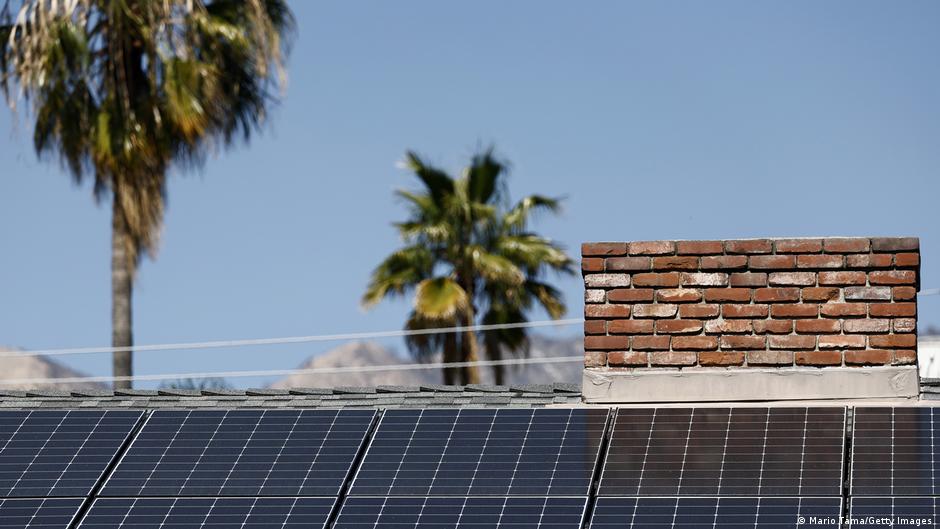
Americans are embracing easy, plug‑and‑play solar units that slash energy costs — even as Washington tries to slow the clean‑energy shift.
DIY solar systems have boomed in Germany and across Europe in recent years, with solar panels showing up on balconies and in backyards.
So far, Utah — which backed Trump for president in 2024 — is the only state to have passed the necessary regulatory reforms to exempt smaller systems under 1,200 watts from rules designed for larger rooftop models.
Vermont and Virginia have also recently advanced similar bills with near-unanimous support, from both Democrats and Republicans.
'Americans are eager for more options to go solar'
Once set up, they reduce the amount of electricity that users take from the grid, generating enough to power small appliances like the fridge, washing machine or computer.
"Americans are eager for more options to go solar.
What we need for the market for plug-in solar to take off is for states to cut red tape that is holding plug-in solar back," said Ben Delman, editorial director of Solar United Neighbors, an advocacy nonprofit based in Washington D.C.
"Once this happens, we expect the market to grow as it has in Germany."
More than 1 million plug-in devices in Germany
Commercial plug-in solar panels have been circulating in Germany since at least 2010, but have only begun to see widespread adoption in recent years.
That popularity was driven in part by Russia's invasion of Ukraine, and the move away from Russian gas.
More than 400,000 new balcony systems were registered in 2024, representing 2.6%, or 0.4 gigawatts, of Germany's new solar capacity that year.
The total number of plug-in installations reached 1 million in June 2025.
But the Bundesnetzagentur, which regulates Germany's electricity networks, said the actual number of installations was likely higher, as not all balcony panels are registered.
The solar tech, which limits feed-in power to 800 watts, is now available across much of the EU, with financial support mechanisms in countries like Germany, Austria and Lithuania .
'Economics make sense' for many in US
For now, the growth of plug-in solar in the US is being held back by an expensive, time-consuming approval process.
"We believe that the bleakness of all things renewable energy at the federal level is one of the factors that make plug-in solar so attractive and popular in this moment, even across the highly divided political spectrum," he said.
"This is something that citizens can do at the hyperlocal level, and state lawmakers can enable it without spending any taxpayer money."
"The economics make sense," said Delman, of Solar United Neighbors.
"We project a roughly five-year payback period today once the regulations change.
This should drop rapidly as more state markets open."
Mayer added that initial demand in states with high electricity prices , like California, would help bring down prices and make plug-in solar more attractive in other markets.
Additional reporting by Amanda Coulson-Drasner.
Edited by: Tamsin Walker
Balcony solar panels: Renewable energy for all!
To view this video please enable JavaScript, and consider upgrading to a web browser that supports HTML5 video
Related Stories



Source: This article was originally published by Deutsche Welle (DW)
Read Full Original Article →
Comments (0)
No comments yet. Be the first to comment!
Leave a Comment