
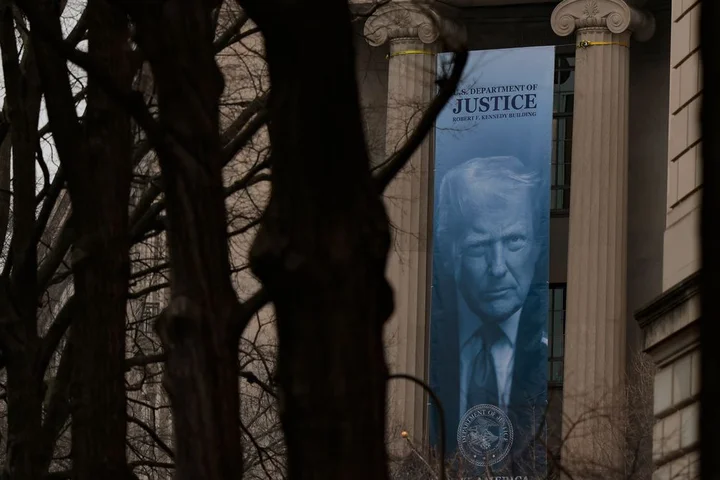
Last week in Rhode Island, in a hearing over the Trump administration ’s efforts to access the state’s unredacted voter lists, US district judge Mary McElroy asked a Department of Justice lawyer what the agency had been doing with the voter roll data it already amassed from other states in recent months.
“We have not done anything yet,” said Eric Neff , the acting chief of the agency’s voting section, a core part of the DOJ’s civil rights division that focuses on enforcing federal laws that protect the right to vote.
Neff added that the data the DOJ collected from states—which can include Social Security numbers, drivers licenses, dates of birth, and addresses—was being kept separate.
But Neff was not telling the truth: The DOJ, he later admitted, was pooling the data and already analyzing it to identify voting irregularities.
In a court document filed on March 27 , Neff walked back his claims.
“The United States represented that each data set was stored separately,” Neff wrote.
“The United States also stated that no analysis had yet been conducted on the data.
To correct and clarify the record, preliminary internal data analysis of the nonpublic voter registration data has begun.
In particular, the Civil Rights Division has begun the process of identifying and quantifying the number and type of duplicate and deceased registered voters in each state.”
The revelation confirms what was widely speculated, which is that the DOJ appears to be pooling the data and using it to identify potential issues with suspected voting irregularities ahead of the midterms, which is a core part of Trump’s broad attack on elections .
Neff and the DOJ did not respond to repeated requests for comment.
Critics have grown increasingly concerned about the DOJ’s voting section, which has undergone a stark transformation since President Donald Trump has retaken office.
A newly installed coterie of inexperienced but ultra-loyal lawyers in the DOJ’s voting section , many of whom have supported election denial conspiracy theories , have spent their time on forcing states to hand over their voter roll information.
The initiative began in May last year, when the Department of Justice sent letters to election officials in at least 48 states and Washington, DC, asking for unredacted voter rolls.
Some Republican-led states immediately handed over the information, but dozens of others pushed back.
As a result, Neff and his colleagues have sued 30 states, asking courts to force them to hand over the information.
So far, courts have sided with the states, with judges already dismissing cases in California , Michigan , and Oregon .
Neff claimed last week in court that 17 states had given unredacted voter roll data to the DOJ, but he didn’t specify which ones.
A tracker maintained by the Brennan Center reports that 12 states have publicly confirmed they have handed over unredacted voter rolls.
It remains unclear if Neff deliberately misled the court in Rhode Island or was unaware of what was happening with the voter roll data, despite being acting chief of the voting section.
Either way, experts are concerned.
“Assuming Neff’s not knowingly lying in court, and the fact is that he's clueless about what's happening, the problem with that is, as a DOJ lawyer, you are charged with knowing these things, you are charged with going into court prepared,” says Becker.
“It is a reflection of the DOJ's rejection of experience and lawyering skill, in favor of loyalty.”
State election officials in most states have continued to rebuke the DOJ’s efforts to access the highly sensitive voting data, and that appears unlikely to change.
“My answer to the voter roll demands is that they'll have to pry it out of my hands,” one election director, who did not want to be named over fears of retribution from the Trump administration, tells WIRED this week.
“There's absolutely no way, because I took an oath of office to protect the voters of the state, and I intend to do so.”
Related Stories

Source: This article was originally published by Wired
Read Full Original Article →
Comments (0)
No comments yet. Be the first to comment!
Leave a Comment