
More than two decades ago, the European Commission floated an idea – introducing a 'Made In Europe' mark for certain products.
It wasn’t exactly a novel concept – consumers would have been used to seeing ‘Made in China’ or ‘Made in the USA’ on many of the products they bought.
Individual European countries would also have stuck a ‘Made In…’ mark on products, too.
So the rather simple suggestion was to create a European equivalent.
But, after some discussion and consultation, the idea sort of just … fizzled out.
Until now.
In recent weeks, the ‘Made In Europe’ debate has been reignited – though now it’s very different to the idea that was floated in 2003.
Because the current debate is less about labels and more about what some say is the existential threat facing the bloc’s entire economy.
And its significance can be measured by just how annoyed it’s made China.
So what’s the new ‘Made In Europe’ idea about?
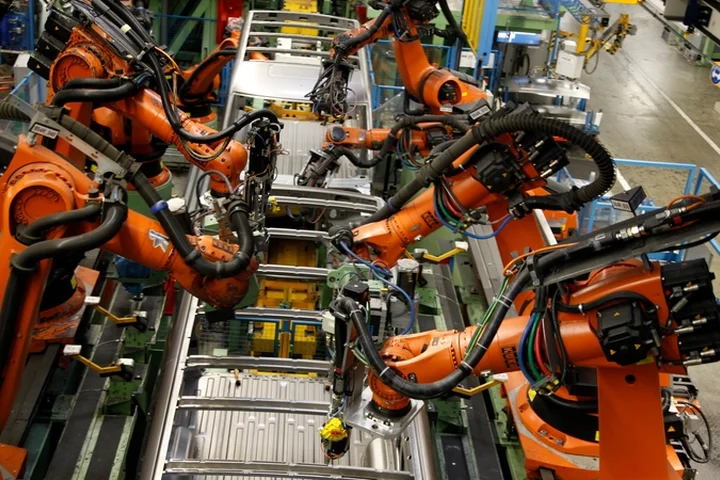
The Made In Europe plan is really a broad push by the European Union to try to encourage more manufacturing and production in Europe – in order to boost the economy here, but also, and maybe more importantly, to reduce the bloc’s reliance on other countries.
Because the EU’s manufacturing base has slowly been eroded away.
In the 1990s, it accounted for more than 20% of the bloc’s GDP, today it makes up just 14%.
And officials feel measures need to be taken to halt, and ultimately reverse, that trend.
At the heart of the plan to do so is the Industrial Accelerator Act, which was published last month.
It proposes a fairly significant shift in priorities for EU countries.
For example, as things stand, there are strict rules in place around public tenders and procurement above a certain value.
In those cases, a government has to make sure the tender is open to everyone, and they can’t favour a local bidder over one from other countries.
Ultimately, they had to focus on the bid that offered the best value.
But under this act, countries would now be required to focus less on the price and more on things like emissions and the bidder’s location.
If it became law, they would actually need to give preference to European companies, or bids where the products were primarily being made in Europe.
The act also proposes location-based minimum thresholds around the likes of subsidies and grants – so a company or product would only qualify if X% of the goods were European-made.
And the act specifically focuses on a number of key areas – namely, electric vehicles, steel production, and green tech like solar panels and wind turbines.
That’s because they are seen to be of strategic importance to the EU, and areas that Europe wants to be competitive in.
While the ‘Made in Europe’ designation died a quiet death 20 years ago, the notion of the EU favouring European goods over those made elsewhere had still had its supporters in recent years, particularly in the likes of France.
But it hadn’t gained momentum until recently, with the prevailing wisdom across most of Europe instead being a focus on free trade and open markets, which would give European countries the best access and citizens the best choice.
But things have changed considerably in the past few years.
The pandemic was one of the big turning points.
Because when global supply chains ground to a halt as a result of lockdowns, particularly the severe ones that happened in China, it highlighted just how exposed Europe was in the event of trade disruption.
That was true of unexpected events like a pandemic, but it would also be true in the event of a souring in Europe’s relationship with other countries.
It was that pandemic experience in particular that led the EU to focus on encouraging more computer chip production in Europe, so that high-tech industries here were less dependent on the likes of Taiwan in the future.
Russia’s invasion of Ukraine then highlighted how dependent many European countries and their industries – particularly Germany – were on cheap Russian gas.
And in more recent times, the return of Donald Trump to the White House has brought focus to Europe’s reliance on the US for so many things.
That’s obviously become a problem in the context of his trade and tariffs policy - but his hostile remarks around NATO also sparked fears that the US might leverage the dependence many European armies had on the American arms industry.
And the Trump Administration’s broader hostility to Europe has brought sharp focus to how reliant the European economy is on US goods and services in general – particularly in areas like tech.
One thing that has really spooked European leaders in recent months is the International Criminal Court judges who were sanctioned by the US because they issued an arrest warrant for Benjamin Netenyahu.
That has led to them being blocked from their email accounts and other digital services, while US dominance around financial services means they have also lost access to credit cards.
(The push for a digital euro is being pitched as part of an attempt to give Europeans a local option for electronic transactions in the future).
So all of this can be seen as factors that have given more weight to the argument that the EU should start to prioritise European companies.
So why is China angered about the Made in Europe plan?
If European countries are given priority in future, major European contracts, this would of course disadvantage firms from other parts of the world.
That includes China, which has benefited greatly from being able to sell products into Europe.
That includes some of the areas that are specifically cited in the Industrial Accelerator Act, like steel and solar panels and EVs.
If Chinese cars and solar panels no longer qualify for green grants in Ireland, for example, that would significantly impact their sales in Europe.
But there is also a particular proposal within the act that, while not actually naming China, is very much focused on trying to contain its influence in Europe.
It applies to investments worth €100m or more, from companies based in countries that account for 40% or more of the global production of certain strategic products.
Batteries is one area, for example, which would apply to Chinese firms.
And China says these kinds of requirements would breach World Trade Organisation rules and global agreements relating to intellectual property.
(It should be said, there are other voices opposing the plan – including some member states within the European Union – who argue that this plan would mean abandoning the European project in favour of protectionism.)
What could China do in response?
In a submission commenting on the proposal, China says it is willing to negotiate with the EU in relation to this, but that, if it is ignored, it would have no choice but to bring in countermeasures.
It doesn’t specify what that might mean, though we’ve already had some trade skirmishes between the EU and China in recent years.
For example, it opened up investigations into some areas where Europe exports a lot to China, like pork, certain drinks like wine and brandy.
So, potentially it could make it far more expensive for European companies to sell products into China, which could be very significant to some firms.
Last year, the EU exported close to €200 billion worth of goods to China.
But as Europe is heavily dependent on other countries – including China – for a lot of products, China could also restrict its own exports in order to punish Europe.
A block on Chinese electronics and textiles reaching Europe, for example, could have a huge impact on businesses and consumers here.
Some say China’s opposition to the plan is a tad hypocritical
There is certainly a case to be made there.
The European proposal to require certain foreign investors to partner up with a local firm is heavily inspired by a rule that China has had for many years, for example.
So Europe would say that they are just proposing to do the same thing that China has done for decades.
But there’s also a feeling that Europe’s manufacturing sector is weaker today, largely because China has taken advantage of the bloc’s attempt at having free and open global trade.
Critics of China say that they have long given heavy subsidies to manufacturers in areas like steel and solar panels, and that has allowed them to undercut European rivals, and put many firms out of business.
And there’s a fear that the same is now happening with electric vehicles – which is one of the reasons why the EU has proposed some hefty tariffs on Chinese EVs.
Partially as an attempt to get around that, manufacturers like BYD have established factories in the likes of Hungary - so technically they’ll be European-made cars, and so not subject to Chinese tariffs.
Under these new proposals, though, that kind of move might not be possible without a local partner on board.
But the likes of BYD are relevant to this too, because they’re symbolic of another reason why some see China’s opposition as hypocritical.
Because the EV-maker is part of China’s own industrial plan, called Made in China 2025, which was unveiled over a decade ago.
That was itself inspired by a German manufacturing plan but, in a lot of ways, its success is in turn what’s spurred Europe to create the Made in Europe plan.
This was a national strategic plan to develop China’s manufacturing sector from being the ‘factory of the world’ to being a global player in its own right.
Because for years China’s industrial policy was to attract in European and American companies and offer to make their products for them cheaper than anyone else.
And it was extremely successful in doing that.
But quickly, China realised that this economic model came with a lot of limitations.
Firstly, it only worked if they were the cheapest – and with China’s middle class growing, costs within the country were rising.
At the same time you had the likes of India and Vietnam building up their own industrial capacity and being able to better compete as manufacturers.
That meant it was getting harder for China to remain the cheapest on the market.
So China figured that, because it had the manufacturing base and capacity, and it already had a huge amount of experience and know-how, it should push on to become more than just a contract manufacturer for cheap stuff for American and European consumers.
Hand in hand with that was also a reckoning that Chinese firms shouldn’t just make things for other companies to sell to consumers – but start selling directly themselves.
Because under the old ‘factory of the world’ model, Chinese manufacturers got a cut but the American and European brands took the bulk of the profits.
And so the Made in China 2025 initiative was a specific plan to shift the country’s manufacturing to the higher and more valuable end of the scale – but at the same time, it envisioned the growth of domestic companies, which would then expand beyond Chinese borders to be come global players in their own right.
Yes – probably one of the most successful so far.
But the EV market is actually full of Chinese brands that are trying to get a global foothold; the likes of Polestar, Ora and Xpeng are sold in Ireland at the moment.
And then of course there are the online retailers like Temu and Shein, which have become massive players, particularly in fast fashion.
Meanwhile, there are particular fashion brands that are growing rapidly out of China – like footwear brand Anta.
It has been around since the ‘90s, but is now targeting growth in the US and Europe.
We’re also seeing this in electronics and appliances – with the likes of Hisense, TCL and Xiaomi.
And it’s happening in far more low-tech areas like cafés and tea shops.
Luckin Coffee is a Chinese chain that was founded nine years ago, it’s already bigger than Starbucks in China, it has around 26,000 stores worldwide, including ten in New York.
There are suggestions it’s eyeing expansion into the European market.
Meanwhile, Molly Tea, which was only founded in China five years ago, now has branches in the US, Canada, England and Austria.
And that’s ignoring some of the old American and European brands that China has taken control of.
For example while Volvo is still headquartered in Sweden it’s been owned by China’s Geely for nearly 16 years.
Supposedly, British car-maker MG is actually owned by Shanghai Automotive Industry Corporation, or SAIG Motors.
Haier is a Chinese appliance company that’s now a brand in its own right – but people are probably more familiar with names like Hoover and Candy, which it also owns.
Meanwhile, that footwear company Anta – at the start of this year bought a more than 29% stake in Puma, which at one stage would have been one of Europe’s biggest indigenous sportswear brands.
Related Stories


Source: This article was originally published by RTÉ News
Read Full Original Article →
Comments (0)
No comments yet. Be the first to comment!
Leave a Comment