
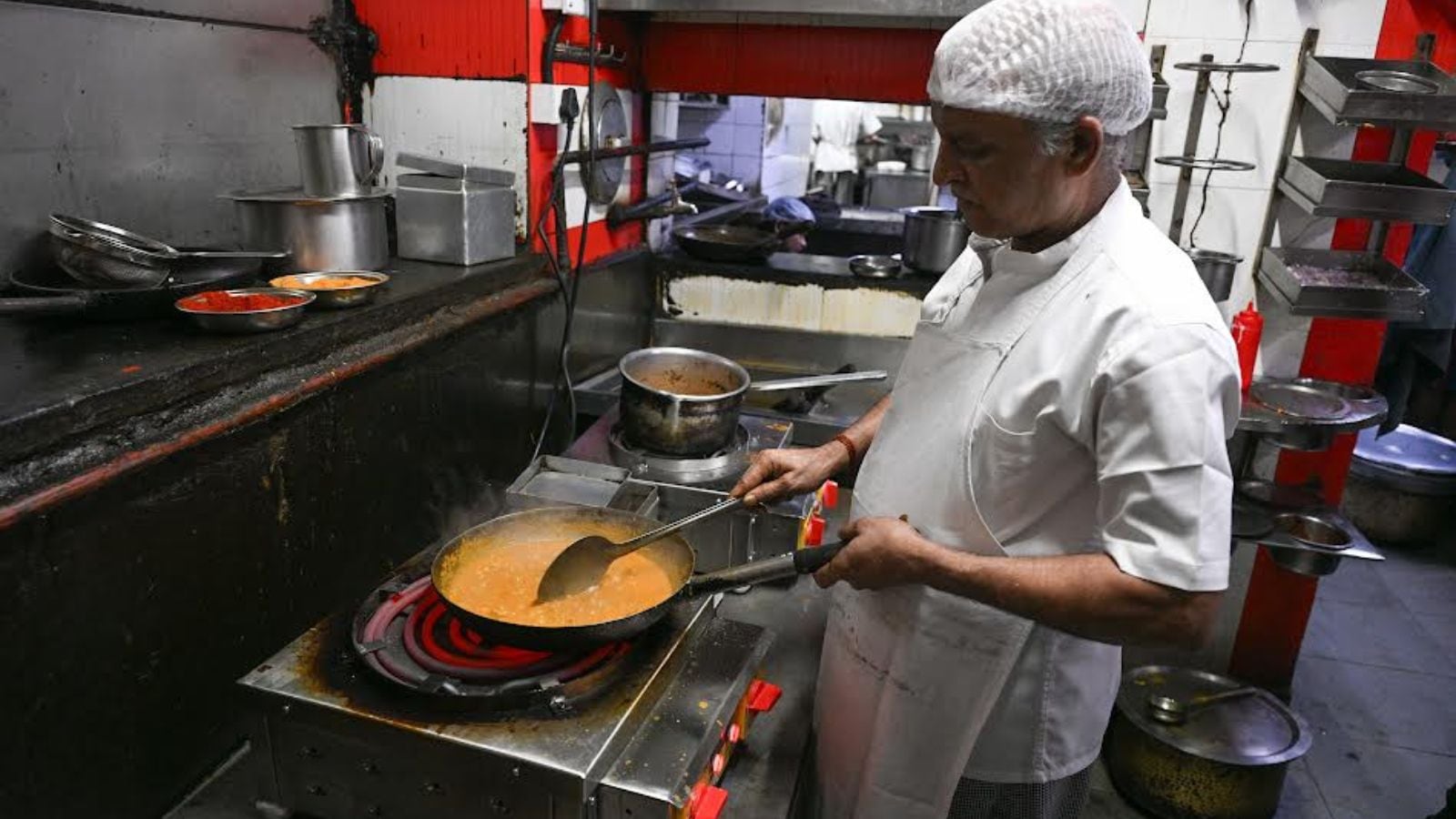
It is noon and Ram Prasad Sharma (56), head chef at Great Punjab, a 66-year-old North Indian restaurant and bar in Dadar East, is making chana gravy for staff lunch taking him almost twice the usual time.
For the first time in his career, Sharma is cooking on an electric coil stove, an appliance that has become an ally for many restaurants because it works with existing utensils.
But he is not impressed.
“After boiling, a chana gravy would take me about 20-25 minutes on gas.
I’ve already been making this for over 40 minutes and it will take another five minutes before it’s done,” he said.
When the first order of the day arrives — vegetarian biryani and dal tadka for takeaway — Sharma switches on the electric coil again.
“It only starts cooking when the coil turns red.
That takes a few minutes,” he said, placing a pan on the stove and waiting for the pre-prepared onion-tomato paste to heat up.
“Earlier I could assemble a vegetarian biryani in 10 minutes and dal tadka in five because I could always use high flame on the gas stove.
This takes time.
The hotter it gets, the better flavour it extracts,” said Sharma, who joined Great Punjab in 1994 as a dishwasher and worked his way up to become head chef.
On a normal day, he would prepare four base gravies — vegetarian, chicken, white sauce and mutton — along with a mixed-vegetable gravy in about two hours.
“Today one gravy took me half an hour on a 4.5-kilowatt stove,” he said.
When asked whether electric stoves would at least reduce the heat in the kitchen, Sharma shook his head.
“It will be worse when all four gas burners are replaced.
They emit more heat.
The smoke, however, will be less.”
For Dhruveer Gandhi, 41, the third-generation custodian of Great Punjab, the past few days have been about trial and error.
He purchased one 4.5-kilowatt stove for Rs 20,000, two 3.5-kilowatt stoves for Rs 15,000 each, and two 2.5-kilowatt units earlier this week.
An electrician rewired the kitchen; a plug-and-socket AC distribution board was installed for the larger units — changes costing upwards of Rs 25,000.
“It’s only after using them that we realised what works and what doesn’t,” Gandhi said.
But now he needs more stoves, and there are none to be found.
A little after 1 pm, raised voices echo through the restaurant.
Gandhi has lost his calm while speaking to his general manager.
“I told you to buy them on Saturday!
If you had, we wouldn’t be in this situation,” he says.
Later, once cooled down, Gandhi explains, “There was a circular from the government on March 5 saying LPG should be supplied only for domestic use.
I was in Thailand for my birthday when I saw it, but I shared it with my general manager and asked him to buy electric stoves.
He didn’t act on it.
Now there’s no stock anywhere.” A vendor inPunehe had approached has called back with bad news: the last stove he had promised is no longer available.
Across the city in Crawford Market, a similar sense of urgency played out at Hotel Sadanand.
The panic began on Monday when Abhishek Shetty, who took over the restaurant less than three years ago, learnt that he would receive only two cylinders instead of the usual seven.
The eatery is known for long queues, especially for its South Indian fare — idli, dosa, sambar — and its popular thali meals.
Shetty had an advantage: he also runs a business supplying electrical equipment.
“I had some stock with me.
I sat down with my manager and we designed a menu we could cook using electric appliances,” he said.
The kitchen now runs on a patchwork of equipment: a large hot plate for dosa, a smaller one for chapatis and pav, an electric idli steamer, and a deep fryer for puris, vadas and cutlets.
When we visited on Thursday, the kitchen looked dramatically different from just a week ago.
In one corner, puris were being fried in a deep fryer — an appliance usually associated with french fries at McDonald’s or onion rings in fast-food restaurants.
Nearby, a large hot plate was turning out masala dosas.
A newly installed electric idli steamer sat opposite the old gas-fuelled boiler, while tea was brewing on a glass-top induction stove.
The biggest operational change has been timing.
The kitchen team earlier arrived at 5 am; now they return late at night to prepare batches in advance.
Smaller utensils mean more batches: sambar once made in three batches of 10-12 litres is now made in five batches of 7 litres.
Chintu Das, 26, a three-year veteran at the restaurant, said it took about half an hour to understand the new equipment.
“After that it became easy,” he said.
The hot plates come with thermostats, similar to adjusting a gas flame.
“At first he was scared,” Shetty said, referring to Das.
“But once he realised the knobs work like a gas stove, he became comfortable.
The team took about a day.”
Speed, however, remains the real constraint.
“I can’t make four dosas at once,” Das said.
“Only one, maybe two.” The new idli steamer produces only 27 idlis per batch, against the old steamer’s 48.
The menu has been trimmed accordingly: Mysore dosa, rava dosa and uttapam have been temporarily removed.
“They take too much time,” Shetty said.
Great Punjab and Hotel Sadanand are far from alone.
AcrossMumbai, eateries of every size are cutting menus, installing induction stoves, or shutting down temporarily.
Restaurateur Gauri Devidayal, whose three of five restaurants rely on gas cylinders, said the plan at Mag Street is to reduce Asian dishes requiring high-flame wok cooking and pivot to items made on induction stoves.
Even as restaurants scramble, prices for electric equipment are climbing fast.
Suraj Gupta, founder of Fiori, a glasshouse restaurant in Lonavala, shared a supplier message showing a 3.5-kilowatt induction stove jump from Rs 9,500 to Rs 12,000 in a matter of hours.
There is also the problem of limited electrical load capacity.
Shetty had to temporarily shut his dishwasher and one freezer to accommodate the new equipment, even as the circuit breaker tripped repeatedly during installation.
Heena Khandelwal is a Special Correspondent with The Indian Express, Mumbai.
She covers a wide range of subjects from relationship and gender to theatre and food.
To get in touch, write to heena.khandelwal@expressindia.com...
Read More
Stay updated with the latest -Click here to follow us on Instagram
Related Stories


Source: This article was originally published by The Indian Express
Read Full Original Article →
Comments (0)
No comments yet. Be the first to comment!
Leave a Comment