
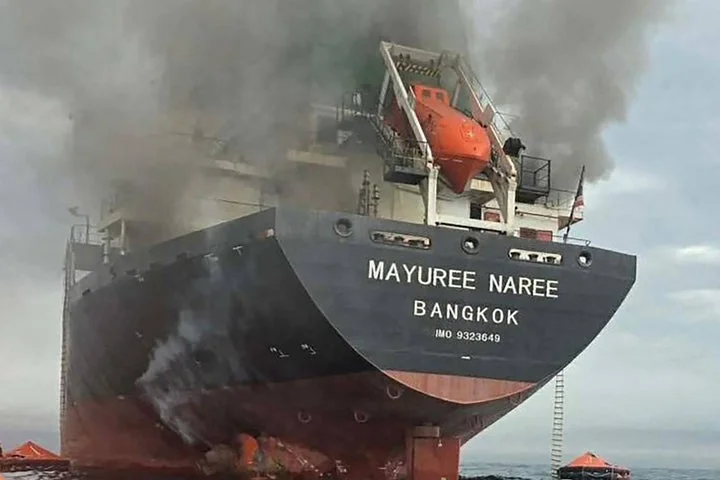
A growing number of countries are bypassing maritime law and gaining safe passage for their tankers via direct diplomacy with Iran
As US president Donald Trump threatens to obliterate Iran’s energy infrastructure unless it reopens the Strait of Hormuz , a number of countries are now negotiating directly with Tehran to secure safe passage for their ships .
Several nations in Asia, arguably the region most affected by the ongoing fuel crisis, have been able to get their vessels through the chokepoint, through which about a fifth of the world’s oil and gas normally transits.
Tehran effectively closed the Strait of Hormuz soon after it was attacked by the US and Israel on 28 February.
The conditions of the agreements that countries are striking with Iran remain unclear; neither shipping companies nor the Iranian government have made the terms of these deals public.
It’s a state of affairs that reflects a new geopolitical reality: access to the world’s most critical energy passage is no longer governed by international maritime law, but by direct diplomacy with Iran .
According to the maritime tracking platform Kpler, commodity traffic through the Strait of Hormuz fell by 95 per cent when the conflict began.
Before the war, around 100 ships transited daily.
On some days over the past week, that number was in the single digits.
But Iran hasn’t closed the strait entirely.
Instead, it has created what the maritime firm Lloyd’s List Intelligence has described as a “de facto toll booth regime” , a permissions-based system operated by the Islamic Revolutionary Guard Corps , in which vessels from friendly countries are escorted through a narrow northern corridor near Larak island.
As of this week, a second, southern corridor near the Omani coastline has become operational, according to Windward Maritime Intelligence, which tracked 11 transits – eight outbound, three inbound – on Sunday split across the two routes.
Iran’s foreign minister Abbas Araghchi has publicly named the countries considered friendly enough for passage: China, Russia, India, Iraq, and Pakistan.
Several others have since joined the list.
India was among the first countries to secure safe transit, reportedly without paying any fees.
India’s foreign minister S Jaishankar told the Financial Times it was a product of direct diplomacy.
The Iranian embassy in New Delhi posted on social media that “our Indian friends are in safe hands”.
In recent weeks, Indian-flagged LPG carriers, including Jag Vasant and Pine Gas , have transited the strait.
Pakistan was allocated 20 vessel slots by Tehran , although the country has few flagged ships in the Gulf.
Islamabad began approaching international commodity traders to temporarily register their vessels under the Pakistani flag to take advantage of the exemption, according to Bloomberg.
“This is a welcome and constructive gesture by Iran,” said Pakistani foreign minister Ishaq Dar.
Thailand struck a deal after weeks of disruptions that included a Thai bulk carrier being struck by Iranian projectiles in March, leaving three crew members unaccounted for.
Prime minister Anutin Charnvirakul announced the agreement on 25 March, and a Thai tanker subsequently crossed without paying a fee.
Malaysia secured assurances of safe passage through what its transport minister Anthony Loke described as a “good diplomatic relationship with the Iranian government”.
The Iranian embassy in the Southeast Asian nation said on Monday that the first Malaysian ship had passed through the strait since the war began.
“Iran does not forget its friends,” it said.
The Philippines , despite its close ties with the US, on Thursday became the latest Asian country to secure an agreement after what foreign secretary Theresa Lazaro described as “a very productive phone conversation” with Tehran .
Iran assured “safe, unhindered and expeditious passage” for Philippines -flagged ships, a significant move as Manila was the first country to declare a national energy emergency after fuel prices more than doubled in the wake of the war.
The Philippines imports 98 per cent of its oil from the Middle East.
China, Iran’s largest oil buyer, confirmed that some of its ships had sailed through but did not offer any details.
“Following coordination with relevant parties, three Chinese vessels recently transited the Strait of Hormuz ,” a foreign ministry spokesperson said.
Windward’s data shows Chinese-linked vessels account for around 10 per cent of the limited traffic still moving through the strait, with flows from Kharg Island, Iran’s oil export hub, primarily directed towards the Asian economic giant’s ports.
Indonesia secured passage for two of its vessels – Pertamina Pride and Gamsunoro – carrying crude oil from Saudi Arabia, following diplomatic engagement with Tehran.
Iraq has also been granted an exemption, with Windward identifying 21 Iraqi-linked tankers already operating under the arrangement.
Japan joined the list this week after a vessel operated by Mitsui OSK Lines carrying liquefied natural gas passed through the strait.
The company confirmed the safety of the vessel and crew but declined to say whether any toll was paid or how passage was secured.
The conditions of the agreements enabling safe passage of friendly ships remain opaque.
An Iranian official told Al Jazeera that Tehran was charging fees as “war compensation”, with reports indicating some payments settled in the Chinese currency of yuan.
Analysts told The Independent last week that a passage fee of up to $2m (£1.5m) was paid in one case.
Iran has denied that fees are mandatory.
What is clear is that the system is selectively allocated based on political alignment rather than open maritime norms.
Of the roughly 280 global transit requests tracked by one intelligence firm, only 17 were approved.
Some 670 commodity vessels were still stranded west of the strait as of last week, according to Bloomberg.
Greek companies alone had at least 75 vessels in the area, Chinese firms 74, Japanese companies at least 23 oil and gas vessels, and Indian companies 24.
Iran’s parliament is pursuing legislation to formally codify the toll system, according to Fars and Tasnim news agencies, likely making permanent a wartime improvisation and turning one of the world’s most important shipping routes into a fee-paying corridor controlled by its military.
Join thought-provoking conversations, follow other Independent readers and see their replies
Related Stories
Source: This article was originally published by The Independent
Read Full Original Article →
Comments (0)
No comments yet. Be the first to comment!
Leave a Comment