
Morning in Bandra begins with a quiet argument between the sea and the city.
The city insists on urgency — scooters sputtering, crows cawing, construction clanging its metallic mantras into the morning air.
But the Arabian Sea refuses the tempo.
It moves like an old mystic, slow and steady, arriving and retreating with a rhythm older than ambition.
From my window I watch the water wrinkle into waves, and from the corner of the room comes another tide entirely — the voice of Abida Parveen rising like incense.
My heart has fallen in love with the freedom of fakiri.
The song is playing because my younger disciple Haridashv Malhotra has made it part of his morning ritual.
Every day he sits, breathes, and lets Kabir travel through Abida’s voice into the room like a quiet guest who never leaves.
It fills the air the way memory fills a house long after the guests have gone.
The notes hover, hum, hold.
It is strange how songs arrive at the right time but are understood only years later.
I am fifty-three now, sitting by the sea inMumbai, listening to a student barely thirty absorb Kabir with a clarity that took me decades to recognise.
In that room, in that moment, my life feels circular — teacher learning from student, song travelling through generations, devotion dissolving distance.
Because Kabir has always travelled lightly.
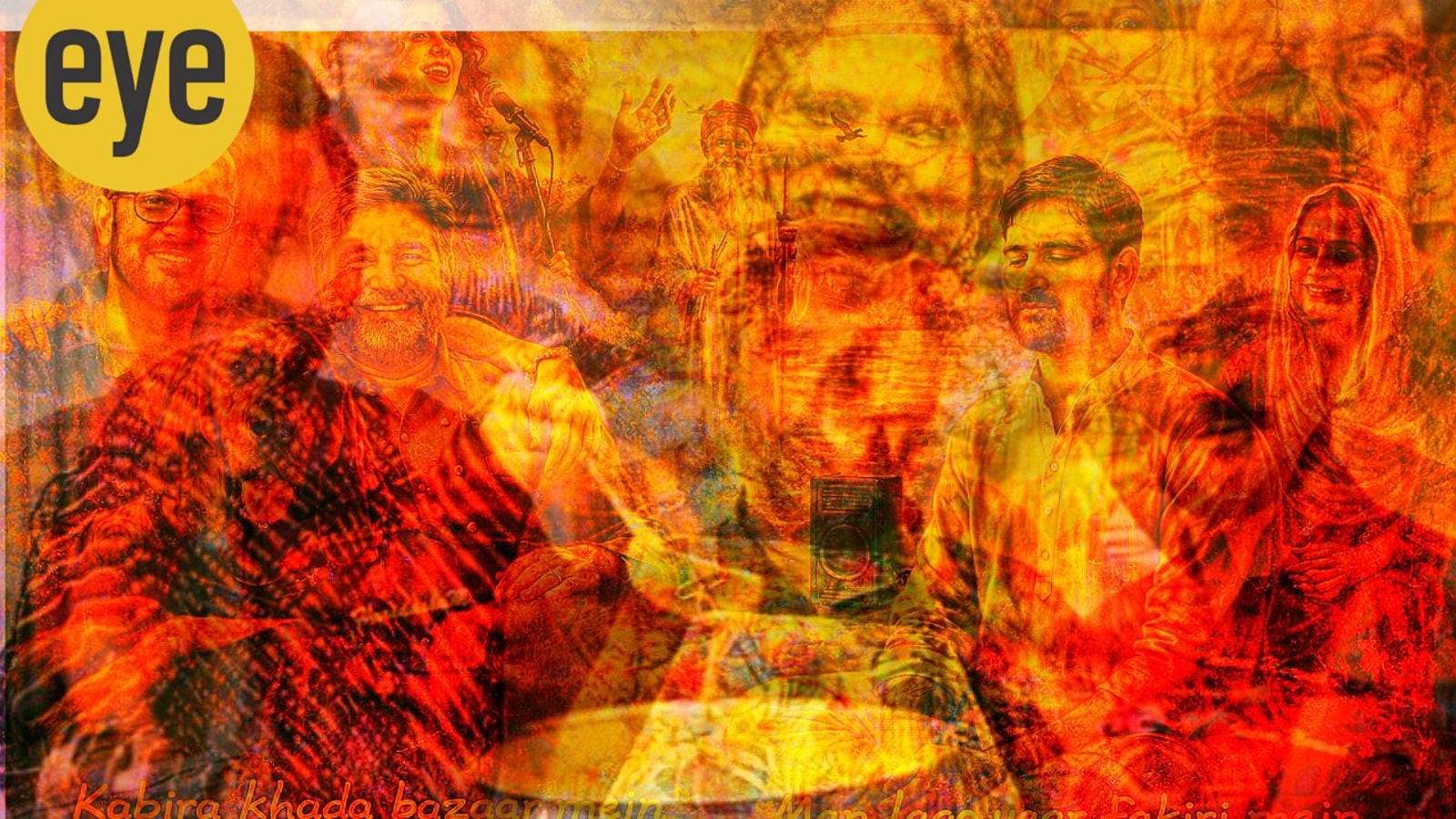
Kabira khada bazaar mein, liye lukaati haath,jo ghar jare apna, chale hamare saath.
Kabir stands in the marketplace holding a torch.
Whoever burns their own house may walk with me.
Burn the house of ego.
Burn the rooms of pride and possession.
Burn the illusions that make us believe success equals satisfaction.
It is a radical request — especially for those of us who have tasted success.
Because I have tasted it.
I know the intoxicating aroma of acclaim, the shimmering seduction of success.
I was the chef whose restaurant Devi became the first Indian restaurant in North America to receive a Michelin star.
Awards arrived.
Articles appeared.
Cameras flashed.
Critics applauded.
The world celebrated.
For a boy who had grown up with dreams simmering quietly in kitchens, that recognition felt like vindication.
The applause tasted sweet.
The success felt solid.
The future gleamed.
But success, like saffron, stains the soul with its own colour.
Over time I began to see what the world rarely admits: success extracts its own tax.
It demands time, attention, ambition.
It asks you to stay awake longer, travel farther, prove more, produce more.
The applause grows addictive.
The chase becomes constant.
It is anasha— a high as potent as prayer.
Money and fame are intoxicants.
Not evil.
Not immoral.
But intoxicating all the same.
And that is where my two disciples enter this meditation like two different verses in the same ghazal.
Vardaan Marwah, my senior disciple, walks the road of ambition with conviction.
When I watch him speak, something extraordinary happens.
I hear echoes of myself travelling through another voice.
His cadence mirrors mine.
His gestures resemble mine.
The same theatrical pause before a story lands, the same flourish of language, the same instinct to stitch culture and cuisine and history into narrative.
Stories I once told him appear again in his voice.
Books I once handed him surface in his arguments.
Ideas I once shared over tea or during long kitchen conversations emerge, polished and alive, in rooms full of listeners.
Sometimes he speaks with such uncanny resemblance that friends who visitPune— friends who know me intimately, who know me too well, who have heard my voice in kitchens and dining rooms and living rooms for years — come back laughing with affectionate amazement.
They say they heard Vardaan speak.
But what they really heard was Suvir.
Not the Vardaan they once knew, but a new Vardaan who mimics Suvir, who parrots Suvir, who sounds like Suvir.
A young man whose diction suddenly stretches toward words that once belonged to my own vocabulary — words that are occasionally incongruent with his own rhythms, his own etymologies, his own pronunciation.
Yet he says them anyway.
And he says them with a spark in his eyes.
A spark that connects those words to me.
To the hours he spent listening.
Sometimes he uses phrases whose meaning he may not fully understand yet, whose linguistic lineage he may not entirely grasp.
But he says them with enthusiasm, and that enthusiasm is charming in an oddly beautiful way.
Because what I hear in that mimicry is not pretension.
Guru gobind dou khade, kaake laagu paay,balihari guru aapne, gobind diyo batay.
If both God and Guru stand before me, whose feet should I touch first?
Blessed is the Guru who showed me God.
In Vardaan’s mimicry — his confident showmanship, his enthusiastic storytelling — I see the strange immortality of teaching.
A teacher lives on in the vocabulary of a student.
Hari’s devotion arrives in a completely different language.
Hari once showed me something that made me deeply embarrassed and deeply moved.
In the small temple in his home — where photographs of gods and goddesses stand beside flickering lamps — he has placed a photograph of me.
Every day, twice a day, when he lights a lamp and folds his hands in prayer, he bows before those images.
It is old-fashioned reverence — the kind of devotion that once defined the sacred relationship between guru and chela.
And when I see it, I feel something complicated inside me.
Because I never offered that kind of devotion to my own teachers.
Sabiha Hashmi gave me art when I felt I had none.
She gave me painting, silk screen, serigraphy — the tactile miracle of colour pressed into cloth, imagination translated into ink.
When I was a young boy, ateenager drowning in lonelinessand confusion in a country where there were no role models for someone like me, Sabiha gave me creativity.
She gave me colour when my world felt grey.
When suicidal thoughts whispered cruelly in the corners of my mind, art became oxygen.
Shankardas Gupta gave me something equally profound: music.
He gave me notes, sound, scale, discipline — vibrations that drowned the madness of hateful clamour that sometimes echoed in my own mind and sometimes roared from the world around me.
As a young boy who felt othered, misunderstood, misfitted, music became refuge.
A raga could quiet storms no conversation could calm.
And Marina Ahmad, my Ustaad for more than thirty years, gave me wisdom that stretched across decades.
She taught me patience in music, patience in listening, patience in life itself.
She shaped not just how I sang, but how I heard the world.
Watching Hari bow before my photograph takes me back to my grandmother speaking of her own guru with reverence.
It takes me back to Marina speaking with devotion about her guru, Pandit Jasraj, and the decades she gave in faithful discipleship.
And I realise something quietly humbling.
I never gave my teachers the reverence these boys give me.
Kabir understood this paradox too:
Pothi padh padh jag mua, pandit bhaya na koy,dhai akhar prem ka, padhe so pandit hoy.
The world dies reading endless books.
No one becomes wise that way.
He who learns the two-and-a-half letters of love becomes truly learned.
And love appears in many forms.
In Vardaan’s enthusiastic mimicry.
And then there are the small details that reveal how differently these two young men inhabit the world.
When an invitation arrives — a conference abroad, an awards ceremony in another city, a glamorous culinary gathering somewhere new — I see a spark ignite in Vardaan’s eyes.
Free plane tickets.
Two nights in a new place.
New restaurants.
New chefs.
New stories waiting to be gathered like spices in a traveller’s pouch.
But give Hari the same two free nights and he will notopen airline websites.He will go to the mountains.
To his grandmother’s home.
To sit beneath skies where stars outnumber ambitions.
To wander through memory with cousins and stories and old recipes simmering slowly in kitchens older than his career.
Where Vardaan collects experiences, Hari gathers understanding.
Where Vardaan explores breadth, Hari explores depth.
Dheere dheere re mana, dheere sab kuch hoye,mali seenche sau ghada, ritu aaye phal hoye.
Slowly, slowly, O mind.
Everything unfolds in its time.
The truth is I see myself in both of them.
I have lived much of Vardaan’s life — the flights, the festivals, the applause.
But now, at fifty-three, if given that same freedom of time, I would choose Hari’s road.
The road where the sky is larger than ambition.
And yet I marvel at both of them — the thirty-year-old who carries the calm of a sixty-year-old, and the thirty-year-old who remains as carefree as I once was.
Kabir knew this better than anyone.
As a gay man of fifty-three, single, I sometimes wonder what the future holds.
Life may yet offer many joys, but loneliness sometimes sits beside me like a quiet companion.
And yet I realise something profound.
I may besingle at fifty-three, but I have two heroes of tomorrow giving me extraordinary credence today.
Hari gives me the quiet strength of belonging.
Vardaan gives me the strange joy of dreaming like a father.
Through Vardaan I see a world I may never see again.
Through Hari I see a world where I might still belong.
The sea outside my window breathes slowly.
And somewhere between ambition and stillness, between road and mountain, between Vardaan and Hari, Kabir’s laughter drifts gently across the centuries.
Every path, if walked honestly, eventually bends toward the same horizon.
Related Stories



Source: This article was originally published by The Indian Express
Read Full Original Article →
Comments (0)
No comments yet. Be the first to comment!
Leave a Comment