
Xiaoyu Zhang is an independent scholar of political science and author of The Prehistory of AI Civilization (2025).
He is based in Singapore.
Search author on: PubMed Google Scholar
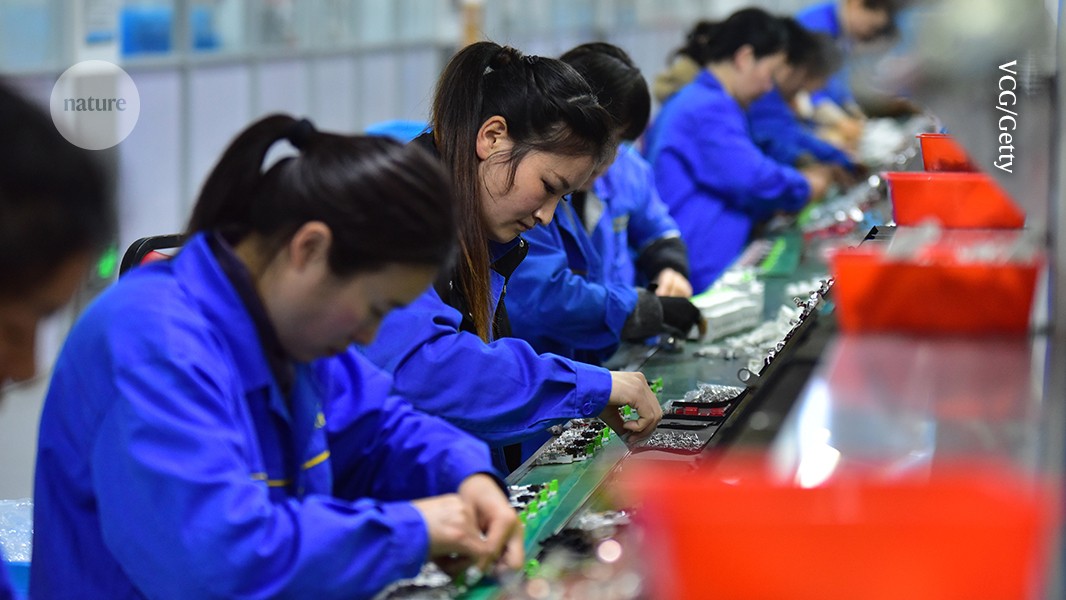
In the 1970s, China opened up its markets to global trade and underwent rapid economic growth and industrialization.
Credit: VCG/Getty
Breakneck: China’s Quest to Engineer the Future Dan Wang W.
W.
Norton (2025)
When it comes to accounts of China’s economic and technological success, a lot has been written but much of it isn’t worth the paper.
Western scholars, especially, need to better understand the facts.
Presenting those facts is the greatest strength of tech analyst Dan Wang’s excellent book Breakneck .
Here are some of the details he describes.
Many of China’s poorest provinces have better infrastructure than the United States’ wealthiest regions.
China’s policies designed to stimulate manufacturing growth have led to price wars, waste and debt crises.
It is true that China’s one-child policy and zero-COVID strategy caused unnecessary suffering.
It is also true that US regulatory policies are hindering the provision of public services such as railways in the United States.
Just for including these facts, I would call Wang’s book one of the best English-language texts on China published in the past few years.
China’s biotech boom: why the nation must collaborate to stay ahead
However, Wang also wants to distil these facts into a particular narrative: China is ruled by engineers, whereas the United States is ruled by lawyers.
He interprets China as a modern version of Prussian Germany or Meiji Japan — governments characterized by authoritarian rule and technocracy, where technical experts make decisions targeted towards narrow goals such as economic growth or industrial strength while neglecting others.
Wang is deeply sceptical of what he sees as China’s top-down, technocratic model.
His core argument is a familiar one in the field of political economy: no central planner, however skilled, can manage a complex economy better than the market can.
Economists and philosophers such as Friedrich Hayek and Michael Oakeshott have called this faith in central planning the ‘pretence of knowledge’ or ‘rationalist conceit’.
What makes Wang’s version fresh is his framing of this idea through the relationship between the United States and China, and the richness of his on-the-ground reporting.
But, in my view, the narrative that he constructs doesn’t always follow the facts.
Given that many of China’s leaders were educated in engineering, it’s only natural for scholars such as Wang to try to establish a causal link between their backgrounds and the country’s economic and technological achievements.
But evidence doesn’t support this interpretation (see go.nature.com/4zytrx9 ).
For example, China had the highest proportion of technocrats among the leaders of its provinces in the 1990s; there are fewer now (see go.nature.com/4rkszna ).
Chinese leaders are less likely than their US counterparts to have legal backgrounds, but this is because, in China, the legal profession mainly offers a route into the judicial system, which is mostly separate from the government.
And there are other paradoxes.
If China’s leaders supposedly follow a logical and evidence-based engineering culture, why would they come up with so many convoluted policies, such as the one-child and zero-COVID rules?
Such cases of overly complex governance are rare in other nations under technocratic governance (such as Japan and Singapore) or in technology companies (such as Google, Amazon and Huawei).
It’s common for scholars of China, especially those based in the West, to analyse how organizations’ rules and norms shape political, social and economic behaviour, but also to neglect more-fundamental aspects of societies.
The first variable affecting China’s political situation, I suggest, is scale.
Humans are limited in their ability to organize in large groups.
Governing a vast country such as China, which has 1.4 billion people, requires several layers of administrative institutions, all managing the nation at various scales.
These layers inevitably reduce the ability of the premier — the head of government administration — to govern with precision at a local level.
What happens in Shanghai’s Lujiazui area, Shenzhen’s Nanshan district and in the mountainous province of Guizhou is distinct, even though they’re all in the same nation.
People in diverse regions think and operate differently, as if they are in parallel worlds.
China dominates global manufacturing of drones, smartphones and computers.
Credit: Qilai Shen/Bloomberg/Getty
Drive a few hundred kilometres away, however, and you will find other regions in which per capita GDP, business spirit and governance capabilities are much lower.
You will enter Fundamental China, which contains roughly one billion people.
The local economy here barely survives on money from the issuance of land-use rights and transfer payments to local governments from the central government.
The massive infrastructure projects that make China’s governing class so proud mainly make it possible for people living in such regions to travel to work in the Hayekian cities, where they endure harsh working conditions with a lack of basic welfare protection.
Gluing these two worlds together and maintaining their operation as a nation is Communist Party China, centred in the nation’s capital, Beijing.
Rather than resembling Prussian Germany or Meiji Japan, this world more closely resembles that of traditional Chinese rulers: adopting ‘realpolitik’ methods that use every opportunity and resource (including globalization and technological advancements) to maintain their own rule.
This is self interest, not the principles of engineering.
How China is vying to attract the world’s top scientific talent
Instead, the globalization that the world has witnessed over the past 50 years is the product of cooperation between the Chinese and US governments to oppose the Soviet Union during the cold war.
After 1969, China and the Soviet Union had border conflicts in the northeast and northwest.
In the 1970s, US diplomat Henry Kissinger observed the possibility of Sino–American cooperation and established contact with the Chinese government.
What many people overlook is that it was under Mao Zedong’s leadership in the 1970s that the technological trade barriers between China and the Western world began to drop.
Through a scheme initiated in 1973, China imported technological equipment on a large scale from the United States, West Germany, France, Japan, the Netherlands, Switzerland and Italy.
Ren Zhengfei, who later founded Huawei, began his engineering career at the Liaoyang Petrochemical Fiber General Factory, which was established under this policy.
This gradual loosening of trade barriers was a by-product of a mutual need for geopolitical security.
The consequences of this cooperation wildly exceeded the expectations of the US and Chinese governments at the time: this collaboration turned China into a manufacturing giant.
I think that China’s success was less the result of institutions or trends in governance, as Wang argues, and more the result of the second fundamental variable in the nation’s rise to tech dominance that people often overlook: the properties of technology itself.
Every industrial revolution that has occurred around the world over the past 250 years has had some core industries that possess the most complex supply chains in that era.
Those industries become closely tied to the national economy and people’s livelihoods.
Countries that manage these supply chains successfully tend to experience strong economic growth.
How provinces and cities can sustain US–China climate cooperation
During the First Industrial Revolution (1760–1830), the core industry was steel manufacturing, as well as the building, railway and ship construction that steel made possible.
In the Second Industrial Revolution (from the late nineteenth century to the early twentieth century), the key industries were automobile, electricity and petrochemical production.
To this day, construction and automotive production remain the world’s two largest industries.
Enjoying our latest content?
Log in or create an account to continue
doi: https://doi.org/10.1038/d41586-026-00841-0
The author declares no competing interests.
‘Greed is the iron cage of our times’ — why nationalism is here to stay
AI and the PhD student: friend or foe?
Data from smart watches reveal early signs of insulin resistance
China approves brain chip to treat paralysis — a world first
AI is programmed to hijack human empathy — we must resist that
China intensifies push to become world leader in tech and AI
The problem with Canada’s plan to buy scientific prestige
When artificial lightning strikes
Could flies sniff out contraband chemicals?
From the first telephone to videoconferencing in 100 years
CeMM is recruiting two scientists to join as Starting Principal Investigators within a new research program on pain and aging/healthy.
Research Center for Molecular Medicine (CeMM), ÖAW
Profile the cellular components of tissue microenvironments (TME) in healthy and inflamed sites.
Dortmund, Nordrhein-Westfalen (DE)
Leibniz-Institut für Analytische Wissenschaften – ISAS – e.V.
Postdoctoral positions exploring microbiota–stem cell interactions in development, disease & cancer using gnotobiotic models, organoids & multi-omics.
The Chinese Institutes for Medical Research (CIMR), Beijing
Join Huazhong Agricultural University
No.1 Shizishan Street, Hongshan District, Wuhan, Hubei Province, China
Huazhong Agricultural University (HZAU)
SUSTech School of Medicine offers equal opportunities and welcome applicants from the world with all ethnic backgrounds.
Southern University of Science and Technology, School of Medicine
Related Stories



Source: This article was originally published by Nature News
Read Full Original Article →
Comments (0)
No comments yet. Be the first to comment!
Leave a Comment