
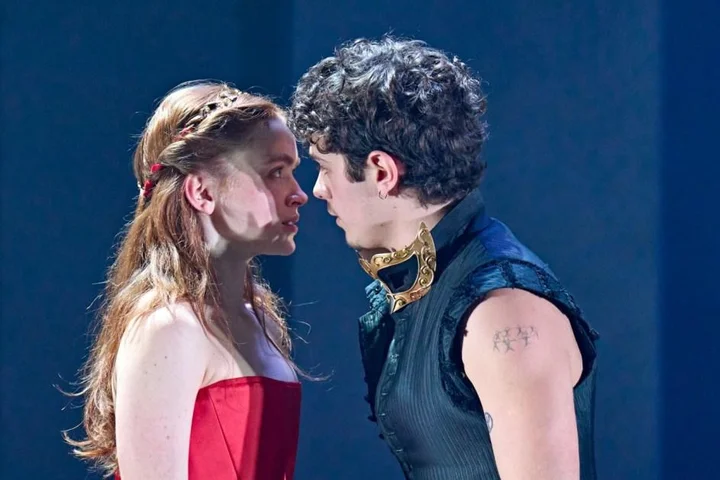
There is a line early in Romeo and Juliet that Robert Icke chooses to underline: ‘In a minute there are many days.’
It becomes the quiet thesis of this urgent, emotionally lucid revival, now playing at the Harold Pinter Theatre, starring Sadie Sink and Noah Jupe.
Time, here, is elastic, fragile, and devastatingly cruel.
Sink, known for her role in Stranger Things, and Jupe, known for a critically acclaimed role in Oscar-winning Hamnet, proved that this was more than stunt casting, even if Shakespeare purists were quick to grumble otherwise when they were first announced as the young lovers.
Icke, one of British theatre’s most intellectually rigorous directors, has never been interested in museum-piece classics.
His productions, including his 2024 interpretation of Oedipus, pick apart and examine rather than preserve.
Yet what is most striking about his Romeo and Juliet is its emotional accessibility.
This is a production that understands that the tragedy only works if you believe, wholeheartedly, in the reckless sincerity of young love.
Sadie Sink and Noah Jupe’s performances
As Juliet, Sadie Sink glows with adolescent intensity.
She spends much of the play curled in bed, tousled, restless, and more or less in her pajamas.
It is a clever, disarming choice: this Juliet is not yet fully formed, still caught between girlhood and adulthood, experiencing emotions so vast they seem to eclipse the world — all from the safe haven that is a teenage girl’s bedroom.
Sink captures that volatility beautifully, playing all the giddy highs, the storming lows, and the sense that everything is happening for the first and last time all at once.
Opposite her, Jupe delivers an angsty but boyishly endearing Romeo.
His early lovesick melancholy over Rosaline borders on petulant, but that proves essential groundwork for what follows.
When his passion turns to Juliet, it is total, consuming, and frighteningly absolute.
Jupe is particularly compelling in moments of rage, where his performance taps into something recognisably adolescent: the uneasy midpoint between a comfort-seeking child’s tantrum and a man violently lashing out.
Their chemistry is tender, awkward, and entirely convincing.
The balcony scene — often overplayed into grandeur — becomes here something far more intimate and, as a result, more affecting.
Mercutio and the Nurse nearly stole the show
Around them, the supporting cast shines.
The Nurse, played with impeccable comic timing by Clare Perkins, draws some of the evening’s biggest laughs, grounding the play’s intensity with warmth, wit, and a deep, aching care that emphasizes the tragedy when it arrives.
But it’s Mercutio, portrayed by Kasper Hilton-Hille, who threatens to steal the production entirely.
His teenage Mercutio is a quivering bow-string, the type of adolescent a secondary school teacher would instantly recognise and shudder.
He embodies the class clown who pushes every joke too far and is always chasing a reaction from the rest of the class.
Intensely physical, he sprawls across the stage, at times dropping his trousers or grabbing himself in a way that feels deliberately shocking, like a dare to the world to look at him and react.
It is attention-seeking taken to its most reckless extreme, as if he might self-destruct before he ever allows himself to be ignored.
Yet beneath that bravado is something more vulnerable.
His performance moves easily between silliness and something more wounded, hinting at a boy unsettled by Romeo’s shifting affections.
Was Robert Icke’s direction heavy-handed or bravely direct?
As for Icke’s direction, it is fluid and precise, with scenes bleeding into one another in a graceful choreography.
Hildegard Bechtler’s design is spare but evocative, allowing the actors’ emotional landscapes to take centre stage.
The production’s most overt device is its use of time: flashes of light interrupt key moments as a large digital clock is projected above the actors, rewinding the action to suggest alternate possibilities.
A missed glance, a delayed exit, or a different decision are briefly imagined, then erased.
This may feel heavy-handed for the seasoned Shakespeare scholar, but for a contemporary audience drawn to the show by the big names attached, it provides a powerful entry point into the play’s central question: how much of tragedy is fate, and how much is chance?
These fractured moments invite us to consider the delicate chain of decisions that leads the lovers to their end, effectively offering an English course into the domino-effect nature of tragedy in a single, elegant stage choice.
It is unabashedly sentimental, and all the more effective for it.
Afterall, this is not a play about subtlety, and Icke was right to tug on the audience’s heartstrings just that much harder.
This also isn’t a production concerned with perfect textual purity or classical restraint, and it will certainly receive criticism for that.
Why you should see this play, even if you think you don’t like Shakespeare
But to watch the audience — many of whom might more readily identify as fans of Stranger Things than of Shakespeare — sit rapt, laughing, weeping, blushing, and generally utterly absorbed, is to understand exactly what this show achieves.
This Romeo and Juliet captures something essential about the play’s emotional core: that its tragedy lies not only in its ending, but in the beautiful, reckless, funny intensity of youth that drives it there.
It doesn’t take itself as seriously as many recent adaptations — including Tom Holland’s stylised 2024 version — and feels far more playful than Shakespeare’s Globe has tended to be with the text in recent years.
Where other productions lean either toward reverent accuracy or veer fully into the avant-garde, this one finds a middle ground that lets the play escape the weight of its own mythology.
In doing so, it makes the most famous play in history feel brand new.
Got a story?
If you’ve got a celebrity story, video or pictures get in touch with the Metro.co.uk entertainment team by emailing us celebtips@metro.co.uk, calling 020 3615 2145 or by visiting our Submit Stuff page – we’d love to hear from you.
Related Stories



Source: This article was originally published by Metro UK
Read Full Original Article →
Comments (0)
No comments yet. Be the first to comment!
Leave a Comment